The short answer: use a managed cloud database service to remove routine infrastructure work such as patching, backups and failover, but do not assume it removes the need for database expertise. Someone still has to design schemas, tune queries, manage access and plan capacity. Hire an in-house database administrator (DBA) when databases are central to your product, workloads are large or complex, and there is enough work to keep a specialist busy. Use outsourced database administration when you need that expertise regularly but not full time, or need cover outside business hours. Many growing companies combine a managed service with outsourced or part-time expertise.
The three models defined
In-house DBA. An employee, or team, responsible for database design guidance, performance, security, backups, upgrades and recovery. They know your data and applications deeply.
Managed database service. A cloud provider runs the database infrastructure for you, for example Amazon RDS, Azure SQL Database or Google Cloud SQL. The provider handles much of the operational work; you still own how the database is designed and used.
Outsourced database administration (DBA services). An external team, sometimes called a remote DBA service, takes responsibility for agreed database tasks under a contract: monitoring, tuning, maintenance, upgrades, migrations and incident response. It can work on self-managed databases or alongside a managed service.
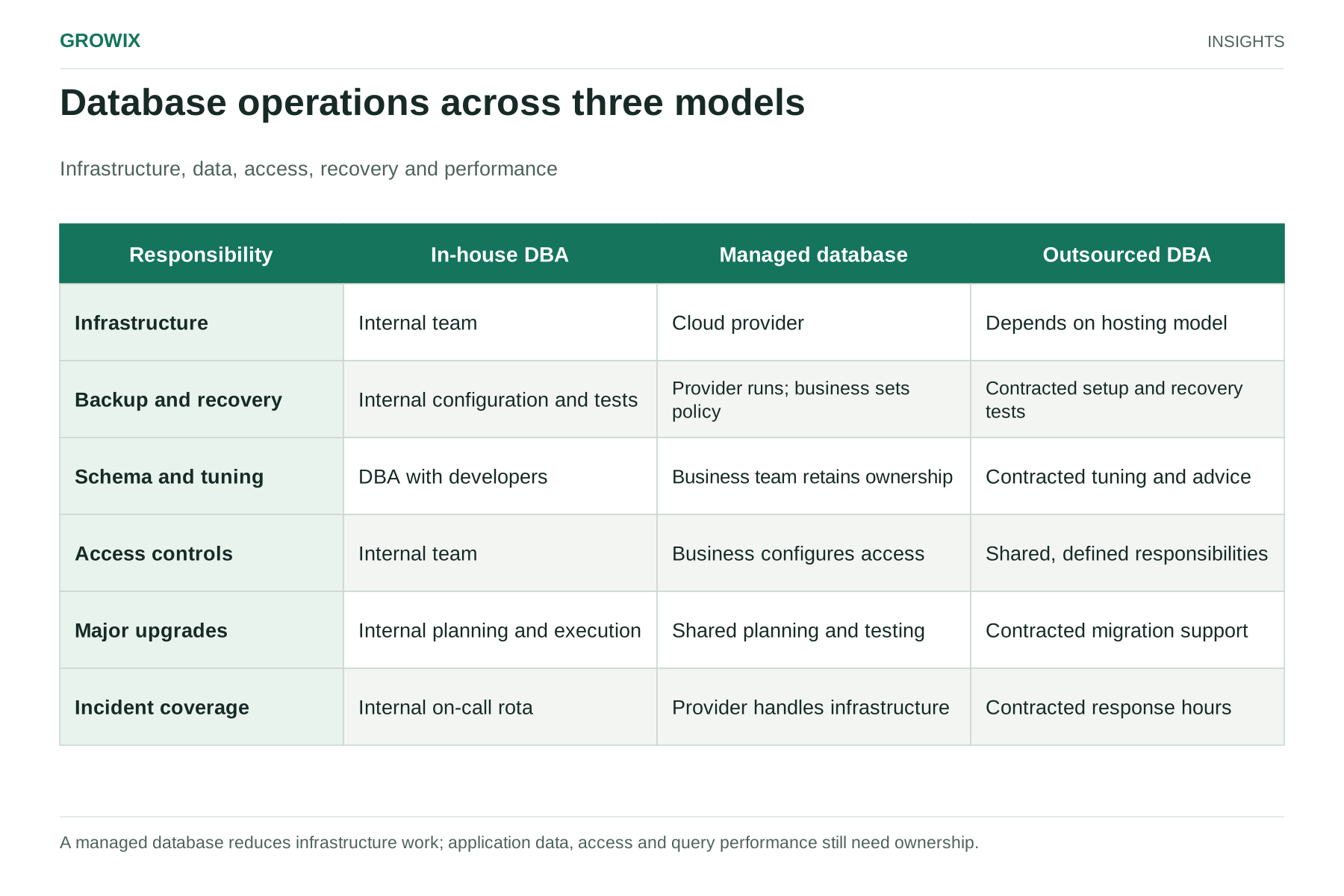
Who does what in each model
The most common misunderstanding is what a managed service covers. Amazon's documentation for Amazon RDS is explicit: RDS manages backups, software patching, automatic failure detection and recovery, and the underlying servers, while the customer remains responsible for application optimization and query tuning. The documentation notes that query performance depends heavily on database design, data size, data distribution, application workload and query patterns. Access control through security groups and identity permissions also stays with the customer.
| Responsibility | In-house DBA on self-managed servers | Managed database service | Outsourced DBA |
|---|
| Hardware, operating system, database installation | Your team | Cloud provider | Provider, if self-managed; cloud provider, if managed |
| Patching and minor upgrades | Your team | Largely cloud provider, within maintenance windows you set | Provider, as contracted |
| Backups and point-in-time recovery | Your team | Cloud provider runs them; you set retention and test restores | Provider configures and tests, as contracted |
| High availability and failover | Your team | Available as a configuration option | Provider designs and monitors |
| Schema design and data modeling | Your team with developers | Your team | Advisory, as contracted |
| Query and index tuning | Your team | Your team | Provider, as contracted |
| Access control and security configuration | Your team | Your team | Shared, as contracted |
| Capacity planning and cost | Your team | Your team | Provider advises |
| Major version upgrades and migrations | Your team | Shared; you plan and test | Provider plans and executes |
| Out-of-hours incident response | On-call rota needed | Provider handles infrastructure failures; you handle the rest | Provider, if 24/7 cover is contracted |
Compare costs
In-house. The US Bureau of Labor Statistics reports a median annual wage of $104,620 for database administrators and $139,500 for database architects in May 2025. Benefits made up 30.0% of private-industry compensation costs in June 2026, so a rough loaded cost for a DBA at the median is about $149,500 a year ($104,620 ÷ 0.70), before tools, training and on-call allowances. One person also cannot cover every hour of the year.
Managed service. You pay the cloud provider for database instances, storage, backups and data transfer. Managed services usually cost more per unit of compute than running the database yourself on virtual servers, in exchange for removing operational work. Check current pricing for your provider and region; it changes frequently.
Outsourced DBA. Typically priced as a monthly retainer for a defined scope and hours, sometimes with incident or project work billed separately.
Hypothetical comparison
The figures below are assumptions for illustration, not quotes or Growix pricing. A SaaS company runs two production databases on a cloud provider's managed service.
| Option | Annual people or service cost | What it covers |
|---|
| Hire one DBA | About $149,500 loaded, plus about $10,000 tools and training (assumed) | Deep product knowledge; business-hours coverage plus an on-call arrangement |
| Outsourced DBA retainer | $48,000 ($4,000 a month, assumed) | Monitoring, monthly tuning review, upgrades, incident response within agreed hours |
| Developers only, no DBA | No direct cost | Managed service handles infrastructure; tuning and design are ad hoc |
Coverage changes the comparison too. A single in-house DBA works roughly 1,800 to 2,000 hours a year, takes holidays and cannot be on call every night. If your service commitments require a fast response to database incidents at any hour, the in-house option needs either a second person or an outsourced arrangement for out-of-hours cover, which narrows the cost gap between the models.
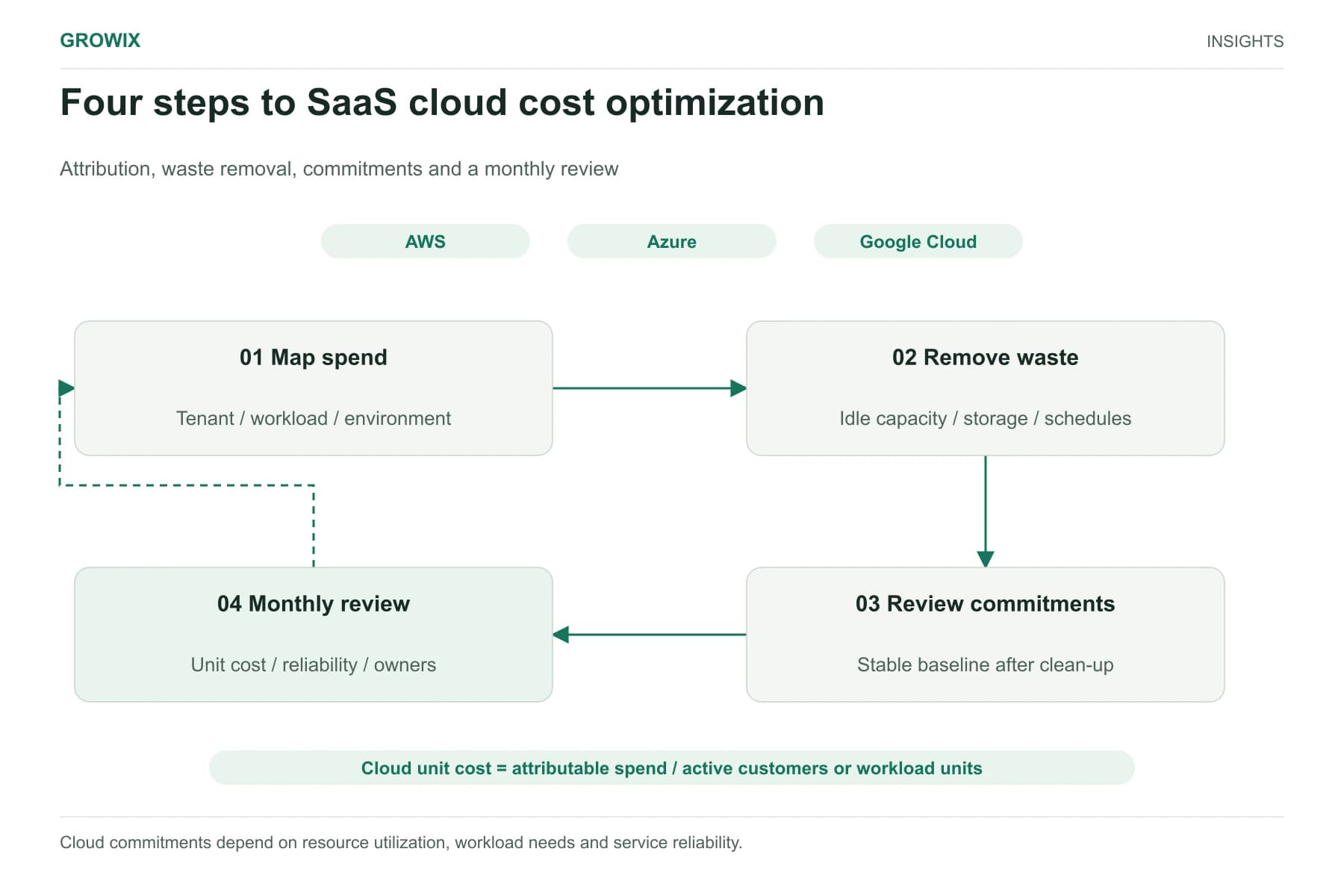
The "developers only" option looks free but often is not. Slow queries, missing indexes and poorly planned migrations show up as cloud cost, incidents and engineering time. Our guide to SaaS cloud cost optimization explains how database tiers often become one of the largest lines on the bill.
Signs your databases need specialist attention
Whichever model you use today, these symptoms suggest the current arrangement is not enough:
- Application pages or reports slow down as data grows, and fixes are guesswork.
- Database instances keep being upsized to solve performance problems, raising cost.
- Nobody can say when a backup was last restored successfully.
- Major version upgrades have been postponed because they feel risky.
- Incidents involving locks, connection limits or storage filling up recur.
- Developers make schema changes directly in production without review.
- Only one person understands how the database is configured.
What changes when you move to a managed service
Moving from self-managed databases to a managed service changes the work rather than eliminating it. Routine tasks such as operating system patching, hardware replacement and backup scheduling largely disappear. New tasks appear: choosing instance classes and storage types, setting maintenance windows, configuring parameter groups, monitoring service-specific metrics and managing cost as usage grows. Some features of self-managed databases, such as certain extensions or operating system access, may not be available. Plan the migration with a rehearsal, a measured performance baseline and a rollback path, as with any infrastructure change.
Questions to ask an outsourced database provider
- Which database engines and versions do your people support day to day?
- What is included in the retainer, and what is billed separately?
- What are your response times for incidents, and during which hours?
- How do you access our systems, and how is that access logged and revoked?
- How often will you review performance and recommend changes, and how do you report?
- Who approves changes to production, and how are they tested?
- What documentation do we receive, and what happens to it if we end the contract?
When each model fits
An in-house DBA fits when:
- Data is central to the product, for example analytics-heavy or transaction-heavy platforms.
- You run several large or complex databases, possibly on different engines.
- You need someone embedded in product and engineering decisions every week.
- Regulatory or contractual requirements favor in-house control of data administration.
A managed database service alone fits when:
- Workloads are moderate and well understood.
- Your engineering team has solid database skills and time to tune and plan.
- You mainly want to remove infrastructure chores.
Outsourced database administration fits when:
- You need specialist skills regularly, but not 40 hours a week.
- You need out-of-hours cover for database incidents.
- You are planning a migration or major upgrade and want experienced hands.
- Your one database expert is a single point of failure.
A combination fits most growing companies: a managed service for infrastructure, plus outsourced or part-time specialist help for tuning, upgrades and incidents, until the workload justifies a full-time hire.
When Growix may not be the right fit: if your databases are small, stable and well within your developers' skills, a managed service and occasional ad hoc advice may be all you need. And if a database is tightly bound to a commercial application, the application vendor's own support may be the right first call.
A decision checklist
- How many production databases do you run, on which engines, and how large are they?
- How often do database issues cause incidents or slowdowns?
- Who currently tunes queries, plans capacity and tests restores?
- What hours of coverage do you need for database incidents?
- Are major upgrades or migrations due in the next year?
- Would losing your current database expert leave a gap?
Answer them with your engineering lead and whoever handles incidents today; the people closest to the databases usually know where the risks are, even if they have never been written down. If the answers show regular specialist work but less than a full-time role, start with outsourced administration on top of a managed service, and review the decision when workload grows.
Frequently asked questions
What do DBA services include?
DBA services usually cover monitoring, performance and query tuning, backups and restore testing, security and access reviews, version upgrades, migrations and incident response, under a contract that defines scope, hours and response times. Check which database engines and versions the provider supports day to day.
Does a managed database like Amazon RDS replace a DBA?
Not entirely. A managed service handles infrastructure work such as backups, patching and failure recovery, but you still own schema design, query performance, access control and capacity planning. Someone with database skills, in-house or outsourced, still needs to do that work.
How much does a database administrator cost?
The US Bureau of Labor Statistics reports a median annual wage of $104,620 for database administrators (May 2025). Adding benefits at about 30% of total compensation gives a loaded cost of roughly $149,500 a year before tools, training and on-call allowances.
Next step
List your databases, their engines, sizes and owners, then record when backups were last restored successfully and who handles tuning. That exercise alone usually shows where the gaps are.
Growix's Database Administration service configures, tunes, monitors and maintains production databases, including version and platform migrations, and our Cloud Infrastructure & Architecture team designs the cloud environments they run in.
Discuss your IT and infrastructure needs