E-commerce SEO for AI Shopping: Preparing Product Pages and Feeds for AI Discovery
AI shopping tools can only recommend what they can read and trust. Make product facts complete, consistent and crawlable across pages, feeds and markup, then measure sales, not mentions.
Shoppers increasingly ask an AI assistant to compare products, check compatibility or suggest something under a budget, rather than typing two words into a search box and scanning ten results. For online retailers, that raises an obvious question: what has to change in e-commerce SEO when the first answer comes from an AI system?
Less than many vendors suggest, and more than many stores have done. Google states plainly in its documentation on AI features and your website that there are no additional requirements or special optimizations needed to appear in AI Overviews or AI Mode, no special schema.org markup, and no new machine-readable or AI text files. A page must be indexed and eligible to show with a snippet. The same documentation recommends the fundamentals: allow crawling, provide a good page experience, put important content in text, keep structured data consistent with the visible page, and keep Merchant Center information up to date.
In other words, AI shopping rewards stores whose product facts are complete, consistent and easy to read across every place they appear. This guide shows how to get there.
Where AI shopping tools get product information
Different AI surfaces draw on different sources, and their documentation changes often. Broadly:
Surface
Main sources of product information
What you control
Google AI Overviews and AI Mode
Google's index of web pages, plus product data such as Merchant Center feeds
Crawlable pages, structured data, Merchant Center feeds
Google Shopping and free listings
Merchant Center product data, checked against landing pages
Feed quality, landing page consistency
General AI assistants with shopping features
Web pages they can access, and in some cases merchant programs or partner feeds
Crawl access, page content, any merchant program you join
On-site shopping assistants
Your own catalog, product data and policies
Product data completeness and policy content
Reviews and third-party sites
Retailer reviews, editorial reviews, marketplaces
Review collection, accurate listings elsewhere
Before investing in any single platform, check its current merchant documentation. The common thread is that every surface works better with structured, accurate, complete product facts.
Step 1: Make product facts crawlable and readable
AI systems, like search crawlers, cannot use facts they cannot reach or read.
Check access. Confirm that robots.txt, your CDN and any bot-protection service are not blocking the crawlers you want, and that product and category pages return normal status codes. Bot protection that silently blocks legitimate crawlers is a common, invisible problem.
Put facts in text. Dimensions, materials, compatibility, capacity, care instructions and what is in the box should be visible as text on the page, not only inside images, PDFs or tabs that load after user interaction.
Use a consistent specification table. A structured table of attributes on every product page, using the same attribute names across a category, makes products easier for people and machines to compare.
Handle variants deliberately. Decide whether each size or color has its own URL. Make sure the selected variant's price, availability and identifiers are reflected on the page and in the data.
Control faceted navigation. Filter combinations can create thousands of thin, duplicate URLs. Use canonical tags and crawl rules so crawlers spend their time on pages that matter.
Test rendering. If product details load through JavaScript, use Search Console's URL Inspection tool to confirm Google sees the rendered content.
Step 2: Align feeds, pricing and stock
For Google surfaces, the product feed in Merchant Center is as important as the product page. Google's product data specification lists the attributes it requires, such as id, title, description, link, image link, availability and price, along with conditionally required attributes like brand, GTIN, MPN, condition, and size and color for apparel variants. It also states that price and availability must match the landing page, checkout and structured data.
Inconsistency is the most common problem. A feed that updates nightly while prices change hourly during a promotion will show the wrong price, and products may be disapproved or shown less. Practical checks:
Update frequency: align feed updates with how often prices and stock change, especially during sales.
Identifiers: supply GTINs where they exist, and use identifier_exists correctly for custom or own-brand products.
Titles: include brand, product type and key distinguishing attributes, written for clarity rather than keyword stuffing.
Product highlights and details: use attributes such as product highlights and product details to supply structured facts the title cannot hold.
Shipping and returns: keep shipping costs, delivery times and return policies accurate in Merchant Center and on the site.
Disapprovals: review diagnostics weekly and fix root causes in the source data, not by editing the feed by hand.
A single product information system that feeds the website, Merchant Center, marketplaces and any on-site assistant is the strongest long-term fix, because it removes the drift between copies.
Step 3: Apply supported structured data
Structured data helps search engines understand a product page reliably. Use the types search engines document and support, not invented "AI schema."
For Google, the relevant guides are merchant listing structured data for pages where customers can buy, product snippets for review and editorial pages, and product variant structured data for products sold in multiple sizes, colors or materials. Key properties include name, image, description, offers with price, currency and availability, identifiers such as GTIN, aggregate ratings and reviews where genuine, and shipping and return details.
Three rules prevent most problems:
Match the visible page. Markup that disagrees with what customers see undermines trust in your data.
Generate markup from the same source as the page. Hand-maintained markup drifts.
Validate after every template change using Google's Rich Results Test and Search Console's enhancement reports.
No markup, file or tag guarantees inclusion in AI answers. Google's documentation explicitly says no special AI files or markup are required.
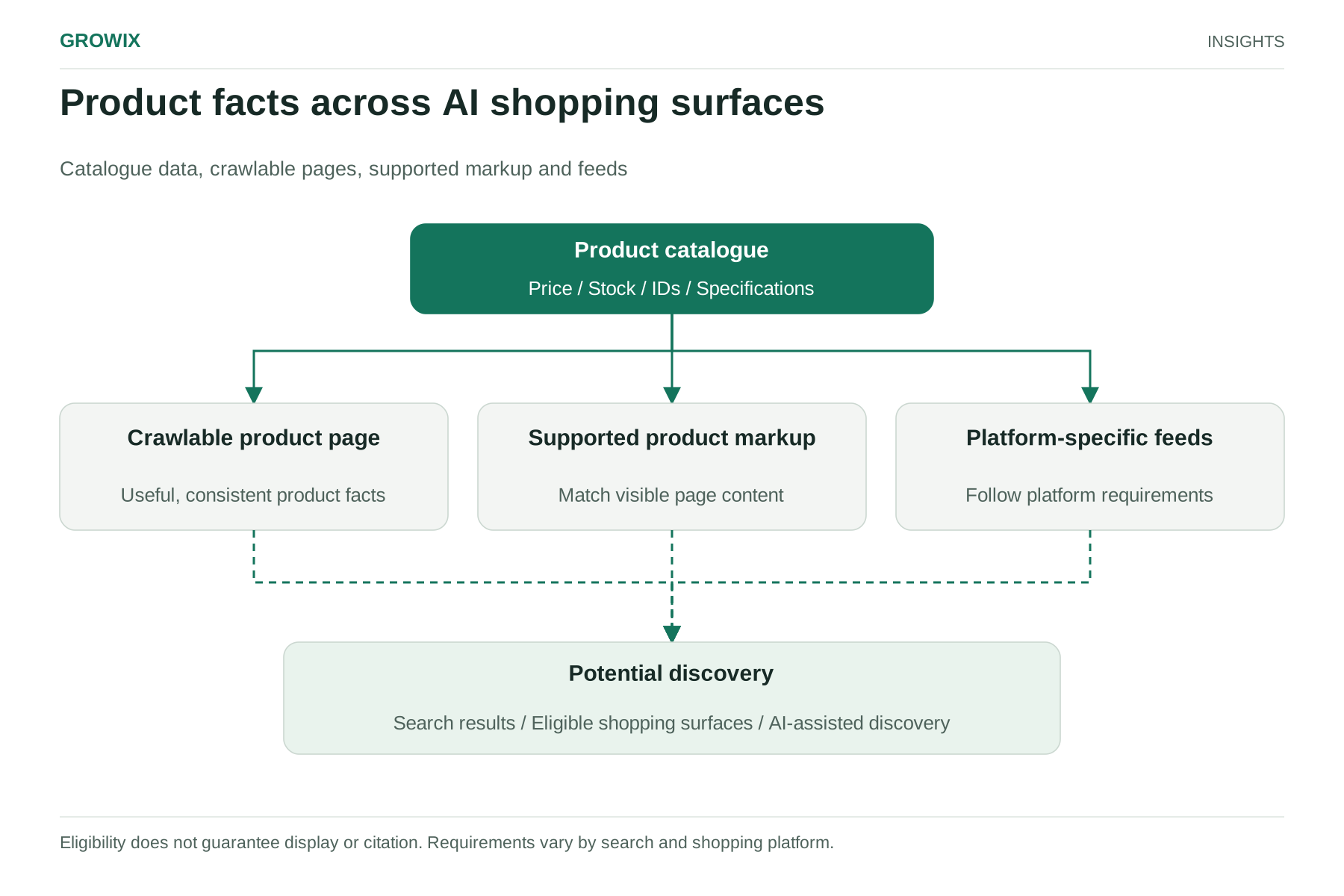
Product facts across AI shopping surfaces. Eligibility does not guarantee display or citation. Requirements vary by search and shopping platform. View full size
Step 4: Answer the questions shoppers ask
AI assistants handle questions such as "Which of these fits a 15-inch laptop?" or "Is this safe for induction hobs?" Pages that answer those questions directly are more useful to everyone.
Product pages: add concise answers to recurring pre-purchase questions from your support tickets and reviews, phrased the way customers ask them.
Category pages: explain how to choose within the category, including the attributes that matter and the trade-offs between them.
Comparison and buying guides: cover real decision points honestly, including when a cheaper option is enough.
Policies: keep shipping, returns and warranty information clear, specific and consistent.
Avoid adding generic question-and-answer blocks for their own sake. A question belongs on the page only if customers genuinely ask it.
A practical framework: the product fact completeness score
Audit a sample of your top products with a simple scorecard. For each product, check eight facts and score one point for each that is complete, accurate and consistent across page, feed and markup:
Fact
Page
Feed
Markup
Current price and sale price
✓ / ✗
✓ / ✗
✓ / ✗
Availability
✓ / ✗
✓ / ✗
✓ / ✗
Identifier (GTIN or MPN)
✓ / ✗
✓ / ✗
✓ / ✗
Key specifications
✓ / ✗
✓ / ✗
Not applicable
Variant attributes
✓ / ✗
✓ / ✗
✓ / ✗
Shipping cost and time
✓ / ✗
✓ / ✗
✓ / ✗
Return policy
✓ / ✗
✓ / ✗
✓ / ✗
Genuine reviews
✓ / ✗
Not applicable
✓ / ✗
Hypothetical example
The following example is invented to show how the score guides priorities.
A kitchenware retailer audits its 50 best-selling products. Prices and availability are consistent everywhere, but 40% of products lack GTINs in the feed, specification tables differ between categories, and return policies in Merchant Center are out of date. The team fixes identifiers first because they affect matching across surfaces, standardizes specification tables by category next, and updates returns information, then repeats the audit monthly across the next 200 products.
Step 5: Measure qualified visits and sales
Measurement in AI search is still imperfect, so focus on outcomes you can trust:
Search Console: Google says traffic from AI features is included in the Performance report under the Web search type. Track non-brand impressions, clicks and conversions for product and category pages.
Merchant Center: monitor free listing performance, disapprovals and price or availability mismatches.
Analytics referrals: segment sessions referred by AI assistants where a referrer is passed, and compare their conversion rates and order values with other channels.
Revenue, not mentions: treat third-party "AI visibility" scores as directional at best. Orders and margin are the measures that matter.
Assisted conversions: many shoppers research with an assistant and buy later through direct or branded search, so look at assisted paths as well as last-click attribution.
Reviews, ratings and reputation
Shoppers ask AI assistants which products are reliable, comfortable or worth the price, and the answers lean on what other people say. Review content therefore matters for AI shopping as much as for conversion on your own pages.
Collect reviews systematically after delivery, with prompts that encourage specifics such as fit, durability or ease of setup.
Show reviews as text on the page, not only inside a widget that loads late or in an iframe crawlers may not read.
Mark up only genuine reviews that are visible on the page. Never write or incentivize fake reviews; besides being misleading, it creates legal risk.
Respond to criticism and fix recurring product or policy problems; repeated complaints become part of how assistants summarize your products.
Keep marketplace and third-party listings accurate, since assistants may draw on them alongside your site.
Keep feeds clean during promotions
Promotional periods are when data drift does the most damage. Prices change quickly, stock runs out and temporary shipping offers appear and disappear. Before any major sale:
Increase feed update frequency, or use automated price and availability updates where your platform supports them.
Use sale price attributes with start and end dates rather than editing regular prices by hand.
Check that structured data on product pages updates at the same moment as the visible price.
Monitor Merchant Center diagnostics daily during the promotion and assign someone to act on them.
Remove or redirect discontinued products deliberately, rather than leaving out-of-stock pages that confuse shoppers and crawlers.
Common mistakes
Treating AI shopping as a separate project rather than an extension of product data quality and SEO.
Buying tools that promise AI visibility before fixing the basics of crawl access and data consistency.
Optimizing only the top products. Long-tail products often answer the specific questions assistants handle well.
Letting paid and organic feeds diverge without a shared owner, so titles and attributes contradict each other.
Responsibilities
E-commerce or merchandising: product data completeness and accuracy.
SEO: crawlability, templates, structured data and Search Console monitoring.
Paid and marketplace teams: feed quality and Merchant Center diagnostics, coordinated with SEO.
Engineering: feed generation, markup templates and rendering.
Customer service: sources of real customer questions and policy accuracy.
Frequently asked questions
What is e-commerce SEO?
E-commerce SEO is the work of making an online store's category and product pages easy for search engines to crawl, understand and rank: technical health, complete product information, consistent feeds and structured data, useful content and reviews. The same foundations now feed AI shopping answers.
How do you optimize product pages for AI shopping assistants?
Put product facts such as dimensions, materials, compatibility and what is in the box in visible text, keep prices and stock identical across the page, feed and marketplaces, use supported structured data that matches the page, and answer the pre-purchase questions customers actually ask.
Do you need special markup or an llms.txt file for AI search?
Not for Google. Google's documentation says no special AI files or markup are required to appear in its AI features; standard SEO best practices apply. Other AI platforms use their own crawlers and data sources, so check that you are not blocking the ones you want.
Next steps
Run the completeness score on your top 50 products, fix the most common gap across all of them, and set up a monthly check. That single habit improves classic search, shopping listings and AI-generated answers at the same time.
Growix's Search & AI Visibility service covers technical SEO and visibility in AI answer engines, and our E-commerce Marketing team grows online stores and marketplace presence. For the broader question of how AI search fits alongside classic SEO, see SEO vs AEO vs GEO.