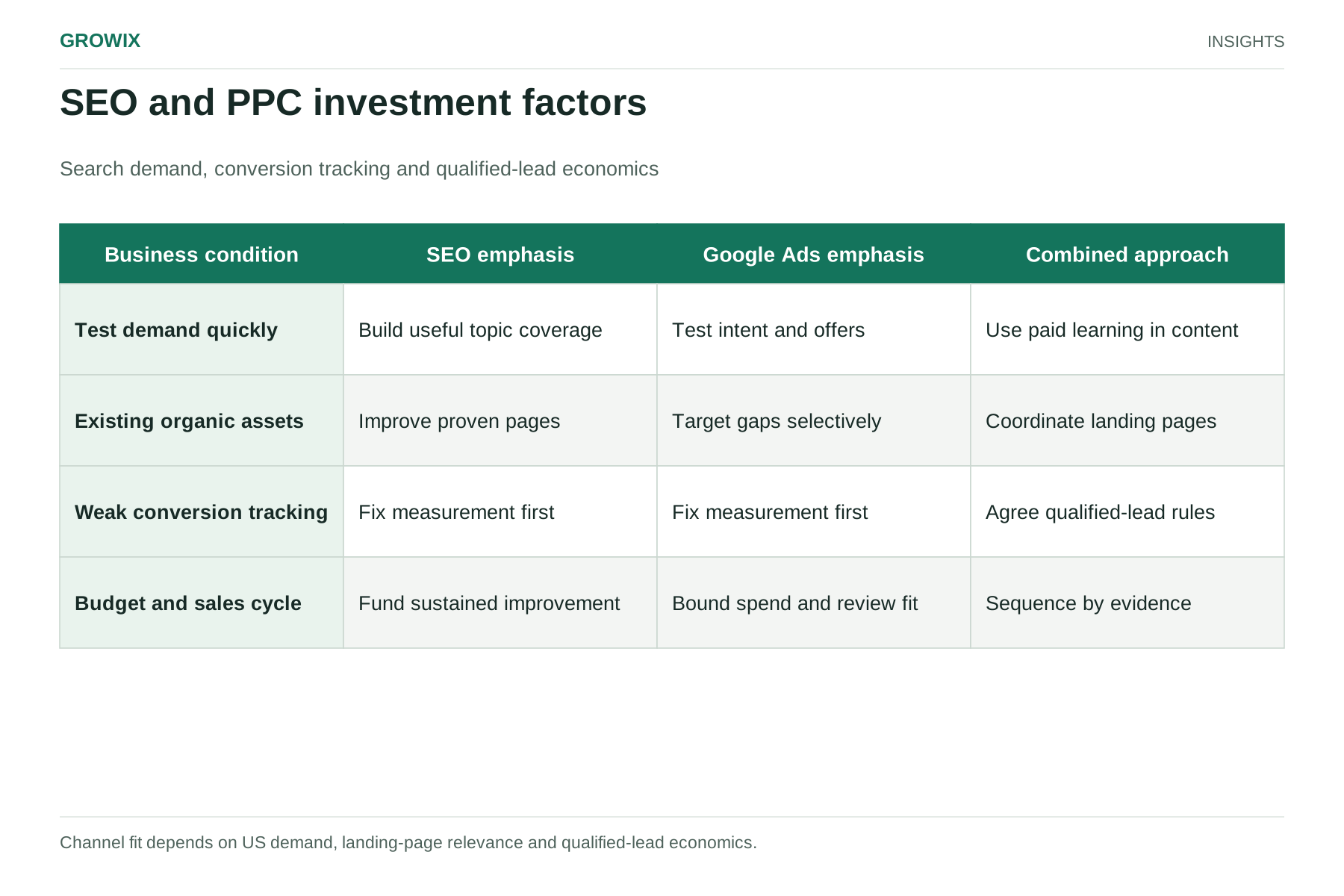
The short answer: put your next budget into paid search (PPC, usually Google Ads) when you need qualified leads within the next quarter, your buyers search for clear, high-intent terms, and your deal values can absorb a high cost per lead while you learn. Put it into SEO when your sales cycle is long, you can commit for at least a year, and buyers research extensively before contacting anyone. Most B2B companies with established demand end up doing both, using paid search to learn quickly which queries produce pipeline and SEO to cover those queries durably.
This guide compares the two on speed, cost and risk, shows how to model qualified lead economics with your own numbers, and gives recommendations by budget and sales cycle.
The options defined
PPC (pay-per-click) search advertising places ads in search results for chosen keywords. You pay when someone clicks. Results start as soon as campaigns launch and stop when spending stops. In B2B, Google Ads is the main platform, with Microsoft Advertising as a smaller secondary option.
SEO (search engine optimization) improves your site's visibility in organic results through technical improvements, content that answers buyer questions and authority built over time. There is no cost per click, but there is a cost per page, per improvement and per month of effort, and results take months to build. The same work also supports visibility in AI-generated answers, which our guide to SEO vs AEO vs GEO covers.
Side-by-side comparison
| Factor | PPC search advertising | SEO |
|---|
| Time to first results | Days to weeks | Typically months, depending on authority and competition |
| Cost profile | Variable media cost per click plus management | Mostly fixed effort: content, technical work, management |
| What happens when spending stops | Leads stop almost immediately | Rankings decay gradually; much of the value persists |
| Speed of learning | Fast; test keywords, messages and offers within weeks | Slow; feedback loops take months |
| Control | High over keywords, budget, timing and landing pages | Indirect; you influence but do not control rankings |
| Cost per lead over time | Tends to stay level or rise with competition | Tends to fall as content compounds, if the program works |
| Best for | High-intent, commercial queries; launches; testing demand | Research-stage and problem queries; durable coverage of core topics |
Model qualified lead economics
Raw lead counts mislead in B2B. Model each channel through to qualified pipeline and revenue.
What benchmarks can and cannot tell you
LocaliQ's 2026 search advertising benchmarks, based on its customers' Google Ads and Microsoft Ads campaigns, report an average cost per click of $5.87, a conversion rate of 4.85% and a cost per lead of $93.69 for the Business Services category, against an all-industry average cost per click of $5.42. The page does not state a collection period or geography, and its customer base is not representative of every market, so treat the figures as a rough reference. Competitive B2B software and professional services terms often cost considerably more per click. Your own account data, or a short test campaign, is the only reliable source.
Hypothetical paid search model
The following figures are assumptions for illustration, not benchmarks or Growix pricing.
- Monthly media budget: $5,000. Assumed cost per click: $12. Clicks: about 417.
- Landing-page conversion rate: 3%, giving about 12.5 leads a month and a media cost per lead of $400.
- Lead-to-sales-qualified rate: 25%, so about $1,600 in media per sales-qualified lead.
- Win rate from qualified lead: 20%, so about $8,000 in media per new customer.
- Adding an assumed $2,000 a month for management, the first year costs $84,000 for about 150 leads, roughly $560 per lead.
Whether $8,000 of media per customer is acceptable depends on contract value and margin. For a product with an annual contract value of $24,000, it may be; for $3,000, it is not.
Hypothetical SEO model
Again, the figures are assumptions.
- Year one investment: $8,000 a month for content, technical improvements and management, or $96,000.
- Organic leads build slowly: none in the first two months, rising to about 22 a month by month twelve, for a total of 122 in the year. That is roughly $787 per lead in year one.
- Year two: investment falls to $5,000 a month for maintenance and new pages, or $60,000, while leads hold at about 25 a month (300 a year), roughly $200 per lead.
The pattern, rather than the specific numbers, is the point: SEO is usually more expensive per lead at first and cheaper later, if the program works. It can fail to work, particularly in very competitive spaces or when the site has little existing authority, so build in review points rather than committing blindly.
Factors that change the answer
Existing authority. A site that already ranks for related terms and has earned links will see SEO results faster than a new domain.
Conversion rate of your site. A weak landing page makes both channels expensive. Improving conversion often lowers cost per lead more than changing channel.
Sales cycle length. With a nine-month cycle, the slow start of SEO matters less, and paid search results also take months to show up as revenue.
Search demand. If few people search for your category, neither channel will deliver volume. Demand generation through other channels, such as content distribution, events and outbound, may matter more.
Lead quality controls. Paid campaigns attract irrelevant clicks without negative keywords, location settings and qualifying landing page copy. Import offline conversions, such as qualified opportunities from your CRM, so bidding optimizes for pipeline rather than form fills.
How AI answers change the trade-off
AI Overviews and AI assistants now answer many informational questions directly in search results or chat. That affects the two channels differently.
For SEO, broad informational articles may earn fewer clicks than before, because the answer appears on the results page. Pages that answer specific commercial questions, such as pricing logic, integrations, comparisons and implementation details, remain valuable because buyers still need to verify and act. Google states that traffic from its AI features is reported within Search Console's normal Performance data, so you can monitor the effect on your own pages rather than relying on industry averages.
For paid search, high-intent commercial queries continue to carry ads, and the auction still decides what you pay. The main change is that buyers may arrive later in their research, having already formed a shortlist. Landing pages need to answer comparison and pricing questions quickly.
Neither change makes one channel obsolete. Both strengthen the case for content that answers buying-stage questions and for measuring channels on qualified pipeline rather than raw traffic.
Running both: how they reinforce each other
When you run both channels, use each to make the other cheaper:
- Use paid search data to choose SEO topics. Search terms that produce qualified leads in paid campaigns are strong candidates for organic pages.
- Use organic rankings to reduce paid spend. Where you rank consistently at the top organically for a term, test reducing bids and watch total conversions, not just paid ones.
- Share landing-page learning. Headlines and offers that convert in paid tests can improve organic pages, and vice versa.
- Protect your brand terms. A small branded paid campaign is often worthwhile when competitors bid on your name, but measure whether it adds conversions or only shifts them from organic.
Recommendations by budget and sales cycle
| Situation | Suggested emphasis |
|---|
| Small budget, long sales cycle, patient leadership | SEO focused on a narrow set of high-intent topics; a small branded and competitor paid campaign |
| Small budget, need leads this quarter | Tightly targeted paid search on the highest-intent terms only; fix landing page conversion first |
| Moderate budget, established product | Paid search to learn which queries convert; SEO to cover the proven queries and buyer questions |
| New category with little search demand | Demand generation and content distribution first; small paid tests to measure emerging demand |
| Large budget, competitive market | Both channels with shared keyword and conversion data, managed against qualified pipeline |
When Growix may not be the right fit: if your monthly budget can fund only a very small test, the cost of agency management may outweigh the media. A narrow, self-managed campaign on a handful of high-intent terms, combined with work on your own landing page, may be the better first step.
Set up measurement before you spend
- Define a qualified lead with sales, in writing.
- Track source and campaign for every lead into the CRM, through to opportunity and revenue.
- Import CRM stages back into Google Ads as offline conversions.
- Use Search Console for organic queries and pages, and compare organic leads by landing page.
- Review monthly: cost per qualified lead, pipeline value and win rate by channel.
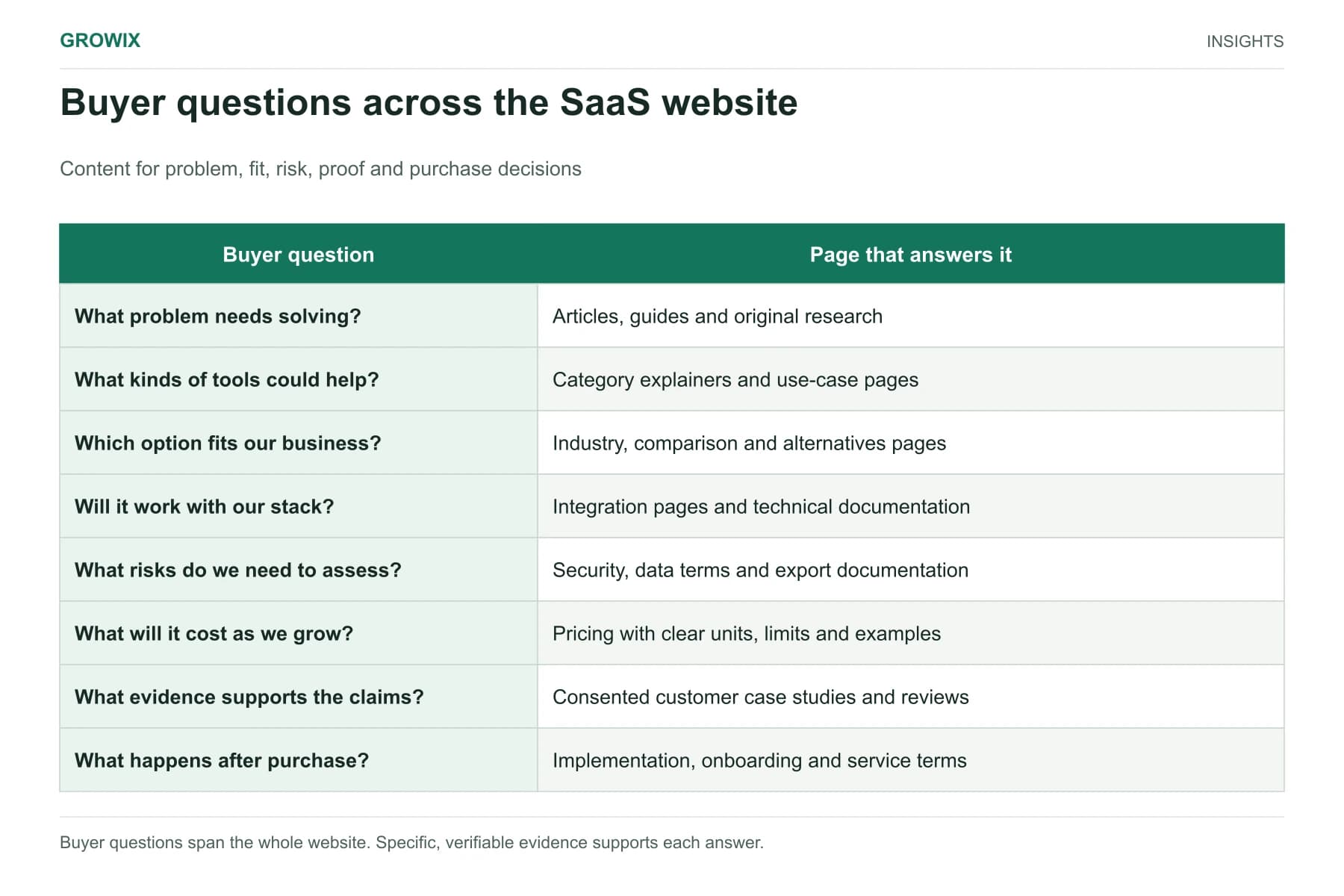
Our guide to B2B SaaS content strategy explains how to map buyer questions to the pages that convert organic visitors.
Frequently asked questions
What is the difference between SEO and PPC?
PPC (pay-per-click) buys placement in search results: you pay for each click, and traffic stops when spending stops. SEO earns placement in organic results through technical work, content and authority: it takes longer to build but keeps producing traffic without a cost per click.
Is SEO or PPC better for B2B lead generation?
PPC is usually better when you need qualified leads within a quarter and buyers search for clear, high-intent terms. SEO is usually better for long sales cycles, extensive buyer research and businesses that can commit for at least a year. Many B2B companies run both and use each to improve the other.
How long does SEO take to produce B2B leads?
Typically months rather than weeks, and longer for a new domain or a competitive category. Plan for at least a year of steady investment, and track leading indicators such as rankings and qualified traffic before expecting a lower cost per lead.
Next step
Gather three numbers before deciding: your average contract value, your lead-to-customer conversion rate and your sales cycle length. Run both models above with them. The channel that produces qualified pipeline at an acceptable cost within your time horizon is your starting point. If you are setting next year's targets, our guide to 2027 growth planning for B2B SaaS shows how pipeline requirements follow from retention and revenue goals, and in-house marketing vs an agency covers who should run the channels you choose.
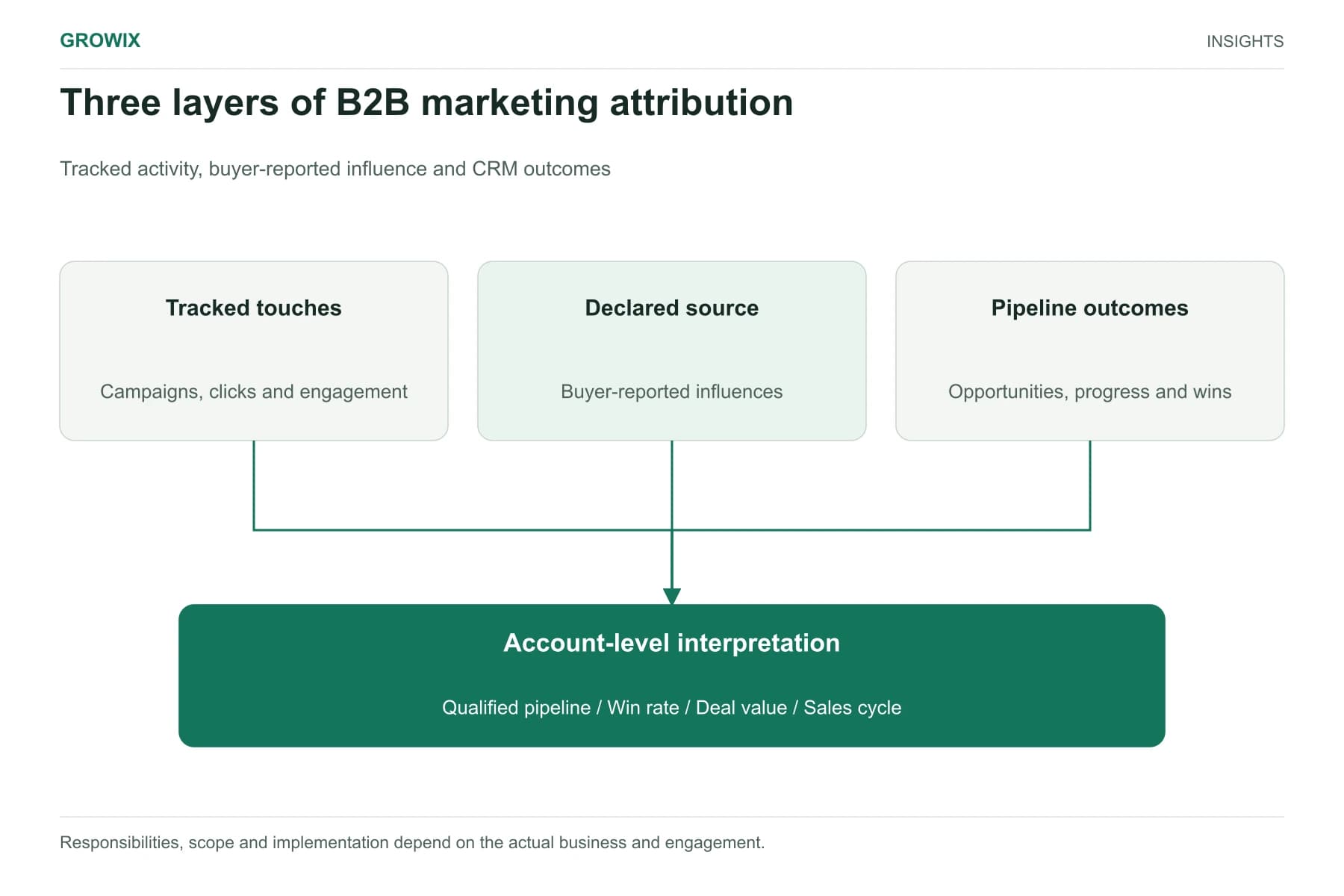
Growix's Performance Marketing team runs paid search and paid social against business outcomes, our Search & AI Visibility service builds durable organic and AI search visibility, and our Lead Generation & Demand Generation team connects both to qualified pipeline. To judge which channel actually produces pipeline, see B2B marketing attribution, and for outbound prospecting alongside search, see outsourced SDR and appointment setting.
Discuss your marketing priorities