Affiliate Links and FTC Disclosure Rules: A Practical Guide for Brands and Their Partners
Affiliate Links and FTC Disclosure Rules: A Practical Guide for Brands and Their Partners
Clear disclosures help audiences understand paid relationships. A practical process for partner guidance, content checks and documented follow-up, grounded in FTC sources.
Affiliate and creator programs work better when audiences can recognize paid relationships. The Federal Trade Commission publishes guidance on making those relationships understandable through clear wording, noticeable placement and disclosures suited to the content format.
This guide focuses on program operations: giving partners useful guidance, checking published content and recording follow-up. It does not determine whether a particular advertisement, contract or disclosure meets every applicable legal requirement.
What the FTC's guidance says
Start with the FTC's Endorsement Guides FAQ and Disclosures 101. These explain why commercial connections should be understandable to the audience and why the wording, placement and format matter.
For a program team, the useful questions are practical:
Can someone understand the relationship without opening another page?
Is the disclosure near the recommendation and easy to notice?
Does a video or live stream communicate the relationship to viewers who encounter it there?
Are partners describing genuine experiences and using supportable product claims?
Is there an owner for checking content and following up on problems?
The FTC's examples are context-dependent. Treat the examples below as illustrations for discussion with your partners, not as pre-approved wording or a guarantee of legal compliance. If the program collects or rewards reviews, consult the FTC's consumer reviews guidance separately.
Good and poor disclosures
Situation
Poor practice
Better practice
Blog review with affiliate links
One line in the site footer
A short statement near the top, such as "I earn a commission if you buy through links in this post," plus "Paid link" labels where helpful
Product link in a list
Link labeled only "affiliate link"
"Paid link" next to the link, or a clear statement before the list
Social post
"#sp" or "#collab" at the end of a long caption
"Ad" or "#ad" at the start of the caption
Short video
Disclosure only in the description
Spoken and on-screen disclosure in the video itself
Live stream
Mentioned once at the start
Repeated periodically through the stream
Email newsletter
No mention of commissions
A clear statement near the recommendation
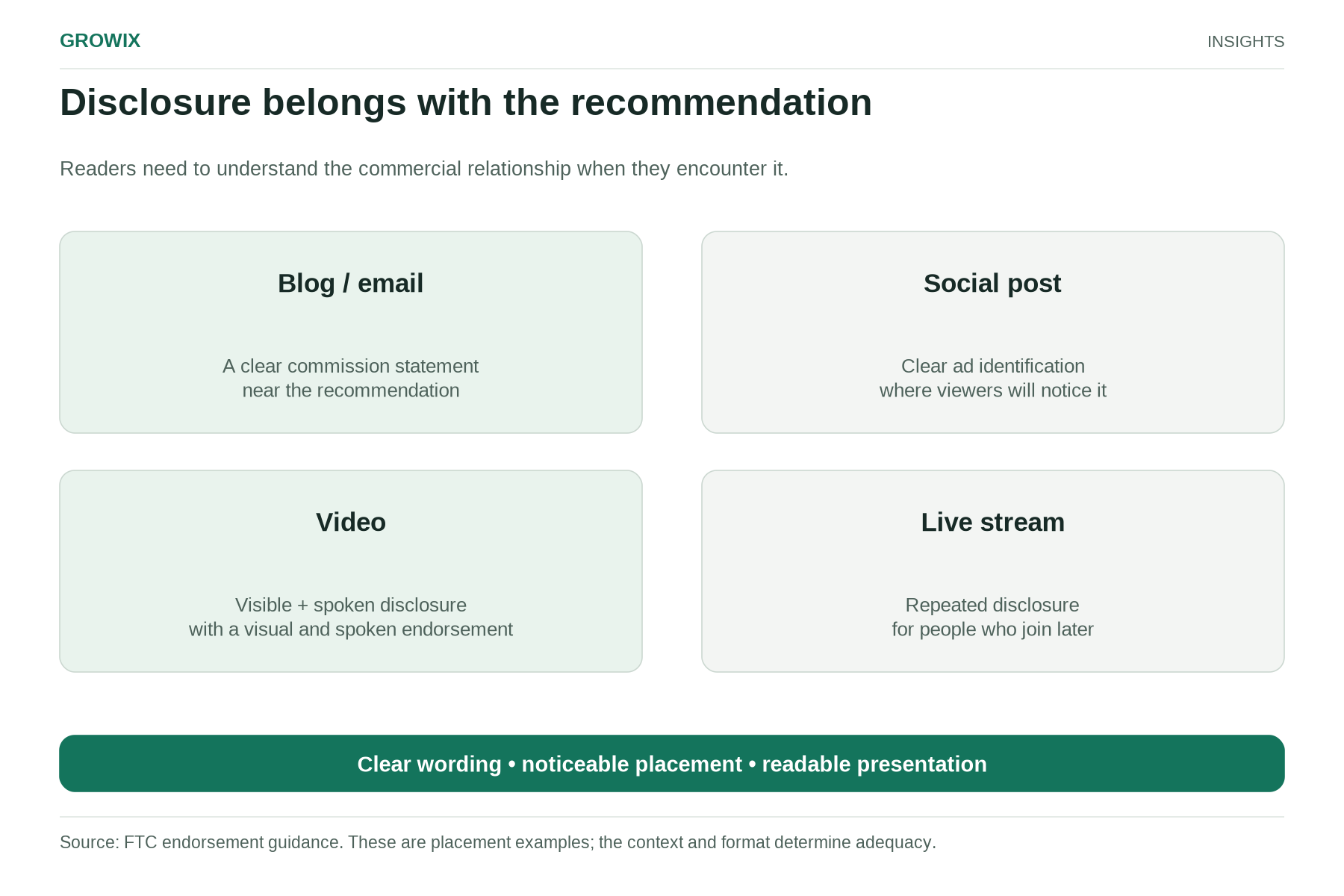
Disclosure belongs with the recommendation. Source: FTC endorsement guidance. These are placement examples; the context and format determine adequacy. View full size
Build disclosure into the program
Put requirements in the terms
Document the program's disclosure expectations, content-review process, correction route and responsible contacts. Have the appropriate adviser review contractual rights and remedies. A network's default terms should be checked against the actual program rather than treated as a complete policy.
Give partners usable guidance
Partners follow guidance that is short and specific. Provide a one-page disclosure guide with:
Example wording to review for each format: articles, lists, social posts, short video, live streams and email.
Examples of correct placement.
What not to say about your products, such as health claims, unapproved discounts or claims you cannot support.
Who to contact with questions.
Onboard before partners promote
Make reading and accepting the disclosure guide part of approval. For creators and larger partners, review the first pieces of content before they go live.
Monitor what partners publish
A documented review routine helps the team identify and correct issues. This is an illustrative operating process, not a statement that a particular sampling plan satisfies a legal standard:
Keep a partner register: name, channels, content types, commission terms and the date they accepted your guidelines.
Review new partners' first content before or soon after publication.
Spot-check active partners on a schedule, prioritizing your highest-earning partners and those using video or social media.
Search for your brand in social platforms and search engines to find content you were not told about.
Record each review: what you checked, what you found and what you asked the partner to change.
Escalate consistently: record the issue, request a correction and refer unresolved cases to the program owner under the agreed terms.
Hypothetical example
The following scenario is invented for illustration.
A skincare brand has 150 affiliates and 40 creators. Each month it reviews the first post from every new partner, plus a sample of 15 existing partners chosen by revenue and channel. In one month, it finds 6 posts with disclosures only in video descriptions and 2 that make unsupported claims about results. It sends the partners specific corrections with deadlines, records the changes and refers one unresponsive partner to the program owner. The log helps the team track what it reviewed and whether requested corrections were completed; it does not establish legal compliance.
Watch the claims as well as the disclosures
Disclosure does not make a misleading claim acceptable. Partners should only repeat claims you can support, describe results that are typical rather than exceptional, and avoid comparisons you have not approved. The FTC's FAQ also notes that endorsements implying current use should reflect genuine, current experience.
Coupon and deal partners need attention too: make sure codes, prices and expiry dates they publish are accurate and authorized.
Format-specific rules worth adding to your guidance
Email and newsletters: check that the commercial relationship is understandable near the recommendation, and have the sender confirm the applicable email-marketing requirements.
Coupon and deal sites: check that published codes and offers are authorized and current, and that pages do not imply an endorsement the site has not given.
Comparison and "best of" lists: disclosure should appear before the list, not only at the end, so readers know the commercial relationship before they compare.
Podcasts and audio: disclosure should be spoken near the recommendation, not only in show notes.
Partners outside the US: confirm the audiences and markets they target, then obtain guidance on the rules that apply in those locations.
A brand's disclosure checklist
Program terms require clear disclosure and allow review and removal.
A one-page disclosure guide with approved wording for each format.
Guidelines accepted as part of partner approval.
First content from new partners reviewed.
A monitoring schedule for active partners, prioritized by revenue and channel.
A record of each review and any corrective action.
Rules on claims, reviews and coupon publication.
An annual review of the guide against current FTC guidance.
Common mistakes
Relying on a site-wide disclosure page instead of disclosures near each recommendation.
Assuming platform "paid partnership" labels are enough. The FTC advises partners not to rely on platform tools alone.
No written guidance, so partners invent their own wording.
Monitoring only at sign-up and never again.
Paying for reviews in ways that encourage only positive sentiment.
Frequently asked questions
Do affiliate links need to be disclosed?
The FTC explains how affiliate commissions and other unexpected commercial connections should be disclosed clearly to audiences. Consult its examples for the format and context of the recommendation; this article is not an assessment of a particular advertisement.
What wording should an affiliate disclosure use?
Plain language near the link or recommendation, such as "I earn a commission if you buy through these links" or "Paid link." The FTC's FAQ says "affiliate link" alone is not adequate, and its influencer guide warns against vague terms such as "sp" or "collab."
Is a brand responsible for its affiliates' disclosures?
The FTC's guidance says advertisers need reasonable programs to train and monitor members of their network, and that delegating promotion to an outside company does not remove responsibility. Brands should set requirements, provide guidance and monitor partners' content.
Next steps
Review your program terms and partner onboarding materials against the FTC guidance above, then check the latest content from your ten highest-earning partners. Those two steps show quickly whether your program needs clearer rules or more monitoring.
Growix's Affiliate Marketing team builds and manages affiliate programs end to end, including partner acquisition, terms and performance analysis, and our Influencer & Creator Marketing team runs creator partnerships with clear briefs and measurable objectives.
Operational guidance based on the linked FTC resources. Program-specific contracts, advertising claims and legal requirements should be reviewed by an appropriate adviser.