Email Newsletters vs Automated Email Flows: Where Should Your Email Marketing Effort Go?
Email Newsletters vs Automated Email Flows: Where Should Your Email Marketing Effort Go?
Campaigns and newsletters drive moments; automated flows work every day in the background. Build the few flows that matter first, then decide how much campaign effort you need.
The short answer: if you have limited time, build a small set of automated flows first, because they send the right message when a customer or lead does something, and they keep working after you set them up. For an online store, that usually means a welcome series, abandoned cart and browse reminders, post-purchase messages and a win-back sequence. For a B2B company, it means a welcome series, follow-up for each lead magnet, customer onboarding and re-engagement. Then decide how often to send newsletters and campaigns. Campaigns remain essential for launches, promotions, news and staying in touch, but sending more of them is rarely the first improvement a small team should make.
The options defined
Newsletters and campaigns are messages you schedule and send to a list or segment at a time you choose: a weekly newsletter, a product launch, a seasonal sale or an event invitation. Each one needs planning, writing, design and approval.
Automated flows, often called email marketing automation, are sequences triggered by a person's behavior or a date: signing up, abandoning a cart, buying, downloading a guide, starting a trial, reaching a renewal date or going quiet. You build and test them once, then improve them over time.
Most email platforms support both. The decision is about where your team's time goes, not which tool to buy.
How they compare
Factor
Newsletters and campaigns
Automated flows
Timing
When you choose to send
When the customer acts
Relevance
Broad, improved by segmentation
High, tied to a specific action
Effort
Ongoing: every send needs new content
Upfront build, then periodic review
Best for
Launches, promotions, news, brand presence
Onboarding, recovery, retention, nurturing
Volume
Large sends to many people
Smaller sends, spread over time
Deliverability risk
Higher if frequency and targeting are poor
Lower, because messages are expected
Measurement
Per campaign
Per flow, over months
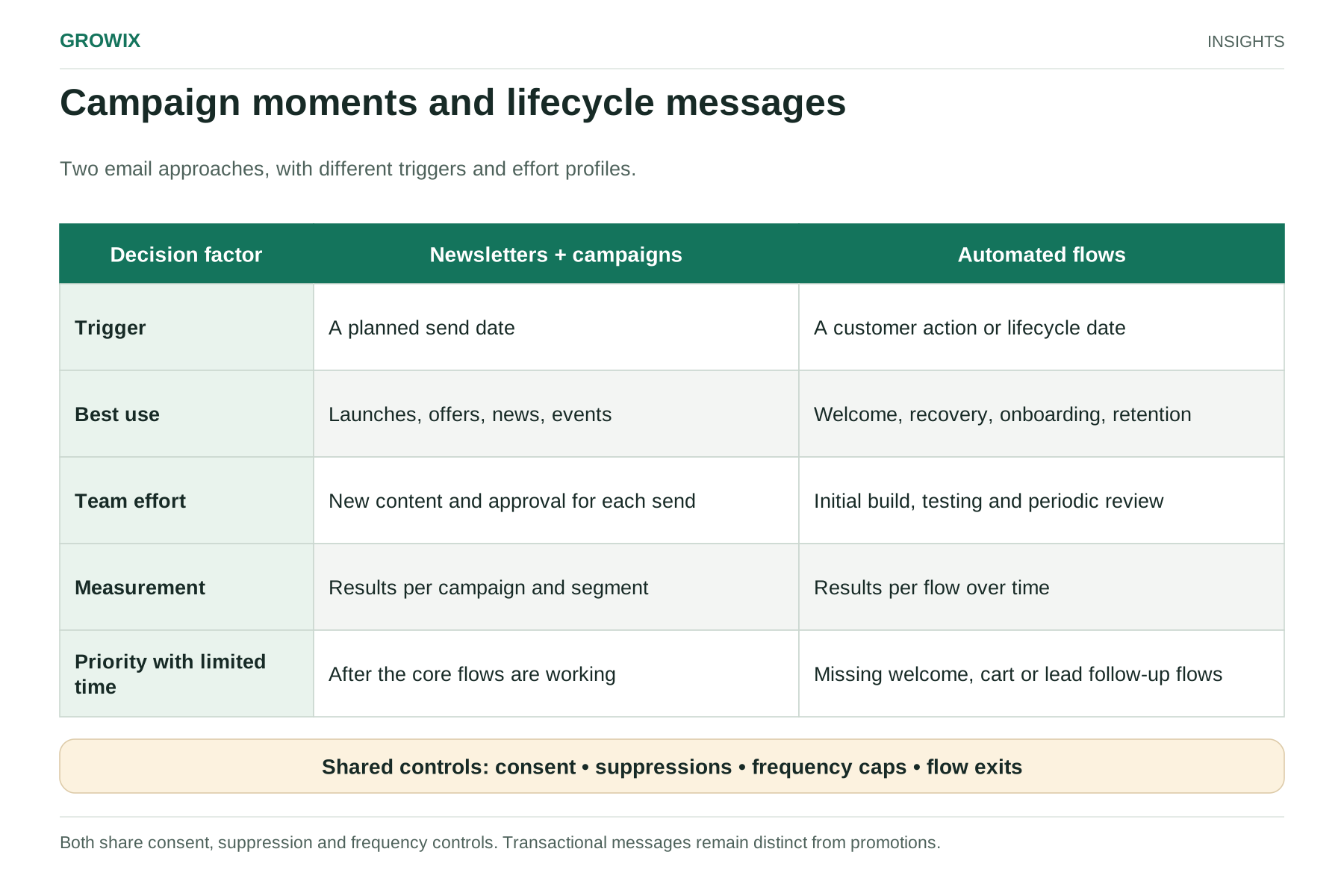
Campaign moments and lifecycle messages. Both share consent, suppression and frequency controls. Transactional messages remain distinct from promotions. View full size Read this comparison as a table
Decision factor
Newsletters + campaigns
Automated flows
Trigger
A planned send date
A customer action or lifecycle date
Best use
Launches, offers, news, events
Welcome, recovery, onboarding, retention
Team effort
New content and approval for each send
Initial build, testing and periodic review
Measurement
Results per campaign and segment
Results per flow over time
Priority with limited time
After the core flows are working
Missing welcome, cart or lead follow-up flows
The flows to build first
For e-commerce
Welcome series: two to four emails after sign-up that set expectations, introduce your best products and explain what makes you different. Deliver any promised discount immediately.
Abandoned cart: a reminder within hours of abandonment, followed by one or two more over the next few days. Show the items and make returning to the cart easy.
Browse abandonment: a lighter reminder for people who viewed products without adding them to the cart, where your platform and consent setup support it.
Post-purchase: order and delivery updates, care or setup tips, a review request after delivery and relevant follow-on products.
Replenishment: reminders timed to when consumable products typically run out.
Win-back: a sequence for customers who have not bought in longer than your usual repeat cycle.
For B2B services and SaaS
Welcome series for newsletter subscribers, explaining what they will receive and pointing to your most useful content.
Lead magnet follow-up: a short sequence related to what the person downloaded or used, ending with a clear next step.
Trial or customer onboarding: messages that help new users reach first value, triggered by what they have or have not done.
Renewal and expansion reminders, timed to the contract, with useful information rather than only a sales prompt.
Re-engagement for subscribers and leads who have gone quiet.
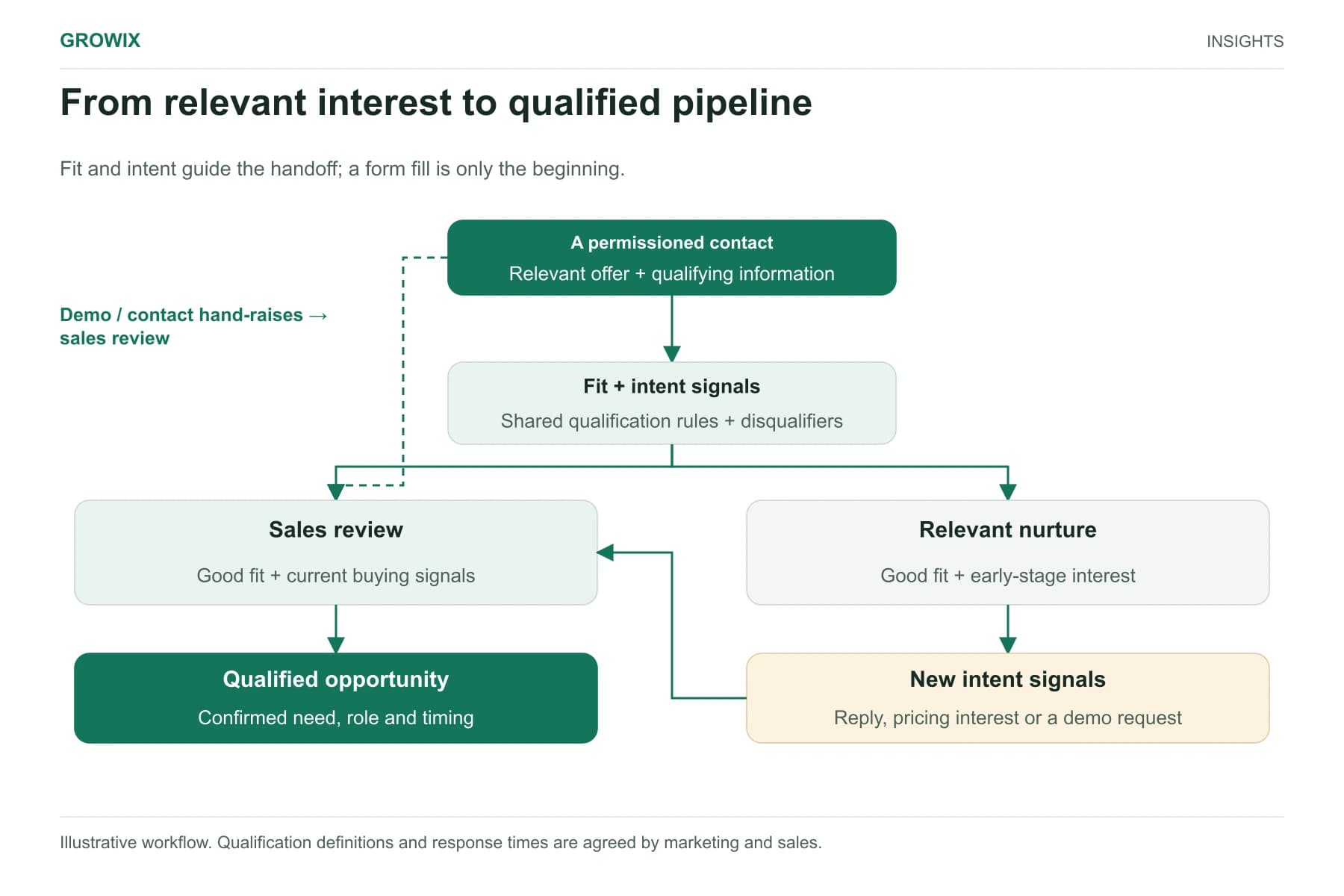
For the scoring and handoff rules that decide when a nurtured lead goes to sales, see our guide to B2B lead generation.
Hypothetical comparison for an online store
The following scenario is invented for illustration, and all figures are assumptions.
A store has 50,000 subscribers, an average order value of $70, and about 3,000 abandoned carts a month where it has the shopper's email address and permission to contact them.
Campaigns: four sends a month to the whole list, with 0.2% of recipients buying from each send. That is 4 × 50,000 × 0.002 = 400 orders, or $28,000 a month.
Abandoned cart flow: recovering 5% of carts produces 3,000 × 0.05 = 150 orders, or $10,500 a month, from a flow built once.
Both matter, and campaigns produce more revenue in this example. But the cart flow adds meaningful revenue with almost no weekly effort, while doubling campaign frequency would need twice the content, risk more unsubscribes and complaints, and would be unlikely to double the result. That is why flows usually come first, followed by smarter campaigns rather than more of them.
Make campaigns work harder
Once core flows are running, improve campaigns before increasing their number:
Segment by behavior: recent purchasers, engaged non-buyers, lapsed customers and new subscribers need different messages and frequencies.
Plan a calendar around real moments: launches, seasons, events and content you genuinely have to share.
Give every send one clear purpose and one main call to action.
Reduce frequency for less engaged subscribers rather than mailing everyone equally.
Write newsletters people want to receive: useful information, not only promotions.
Keep both deliverable
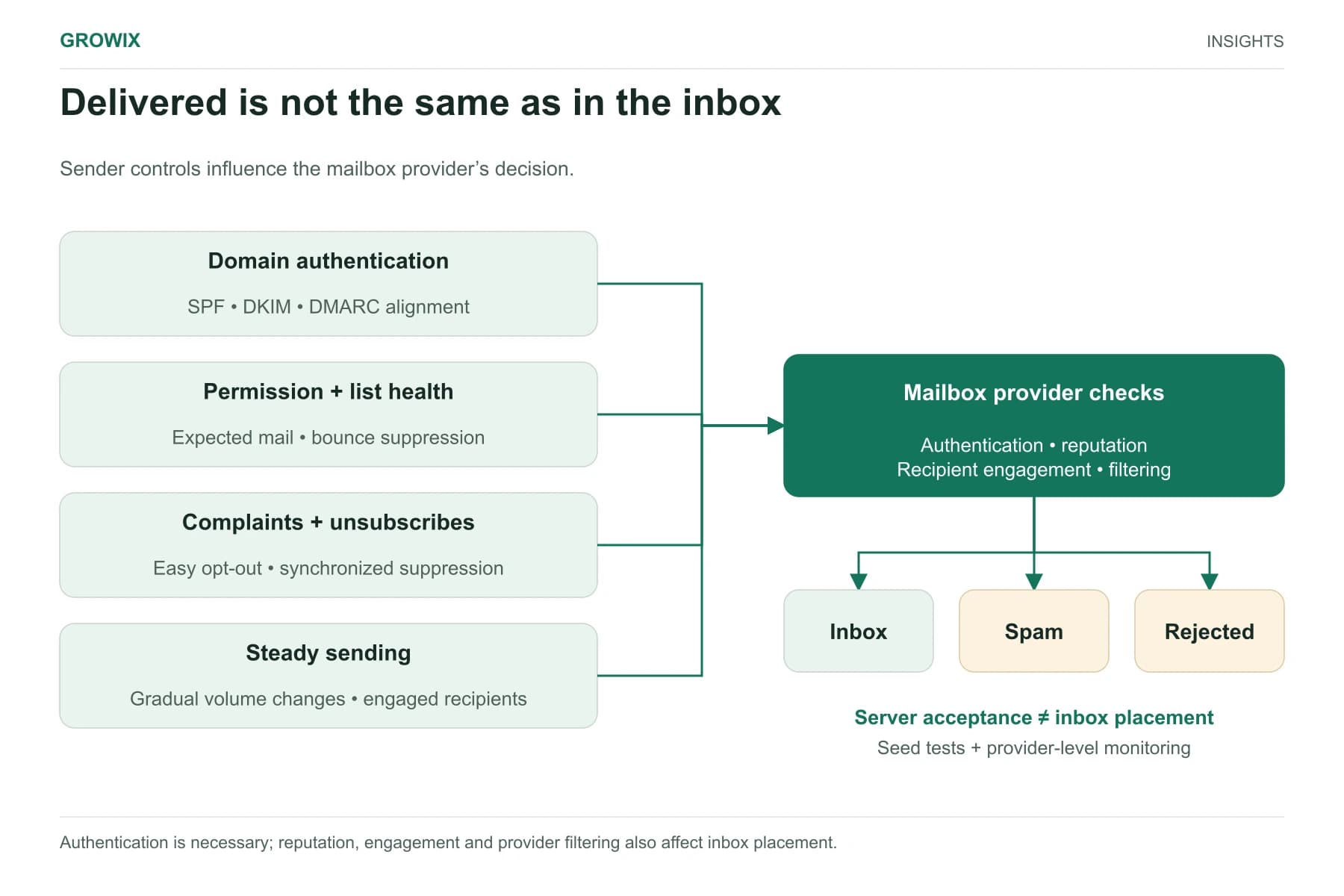
More sends and more automation both increase the volume of mail you send. Authenticate your domain, keep complaint rates low, make unsubscribing easy and suppress people who no longer engage. Our guide to email deliverability covers the requirements Gmail, Yahoo and Outlook now set for bulk senders.
Make sure automated flows respect the same consent and suppression rules as campaigns. A customer who unsubscribes from promotions should not keep receiving them through a flow, although transactional messages such as receipts and delivery updates can continue.
Measure each on its own terms
Campaigns: revenue or pipeline per recipient, click rate, unsubscribe and complaint rates per send.
Flows: conversion rate and revenue or pipeline per person who enters the flow, measured monthly.
Overall program: share of email revenue or pipeline from flows versus campaigns, list growth, and the share of subscribers who are still engaged.
Treat open rates with caution. Privacy features in some email apps load images automatically and record opens that did not happen, so clicks and conversions are more reliable.
When each deserves more effort
Put more effort into flows when:
You have few or no automated sequences running.
Customers buy repeatedly or need help getting started.
Your team is small and cannot produce many campaigns each month.
Put more effort into campaigns when:
Core flows are built, tested and performing.
You have frequent launches, new content or seasonal moments.
You need to stay visible with an audience that buys infrequently.
When Growix may not be the right fit: if you send occasionally to a small list and have no plans to grow it, your email platform's built-in templates and automations may be all you need.
A decision checklist
Which automated flows do you have today, and when were they last reviewed?
What customer or lead actions happen often enough to justify a flow?
How many campaigns can your team produce well each month?
Do you segment campaigns by engagement and purchase behavior?
Can you report revenue or pipeline per recipient for both flows and campaigns?
How to build a flow well
Start from the customer's situation, not your product list: what does someone who just abandoned a cart, or just downloaded a guide, need next?
Keep sequences short at first, with two or three messages, and extend only when data shows later messages still convert.
Add exit conditions, so a customer who buys or books a call leaves the flow immediately.
Avoid overlap: decide which flow wins when someone qualifies for several at once, and cap the total number of emails a person can receive in a week.
Review each flow quarterly, checking links, offers, product availability and performance.
Common mistakes
Setting up flows once and never reviewing them, so they promote discontinued products or expired offers.
Discount-heavy flows that train customers to abandon carts and wait for a code.
Sending campaigns to people who are in the middle of a flow, creating a pile-up of messages.
Judging email only by opens, which privacy features have made unreliable.
Frequently asked questions
What is email marketing automation?
Email marketing automation sends messages automatically when someone takes an action or reaches a date, such as signing up, abandoning a cart, buying, downloading a guide or approaching a renewal. Each sequence is built once and improved over time, rather than written for every send.
Which automated emails should a small business set up first?
For an online store, start with a welcome series, abandoned cart reminders and post-purchase messages. For a service or software business, start with a welcome series, follow-up for your main lead magnet and onboarding for new customers.
How often should you send email newsletters?
As often as you have something useful to say and your audience stays engaged. Watch clicks, unsubscribes and complaints by segment; if they worsen as frequency rises, reduce frequency for less engaged subscribers rather than for everyone.
Next step
List the automated flows you have today and the customer actions that have none. Build the missing welcome and cart or lead follow-up flows first, then review your campaign calendar.
Growix's Email & SMS Marketing team plans campaigns and automated sequences that customers actually read, and our CRM & Marketing Automation team sets up the segmentation, nurturing and workflows behind them.