An affiliate program pays independent partners a commission when the customers they refer buy from you. Partners might be content publishers who review products, creators with an engaged audience, deal and coupon sites, cashback and loyalty platforms, or complementary brands. Because you pay for results rather than for impressions or clicks, affiliate marketing can look like risk-free growth.
It is not quite that. A poorly designed program pays commissions on sales you would have made anyway, attracts partners who game the rules and leaves you responsible for misleading promotions made in your name. A well-designed one reaches new customers through trusted voices at a predictable cost. This guide explains how an e-commerce brand can set up an affiliate program that adds incremental sales: commissions that fit your margins, reliable tracking, clear terms, compliant disclosures and controls against fraud.
Types of affiliate partners
Different partners create very different value, so decide which ones you want before you open applications.
| Partner type | How they drive sales | Main risk |
|---|
| Content publishers and review sites | Product reviews, comparisons and buying guides | Slow to build; may favor higher-paying programs |
| Creators and influencers | Recommendations to an engaged audience | Disclosure lapses; uneven results |
| Coupon and deal sites | Discount codes and offers | Claiming credit for sales already in the checkout |
| Cashback and loyalty platforms | Rewards members for buying | Paying extra on existing customers |
| Brand partners | Recommendations to a complementary customer base | Needs relationship management |
Most new programs do best with content publishers, creators and selected brand partners, then add deal and cashback partners carefully, with rules that limit paying for sales that were going to happen anyway.
Step 1: Set commissions from your margins
Start from what you can afford to pay for a new customer, not from what competitors advertise. Work out contribution per order after product cost, fulfillment, payment fees, returns and support, then decide how much of it you will give up to acquire a sale through a partner. Our guide to e-commerce profitability shows how to build that per-order model.
Hypothetical example
The following figures are invented for illustration.
A store has an average order value of $80 and contribution of $24 per order before marketing costs. It pays affiliates 10% of the order value net of returns.
- Commission on an average order: $80 × 0.10 = $8.
- Contribution left after commission: $24 − $8 = $16.
If the store's other channels cost $30 to acquire a new customer, affiliate sales at $8 look cheap. But if half of affiliate-tracked orders come from existing customers who used a coupon they found online, the real cost per new customer doubles to $16, and the comparison changes.
Common commission choices:
- Percentage of sale, net of returns and cancellations, which keeps costs proportional to revenue.
- Higher rates for new customers than for returning ones, where your tracking can tell them apart.
- Tiered or bonus rates for partners who deliver above an agreed volume.
- Category-specific rates where margins differ by product line.
Step 2: Choose tracking you can trust
Affiliate payments depend entirely on tracking, so choose it carefully.
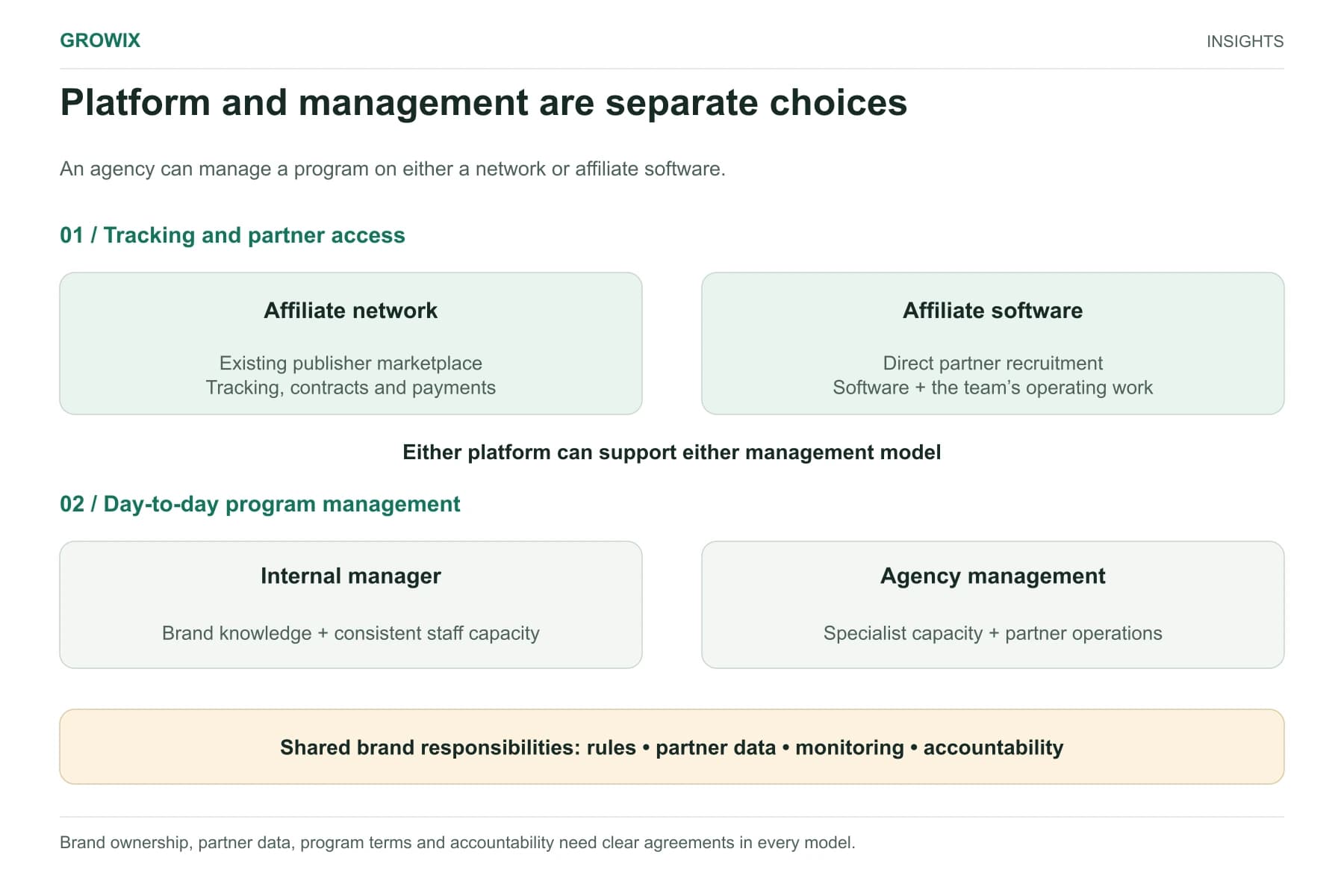
- Affiliate networks provide tracking, partner recruitment, payments and a marketplace of publishers in one place, usually for setup fees, monthly fees and a share of commissions.
- Affiliate software platforms give you tracking and partner management while you recruit and pay partners yourself.
- Built-in tools in some e-commerce platforms suit very small programs.
Whichever you choose, check that tracking works across devices and browsers, that it can use server-side or postback tracking rather than relying only on browser cookies, that returns and cancellations reverse commissions automatically, and that you can identify new versus returning customers.
Decide your attribution rules too: how long after a click a sale still counts, and what happens when several affiliates, or an affiliate and your own ads, touched the same order. Write those rules into your terms.
Step 3: Write clear program terms
Good terms protect you and make good partners trust the program. Cover at least:
- Commission rates and when they are paid, including the approval period that allows for returns.
- Attribution window and how conflicts between partners are resolved.
- Coupon policy: which codes affiliates may publish, and whether commission is paid on orders using codes intended for other channels.
- Paid search rules: whether affiliates may bid on your brand name or variations of it.
- Prohibited methods, such as misleading claims, unapproved discounts, spam, incentivized clicks and placing cookies without a genuine click.
- Disclosure requirements and your right to review content.
- Termination and clawback rights for breaches.
Step 4: Get disclosures right
Affiliates must tell their audience about the commercial relationship. The FTC's Endorsement Guides FAQ says affiliates should disclose the relationship clearly and conspicuously, close to the recommendation, and notes that a disclosure at the bottom of a page or behind a separate "disclosure" link is easy to miss. It suggests a label such as "Paid link" can be adequate next to an affiliate link, while "affiliate link" on its own is not adequate.
The FAQ also states that advertisers need reasonable programs to train and monitor members of their network, and that delegating promotion to an outside company does not remove responsibility. In practice:
- Give partners clear written disclosure guidance with examples.
- Review new partners' content and spot-check active ones.
- Act quickly on misleading claims or missing disclosures.
This is general information, not legal advice. Have counsel review your program terms and guidance.
Step 5: Recruit and support the right partners
- Start with people who already like your products: customers who create content, existing reviewers and complementary brands.
- Approve applications deliberately, checking the partner's audience, content quality and promotion methods.
- Give partners what they need to sell well: product information, images, honest key selling points, a calendar of launches and promotions, and a contact person.
- Communicate regularly: a monthly update on new products, top performers and upcoming offers keeps partners engaged.
A smaller group of active, relevant partners usually outperforms a long list of inactive ones.
Step 6: Control fraud and measure incrementality
Common problems to watch for:
- Coupon leakage: codes meant for a specific channel appearing on deal sites, earning commission on customers who were already checking out.
- Brand bidding: affiliates buying ads on your brand name and taking credit for people searching for you.
- Cookie stuffing and fake clicks: tracking placed without a genuine click.
- Self-referral: partners buying through their own links for commission.
Monitor by partner: share of new versus returning customers, conversion rates that look implausible, sudden spikes, return rates and the share of orders using coupons. The most important question is incrementality: would these sales have happened without the partner? Test it where you can, for example by pausing a partner type in a region or period and comparing results.
Measures of success
- Revenue and orders from new customers through affiliates.
- Effective cost per new customer, including commissions, platform fees and management time.
- Share of active partners generating sales each month.
- Return and reversal rates by partner.
- Contribution margin after commission on affiliate orders.
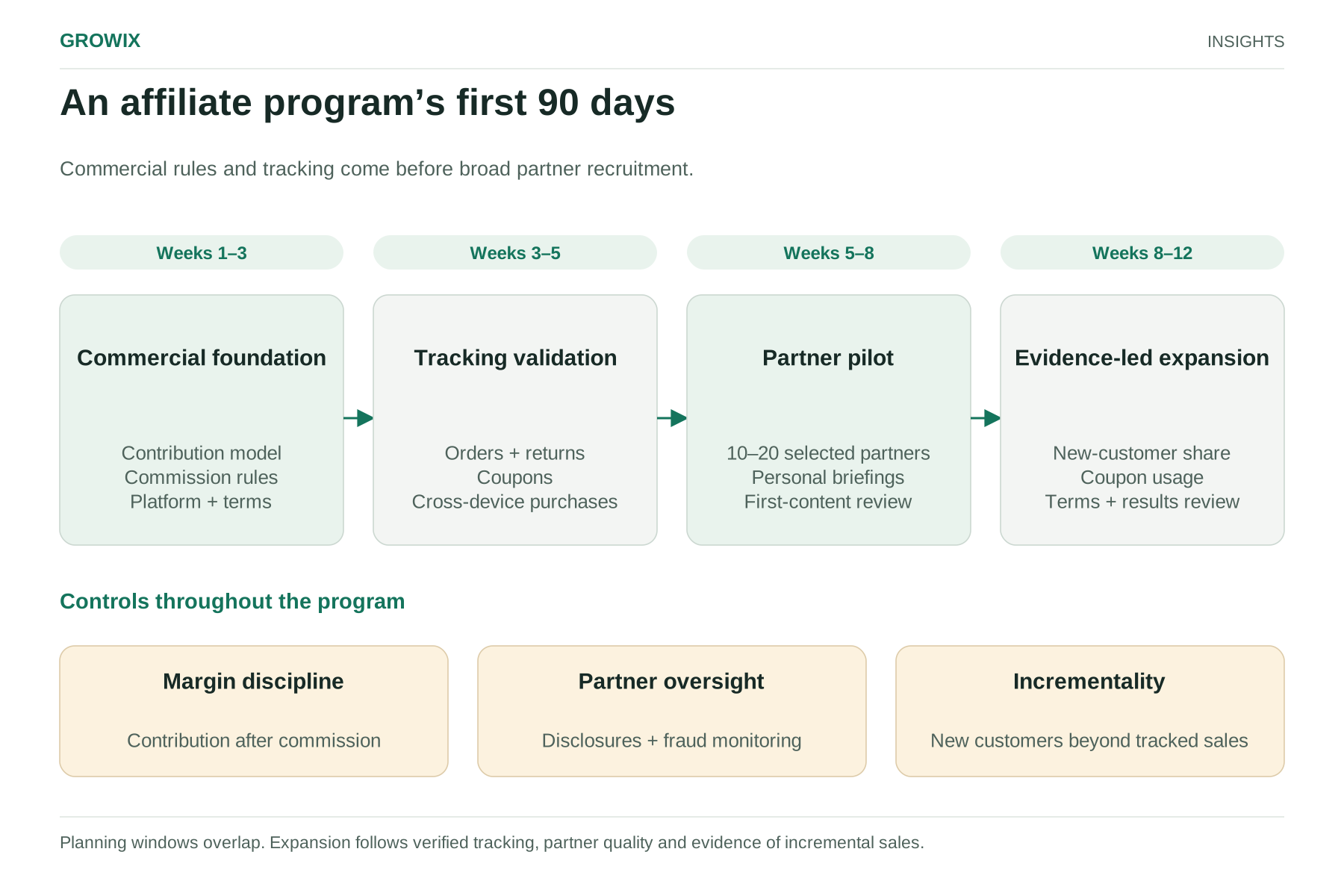
A launch plan for the first 90 days
- Weeks 1 to 3: build the contribution model, set commission rates, choose the platform and write the terms, disclosure guidance and partner onboarding pack.
- Weeks 3 to 5: test tracking end to end with real orders, including returns, coupons and cross-device purchases, before any partner promotes you.
- Weeks 5 to 8: invite a first group of 10 to 20 hand-picked partners, brief them personally and review their first pieces of content.
- Weeks 8 to 12: review results by partner, check the share of new customers and coupon usage, adjust terms, then open applications more widely.
Starting small makes problems cheap to fix and gives you real data before you scale.
Common mistakes
- Copying a competitor's commission rate without checking your own margins.
- Approving every application, which brings in low-quality and risky partners.
- Paying full commission on coupon orders from customers who were already checking out.
- Launching without testing tracking, which leads to disputes with partners over missing commissions.
- Treating the program as passive. Partners need regular information, offers and feedback to keep promoting you.
Frequently asked questions
What is an affiliate program?
An affiliate program is an arrangement in which a brand pays independent partners, such as publishers, creators, deal sites or other brands, a commission when customers they refer make a purchase. Sales are tracked through unique links or codes, and commissions are paid under the program's terms.
How much commission should an affiliate program pay?
There is no standard rate. Set commission from your contribution margin per order and what you can afford to pay for a new customer, and consider paying more for new customers than for returning ones. Compare the effective cost per new customer with your other channels.
How do you prevent affiliate fraud?
Write clear rules on coupons, brand bidding and prohibited methods, approve partners carefully, use tracking that reverses commissions on returns and cancellations, and monitor each partner's new-customer share, conversion rates and order patterns. Remove partners who break the rules.
Next steps
Build your per-order contribution model, decide what you can afford to pay for a new customer through partners, and draft your program terms before choosing a platform. Those decisions shape every choice that follows.
Growix's Affiliate Marketing team builds and manages affiliate programs end to end, from strategy and partner acquisition to performance analysis, and our E-commerce Marketing team connects affiliate activity with your other acquisition channels. To choose how to run the program, see affiliate network vs in-house program vs agency.
Discuss your marketing priorities
This article is general information, not legal advice.