Affiliate Network vs In-house Affiliate Program vs Agency Management: Which Fits Your Brand?
Affiliate Network vs In-house Affiliate Program vs Agency Management: Which Fits Your Brand?
Networks bring reach, in-house software brings control, and agencies bring hands-on management. The right choice depends on the partners you need and the time you can give the program.
The short answer: join an affiliate network when you need access to a large pool of established publishers quickly and want tracking, payments and partner contracts handled in one place. Run an in-house program on affiliate software when your best partners are creators, customers or brands you can recruit yourself, and you want lower ongoing fees and closer relationships. Use an agency, sometimes called an outsourced program manager, when you want the program run actively but do not have someone in-house with the time or experience to recruit partners, police the rules and report on results. The choices combine: many brands use a network or software platform for tracking, with an agency or in-house manager running the program.
The options defined
Affiliate network. A marketplace that connects brands with many publishers. The network provides tracking, reporting, partner contracts, payments to affiliates and often fraud screening. Brands usually pay a setup fee, a monthly fee and a network commission or override on affiliate commissions. Publishers already active on the network can find and join your program.
In-house program on affiliate software. You license an affiliate tracking and partner management platform, recruit partners directly, and pay them through the platform or yourself. Costs are mainly the software subscription and your team's time.
Agency or outsourced program management. A specialist team runs the program for you on whichever network or platform you use: partner recruitment, onboarding, communication, compliance monitoring, fraud review, optimization and reporting. Fees are typically a monthly retainer, a share of affiliate revenue or a combination.
How they compare
Factor
Affiliate network
In-house software
Agency management
Access to partners
Large existing publisher base
Only partners you recruit
Agency's relationships plus your network or platform
Speed to launch
Fast for publisher-led programs
Depends on your recruiting
Fast if the agency has relevant contacts
Ongoing cost
Fees plus network commission
Software subscription plus staff time
Agency fee plus platform costs
Control over rules and data
Shared with the network
Highest
Yours, if contracts say so
Internal effort
Moderate
Highest
Lowest day to day
Fraud screening
Often included at network level
Your responsibility
Agency's job, using platform tools
Best for
Publisher and coupon-heavy programs
Creator, customer and brand partner programs
Brands without an experienced in-house manager
What actually drives the decision
Which partners you need
If your growth depends on large content publishers, comparison sites, cashback and loyalty platforms, many of them work mainly through networks, and joining one is the fastest way to reach them. If your best partners are creators, existing customers, industry experts or complementary brands, you will recruit most of them yourself, and a network's marketplace adds less.
Who will manage the program
Affiliate programs need regular attention: approving applications, recruiting, briefing partners on launches and offers, checking disclosures, reviewing suspicious orders, approving commissions and reporting. If nobody in your team can give it consistent time, the program will drift whichever platform you choose. That is the main case for an agency or a dedicated in-house manager.
Cost at your expected volume
Compare total cost at realistic affiliate revenue levels, not just the headline fee.
Hypothetical comparison
The following figures are invented assumptions for illustration, not market quotes or Growix pricing. A brand expects $50,000 a month in affiliate-tracked revenue and pays partners 10% commission, or $5,000 a month.
The totals are close, so cost alone rarely decides. The question is which option produces more incremental sales from new customers. A network that adds many coupon partners may report more revenue but less of it incremental; an in-house program with a few strong creators may report less but bring genuinely new customers.
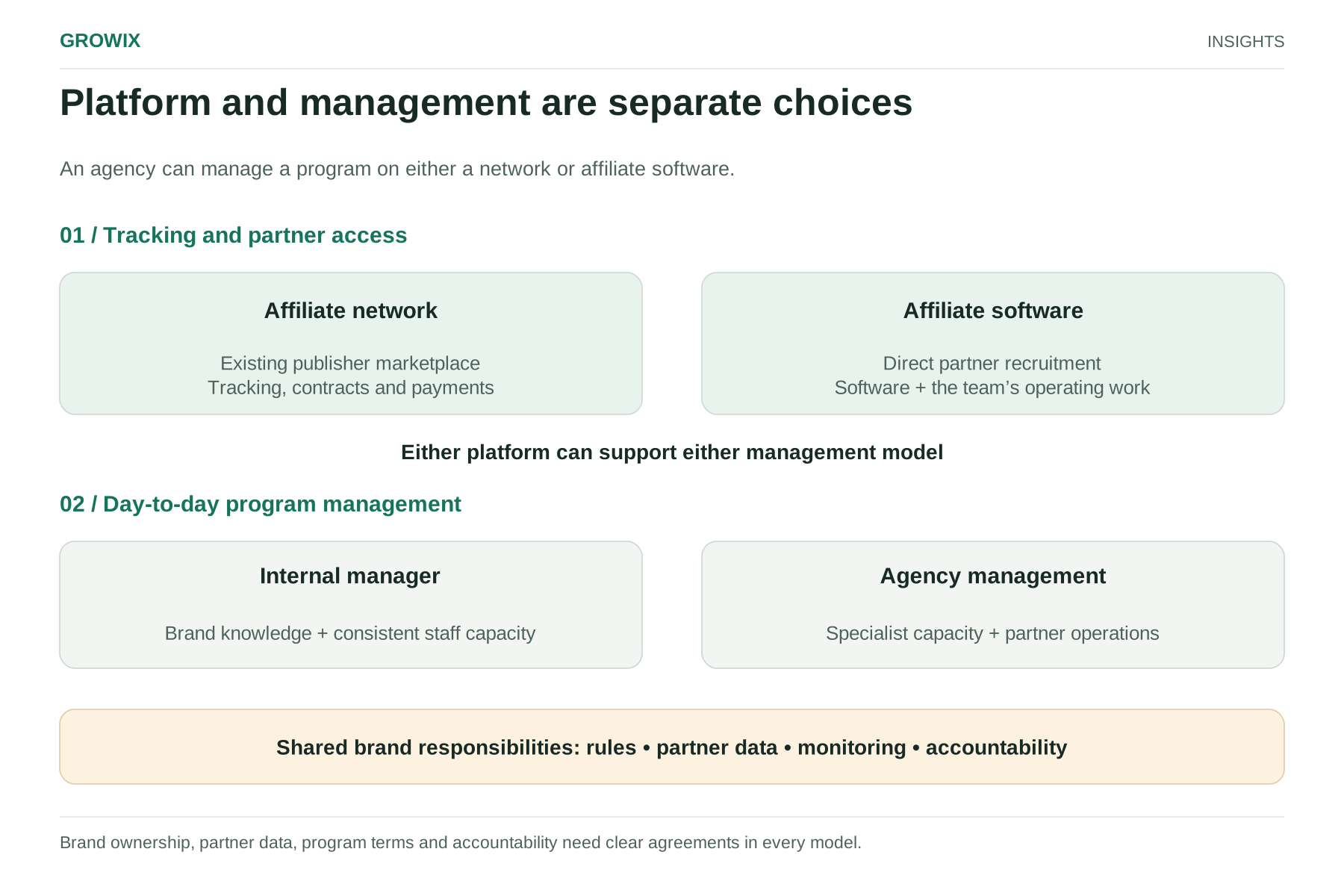
Platform and management are separate choices. Brand ownership, partner data, program terms and accountability need clear agreements in every model. View full size Read this comparison as a table
Decision
Option one
Option two
Tracking and partner access
Affiliate network
Affiliate software
Day-to-day management
Internal manager
Agency management
Control, data and compliance
Whichever model you choose, keep control of the essentials:
Ownership of partner relationships and data: you should be able to export partner contacts and performance history if you change network, platform or agency.
Program terms: commission rules, coupon policy, brand bidding rules and prohibited methods should be yours to set.
Disclosure and monitoring: the FTC's Endorsement Guides FAQ says advertisers need reasonable programs to train and monitor members of their network, and that delegating promotion to an outside company does not remove responsibility. Make clear in contracts who reviews partner content and how quickly problems are fixed.
Fraud and quality reviews: agree who checks for coupon leakage, brand bidding, self-referral and implausible conversion patterns, and how disputed commissions are handled.
Questions to ask before choosing
For a network: Which of our target publishers are active on it? What are all the fees, including overrides and minimums? How are fraud and disputed transactions handled? Can we take partner data with us if we leave?
For affiliate software: Does tracking work reliably across browsers and devices, including server-side tracking? Does it reverse commissions on returns automatically? Can it distinguish new and returning customers? How are partner payments, tax forms and currencies handled?
For an agency: Which partners have you recruited for brands like ours? Who will manage our account day to day, and how much of their time do we get? How do you measure incrementality, not just tracked revenue? What happens to partner relationships if we end the contract?
When each fits
Choose a network when you need established publishers quickly, your products suit content, deal or cashback partners, and you want one contract covering tracking, payments and publisher terms.
Choose in-house software when your partners are mainly creators, customers or brands you can recruit directly, you have someone to manage the program, and you want the lowest platform costs and most control.
Choose agency management when you want an active program without building the skills in-house, or you need to fix a program that has drifted, whichever tracking platform you use.
When Growix may not be the right fit: if your program has only a handful of long-standing partners who need little management, simple affiliate software and an occasional review may be enough.
A decision checklist
Which partner types matter most for your products, and where do they work today?
Who in your team can manage the program each week, and how many hours do they have?
What would each option cost at your expected affiliate revenue, including all fees?
How will you measure incremental new customers, not only tracked revenue?
Can you take partner relationships and data with you if you change provider?
Switching between models
Programs often change model as they grow: from a network to in-house software once a brand has its own partner relationships, or from in-house management to an agency when the program outgrows one person's time. Plan any switch carefully:
Map every active partner and the terms they currently work under.
Tell partners early, explain what changes for them and give them new links well before old ones stop tracking.
Run old and new tracking in parallel for a period, so no commissions are lost in the changeover.
Check contract terms with your network or agency for notice periods and data export rights.
Common mistakes
Choosing a network for its partner numbers without checking whether your target publishers are active on it.
Underestimating management time for an in-house program.
Judging an agency on tracked revenue rather than incremental new customers.
Signing contracts that keep partner data with the provider when you leave.
Frequently asked questions
What is an affiliate network?
An affiliate network is a platform that connects brands with many affiliate publishers and handles tracking, reporting, contracts and payments between them. Brands pay fees and usually an additional commission to the network on top of what affiliates earn.
Is affiliate software cheaper than an affiliate network?
Usually, in platform fees, because there is no network commission. But you must recruit and manage partners yourself, so include staff time in the comparison. For publisher-heavy programs, a network's reach may be worth its higher fees.
What does an affiliate management agency do?
An affiliate management agency runs your program day to day: recruiting and onboarding partners, communicating offers, monitoring disclosures and fraud, approving commissions, optimizing terms and reporting results, using your network or software platform.
Next step
List the twenty partners you would most like to work with and check where they operate today: on networks, on their own or with other brands. That list usually settles whether you need a network's reach or a direct, in-house approach. For the program design itself, see our guide on how to start an affiliate program.
Growix's Affiliate Marketing team builds and manages affiliate programs end to end, including strategy, partner acquisition, partnership campaigns and performance analysis, on the network or platform that suits your brand.