B2B Lead Generation for Services and SaaS: Lead Magnets, Scoring and Nurturing That Turn Into Pipeline
B2B Lead Generation for Services and SaaS: Lead Magnets, Scoring and Nurturing That Turn Into Pipeline
More form fills rarely fix a thin pipeline. Define what a qualified lead is, offer something buyers want, score and nurture what comes in, and judge every channel by pipeline.
B2B lead generation is the work of finding people at companies that could buy from you, earning their contact details and interest, and passing the ones who are ready to the sales team. For B2B services firms and SaaS companies, the problem is rarely a complete absence of leads. It is that marketing reports a healthy number of form fills while sales says the pipeline is thin.
The gap usually comes from three things: no shared definition of a qualified lead, offers that attract the wrong people, and no system for the many leads who are interested but not ready to talk. This guide sets out a practical lead generation system for services and SaaS businesses: define the lead, build offers worth exchanging an email address for, score and nurture what comes in, and measure everything against pipeline rather than volume.
Why B2B lead generation has become harder
Buyers do more of their research on their own than they used to. Gartner reported in a May 2026 press release that 67% of B2B buyers prefer a buying experience without a sales representative, while many still turn to sales reps to validate information they found through AI tools. In practice, that means:
Buyers arrive later and better informed. By the time someone fills in a demo form, they have often shortlisted vendors already.
Gated content attracts researchers, not buyers. Many people download a guide with no intention of buying this year.
Buying groups are larger. One interested contact is not the same as an interested company.
Inbox and privacy rules are stricter. Outreach and nurturing must respect consent, authentication and unsubscribe requirements.
None of this makes lead generation less valuable. It changes what good looks like: fewer, better-qualified leads, more patience with early-stage interest, and a closer link between marketing activity and sales outcomes.
Step 1: Define a qualified lead with sales
Before changing any campaign, agree in writing what marketing should hand to sales. Most B2B teams use stages such as these:
Stage
Meaning
Who owns it
Contact
Someone you can reach, with permission to market to them
Marketing
Marketing qualified lead (MQL)
Fits your target profile and has shown meaningful interest
Marketing
Sales accepted lead (SAL)
Sales has reviewed it and agrees to work it
Sales
Sales qualified lead (SQL)
Sales has confirmed a real need, role and timing
Sales
Opportunity
A deal in the pipeline with a value and stage
Sales
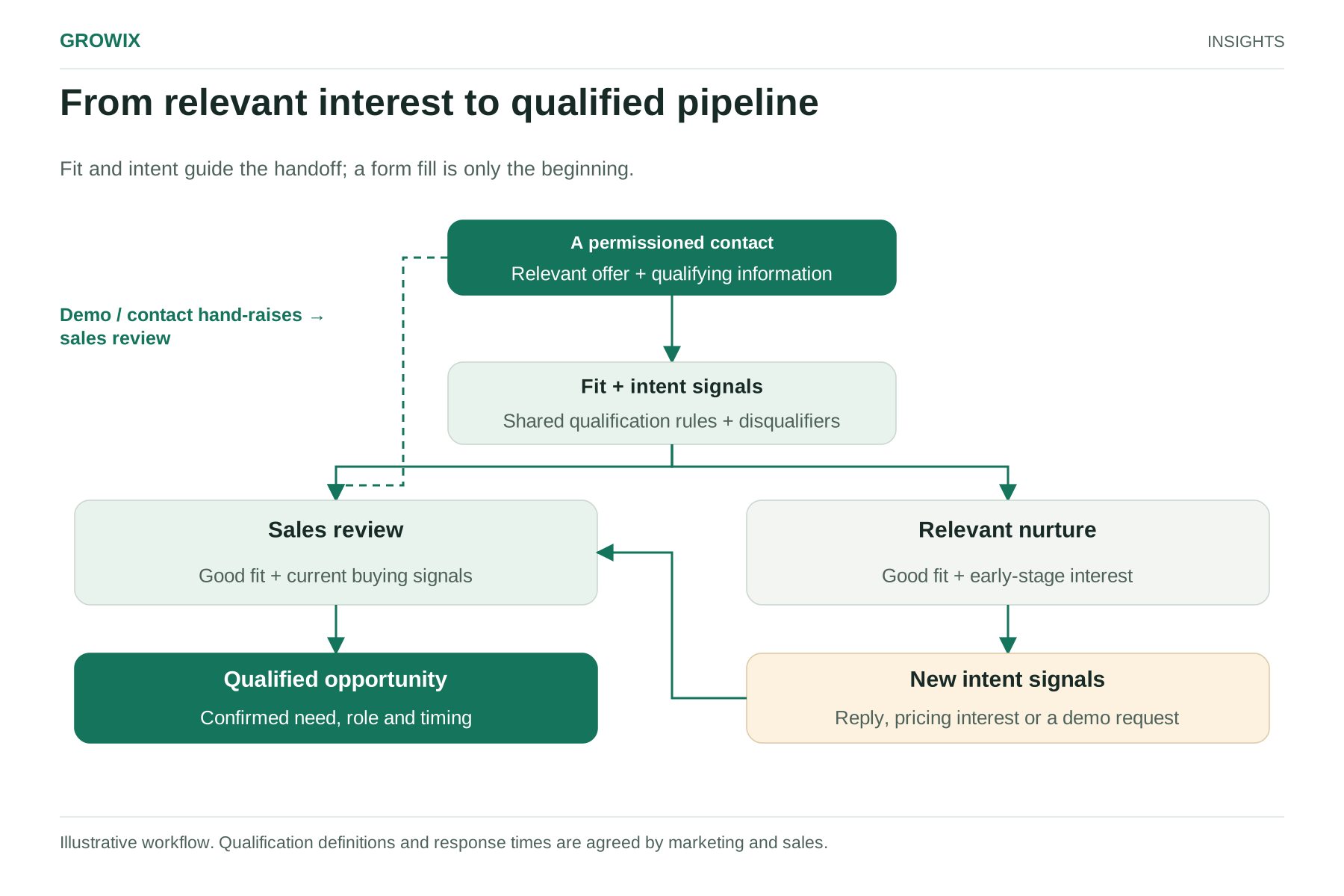
The definitions matter more than the labels. An MQL definition usually combines fit, such as industry, company size, region and role, with intent, such as a demo request, a pricing page visit or repeated engagement with buying-stage content. Write down what disqualifies a lead too: students, competitors, existing customers and companies outside your service area.
Agree a service level as well: how quickly sales follows up on each lead type, and what feedback sales gives when it rejects one. Without that feedback, marketing cannot improve targeting.
Step 2: Build lead magnets buyers actually want
A lead magnet is something valuable a prospect receives in exchange for their contact details. The best ones answer a question buyers have during evaluation, not a broad topic that attracts everyone.
Lead magnets that tend to attract buyers:
Calculators and estimators: a cost, savings or sizing tool that uses the buyer's own numbers.
Assessments and scorecards: a short self-assessment that shows where the buyer stands and what to fix first.
Templates and checklists: documents a buyer will use in their own process, such as a requirements template or a vendor scorecard.
Benchmarks from your own data, where you have enough of it and can explain the method honestly.
Short working sessions: a free review or workshop for qualified companies, positioned as useful in its own right.
Lead magnets that tend to attract researchers:
Broad e-books on general topics.
Trend reports with no practical takeaway.
Content that is freely available elsewhere in better form.
Ask only for the information you need at that stage. A long form reduces conversions; a single email field gives sales nothing to work with. A practical middle ground is name, work email, company and one qualifying question, such as company size or the problem they want to solve. Enrichment tools and later progressive profiling can fill in the rest.
Keep your most useful explanatory content ungated. Buyers and AI assistants alike need to find and understand what you do before they will trade an email address for more.
Step 3: Score leads on fit and intent
Lead scoring ranks leads so that sales spends time on the most promising ones first. Keep it simple enough that sales understands and trusts it.
A practical model uses two separate scores:
Fit score: how closely the company and person match your ideal customer profile. For example, points for target industries, company size bands and decision-making roles, and negative points for disqualifying attributes.
Intent score: how strongly their behavior signals buying interest. For example, a demo request scores highly on its own; a pricing page visit, a case study download or a return visit within a week score moderately; a single blog visit scores little.
Treat a demo request or contact form as a hand-raise that goes straight to sales, regardless of score. Use scoring mainly to decide which of the remaining leads to pass to sales and which to nurture.
Let intent points decay over time, so someone who was active six months ago does not stay "hot." Review the model every quarter by comparing scores with outcomes: if many high-scoring leads are rejected by sales, the weights are wrong.
Step 4: Nurture leads who are not ready yet
Most leads are not ready to buy when they first convert. Lead nurturing keeps them engaged and moves them toward a conversation without pressure.
Effective nurturing for B2B services and SaaS usually means:
Sequences tied to the lead magnet. Someone who used a cost calculator gets content on reducing that cost, not a generic newsletter.
A handful of useful emails over weeks, not daily pushes. Each one should answer a real question, share a relevant example or offer a clear next step.
Content for each role in the buying group. Finance, operations and technical evaluators care about different things.
Signals that re-route leads. When a nurtured lead visits pricing or replies, scoring should move them to sales quickly.
Respect email rules throughout. The FTC's CAN-SPAM compliance guide states that the law makes no exception for business-to-business email, and major mailbox providers expect authenticated sending and easy unsubscribes. Our guide to email deliverability covers the technical side.
From relevant interest to qualified pipeline. Illustrative workflow. Qualification definitions and response times are agreed by marketing and sales. View full size
Choose channels by cost per qualified lead
Different channels suit different stages of demand. Judge each by the qualified pipeline it produces, not the leads it reports.
Channel
Best for
Watch out for
Search ads
Capturing existing demand for clear, high-intent terms
Hypothetical example: a 50-person IT services firm
The following scenario is invented for illustration, and all figures are assumptions.
An IT services firm generates about 200 form fills a month, mostly from a general e-book. Sales accepts only 10 a month and says most are students, very small businesses or people looking for a job.
The firm replaces the e-book with an IT cost calculator for companies with 20 to 200 employees, adds a company size question to the form, and introduces fit and intent scoring. Leads that fit but are not ready receive a five-email sequence about reducing IT costs.
After three months, form fills fall to 120 a month, but sales accepts 30. If the firm's historical rate from accepted lead to opportunity is 40%, that is 12 opportunities a month instead of 4, from fewer leads. The arithmetic: 30 × 0.40 = 12, against 10 × 0.40 = 4.
Common mistakes
Reporting lead volume as success while sales acceptance falls.
Gating everything, so buyers cannot judge your expertise before talking to you.
Scoring models nobody reviews, which drift away from what actually converts.
Sending every new lead to sales immediately, which wastes sales time and annoys early-stage researchers.
Ignoring rejected leads, the best source of information about what to change.
Measures that matter
Sales acceptance rate: share of MQLs that sales agrees to work.
MQL to opportunity conversion, by source and lead magnet.
Cost per qualified lead and per opportunity, by channel.
Speed to lead: time from hand-raise to first sales contact.
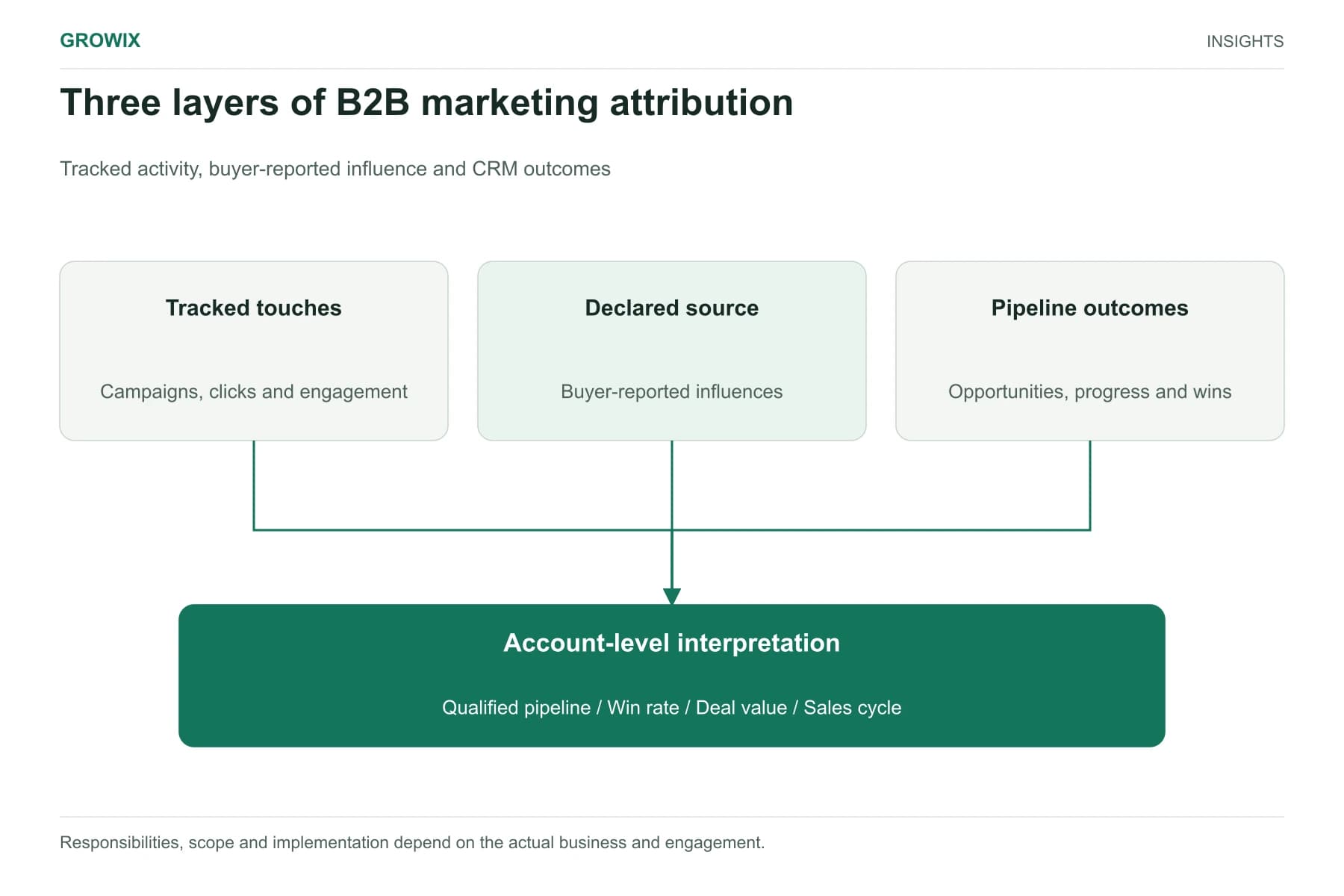
Pipeline and revenue influenced by marketing-sourced leads over a full sales cycle.
Frequently asked questions
What is B2B lead generation?
B2B lead generation is the process of attracting people at businesses that could buy from you, capturing their contact details and interest, and qualifying them so that sales can focus on the companies most likely to buy. It covers offers, channels, scoring, nurturing and the handoff to sales.
What is a good lead magnet for B2B?
The best lead magnets help buyers make a decision they are already working on: calculators that use their own numbers, assessments, practical templates and checklists, or a short working session. Broad e-books tend to attract researchers rather than buyers.
What is the difference between lead scoring and lead nurturing?
Lead scoring ranks leads by how well they fit your target customer and how strongly they are showing buying intent, so sales knows whom to contact first. Lead nurturing keeps leads who are not ready yet engaged with useful, relevant content until they are.
Next steps
Sit down with your sales lead and agree, in writing, what a qualified lead is and what disqualifies one. Then check which of your current offers produced the leads sales accepted last quarter. That comparison usually shows where to focus.
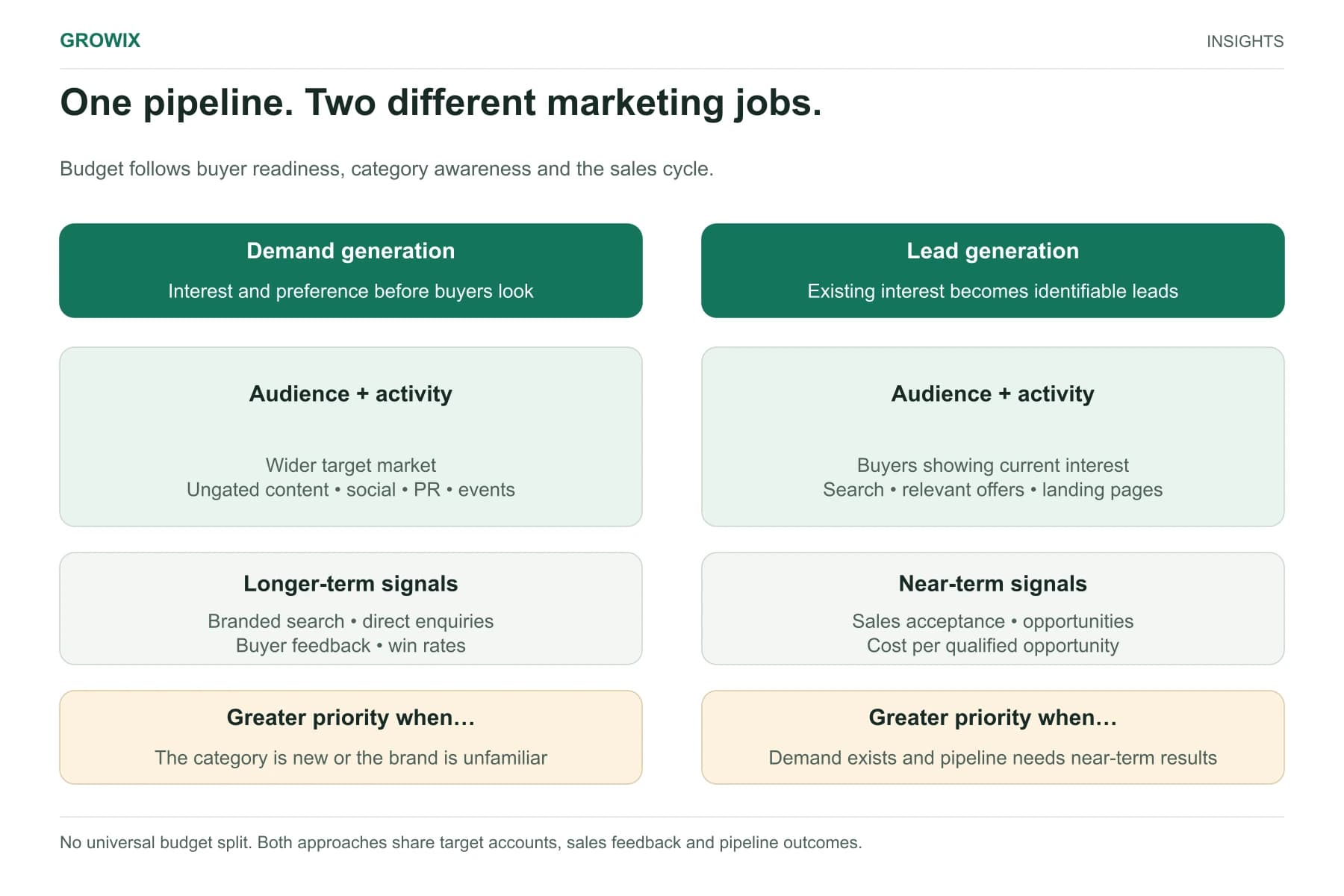
Growix's Lead & Demand Generation team creates demand in the market and converts it into qualified leads, and our CRM & Marketing Automation team sets up the scoring, nurturing and workflows that keep leads from falling through the gaps. To decide how to split budget between capturing and creating demand, see lead generation vs demand generation.