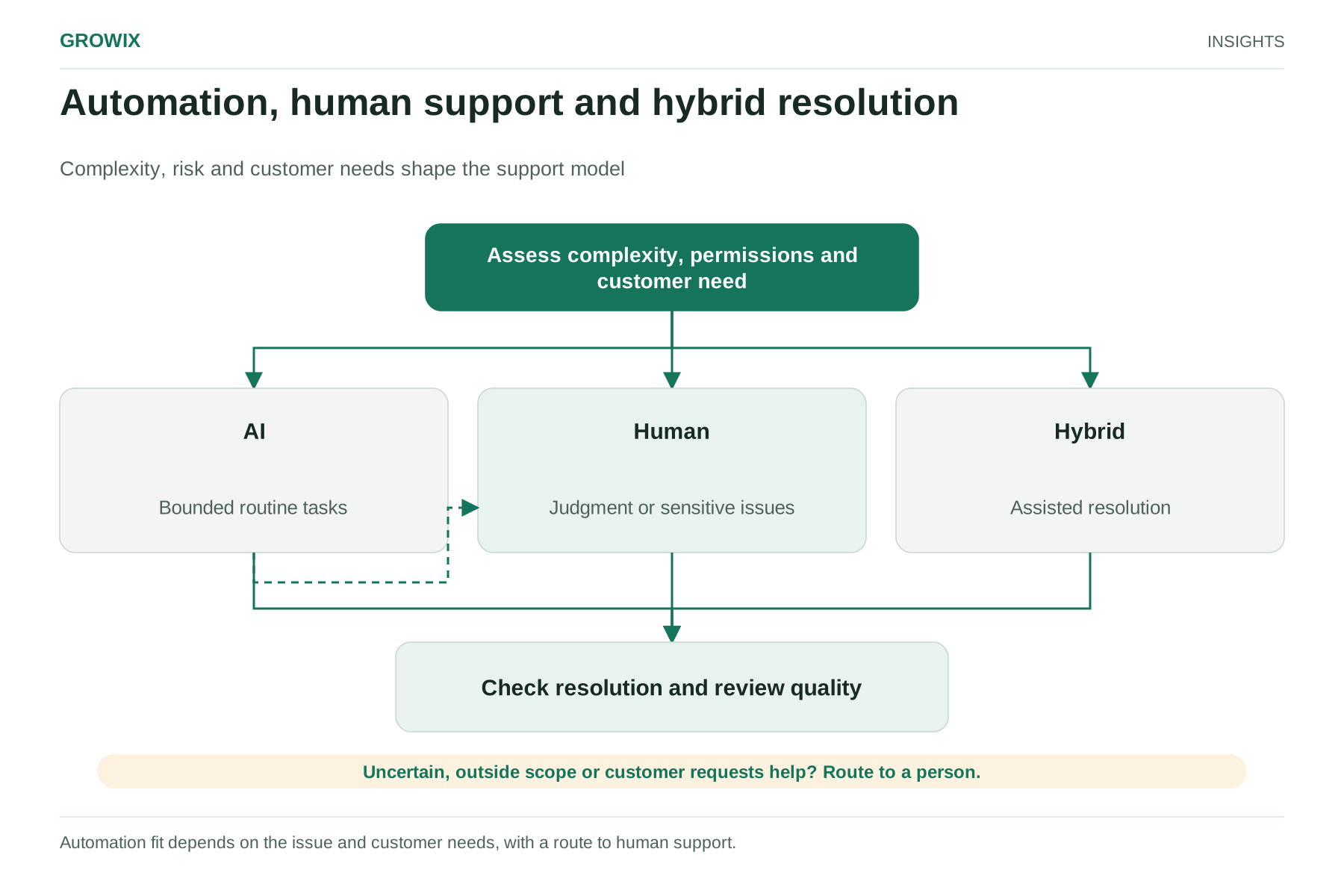
The short answer: for most businesses, a hybrid model works best. AI handles high-volume, low-risk requests where the answer can be checked against your data, such as order status, account questions and policy explanations. Human agents handle complex, sensitive or high-value situations, and any customer who asks for a person. Fully AI-led support suits a narrow set of simple, low-stakes products; fully human support remains the right choice where every interaction carries significant risk or relationship value. The comparison that matters is cost per resolved issue at an acceptable quality, not cost per contact.
Customer expectations reinforce this. In a Gartner survey of 3,566 B2B and B2C customers conducted in February and March 2026, 87% said companies using generative AI for customer service must provide access to a human agent, while half said generative AI makes their interactions easier.
The three models defined
AI-led support. AI agents or chatbots answer most contacts end to end, with limited human backup. The human team is small and handles exceptions.
Human-led support. Trained agents handle contacts, possibly with AI tools that suggest answers, summarize conversations or draft replies, but customers deal with people.
Hybrid support. AI resolves defined request types and gathers context for everything else; human agents handle escalations, complex cases and relationship-sensitive contacts, using AI assistance themselves. The two are designed as one system with clear handoffs.
Segment requests by complexity and risk
Start by classifying your contact reasons. For each, consider complexity (how much judgment and investigation it needs) and risk (the cost of getting it wrong for the customer and the business).
| Segment | Examples | Suggested handling |
|---|
| Low complexity, low risk | Order status, opening hours, password resets, plan features | AI-led, with easy escalation |
| Low complexity, higher risk | Address changes after dispatch, cancellations with fees | AI gathers details and confirms; rules or a person approve |
| High complexity, low risk | Product setup questions, troubleshooting with many variables | AI-assisted human, or AI with strong escalation triggers |
| High complexity, high risk | Billing disputes, complaints, account security, regulated advice, vulnerable customers | Human-led, with AI assistance for context and drafting |
Most businesses find that a meaningful share of volume sits in the first segment and that most of the value at risk sits in the last.
Compare total cost per resolved issue
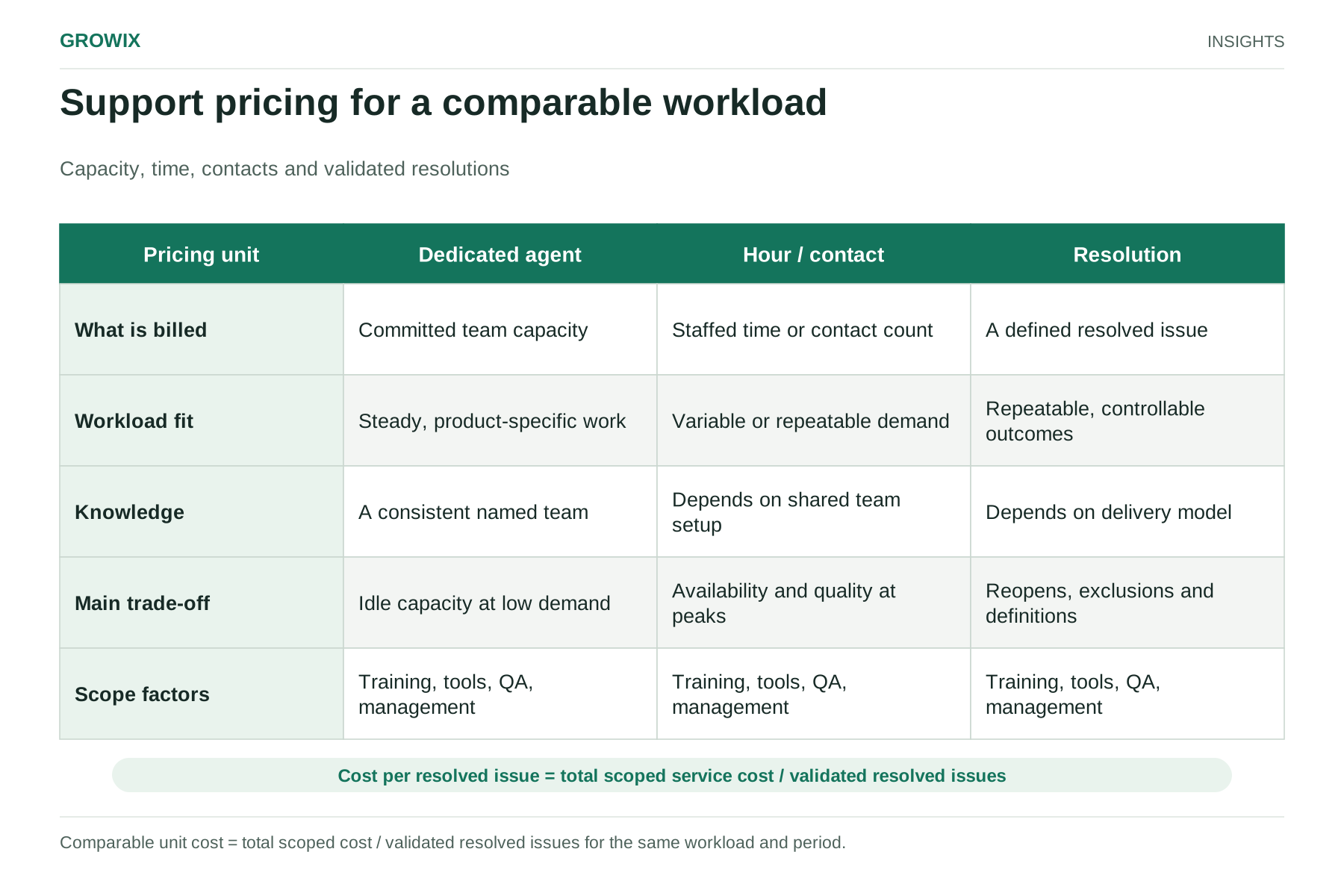
Cost per contact flatters any channel that deflects customers without solving their problem. Use cost per resolved issue instead: the total cost of the support system divided by the number of issues actually resolved, counting repeat contacts.
Reference figures
Hypothetical model
The following figures are assumptions for illustration, not benchmarks or Growix pricing. A business handles 10,000 customer issues a month.
Human cost per contact. Starting from the BLS median wage and dividing by 0.70 for benefits gives about $30.76 per hour. Adding 25% for tools, supervision, training and facilities gives $38.45. At 75% occupancy, each hour of actual handling costs about $51.26. With an average handling time of 8 minutes, that is about $6.83 per contact.
All-human model. If each issue takes 1.25 contacts on average to resolve, 10,000 issues need 12,500 contacts, costing about $85,375, or $8.54 per resolved issue.
Hybrid model. Suppose AI fully resolves 45% of issues (4,500) at $0.99 each, or $4,455, and maintaining the AI's knowledge, testing and quality reviews costs $3,000 a month. The remaining 5,500 issues go to human agents at the same 1.25 contacts each, costing about $46,956. The total is about $54,411, or $5.44 per resolved issue, about 36% lower.
The quality adjustment. Now suppose 10% of the AI's "resolutions" were not really resolved, and those 450 customers come back to a human. That adds about $3,842, raising the cost to $5.83 per resolved issue, and it adds customer frustration that does not appear in the cost model. Gartner's research found that only 27% of customers would try a chatbot again after a negative experience.
The lesson: the hybrid model can reduce costs substantially, but the savings depend on genuine resolution, and measurement must catch false resolutions.
Design clear human escalation
The handoff is where hybrid support succeeds or fails. Design it deliberately:
Escalation triggers. The customer asks for a person; the AI's confidence is low; the topic is on a sensitive list such as complaints, security, legal threats, bereavement or vulnerability; the customer repeats themselves or sentiment deteriorates; the AI cannot complete an action.
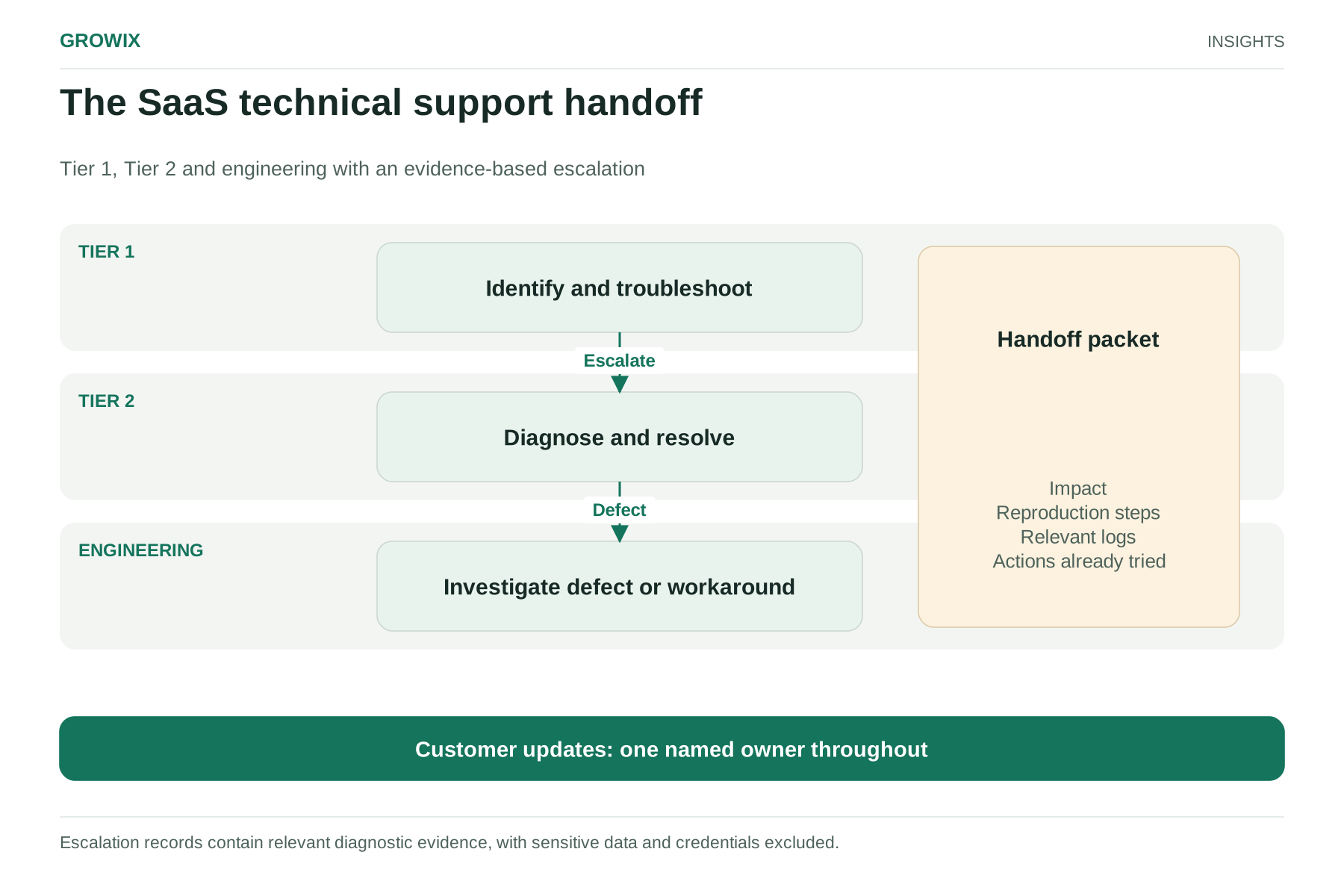
Context transfer. The agent receives the conversation, the customer's details, what the AI checked and what it attempted. The customer never has to repeat the problem.
Honest routing. Tell customers when they are talking to AI, give them a visible way to reach a person and tell them the expected wait.
Ownership after handoff. Once a person takes over, they own the issue to resolution; the AI should not re-engage unexpectedly.
Feedback loop. Agents flag where the AI went wrong, and those cases feed into knowledge updates and testing.
Staff expectations matter too. In a Gartner survey of 321 customer service leaders in October 2025, only 20% had reduced agent staffing because of AI, and Gartner predicted that half of companies that cut staff because of AI would rehire for similar work by 2027. Plan for human agents handling harder, more varied work, not disappearing.
What AI support needs to work well
AI agents are only as good as the information and systems behind them. Before expanding AI handling, check:
- Knowledge quality. Help articles and internal guidance must be current, specific and consistent. Conflicting articles produce conflicting answers.
- System access. To resolve rather than merely answer, the AI needs safe, limited access to order, account or ticket data, with actions restricted to what each request type requires.
- Policies in machine-readable form. Refund rules, eligibility criteria and exceptions should be explicit enough for rules or the AI to apply consistently.
- Testing. A set of real past conversations, including difficult ones, run before every significant change.
- Ownership. Someone in the support team owns the AI's performance, knowledge updates and weekly quality review.
Without these, AI tends to deflect rather than resolve, which shows up later as repeat contacts and complaints.
Where outsourced human support fits
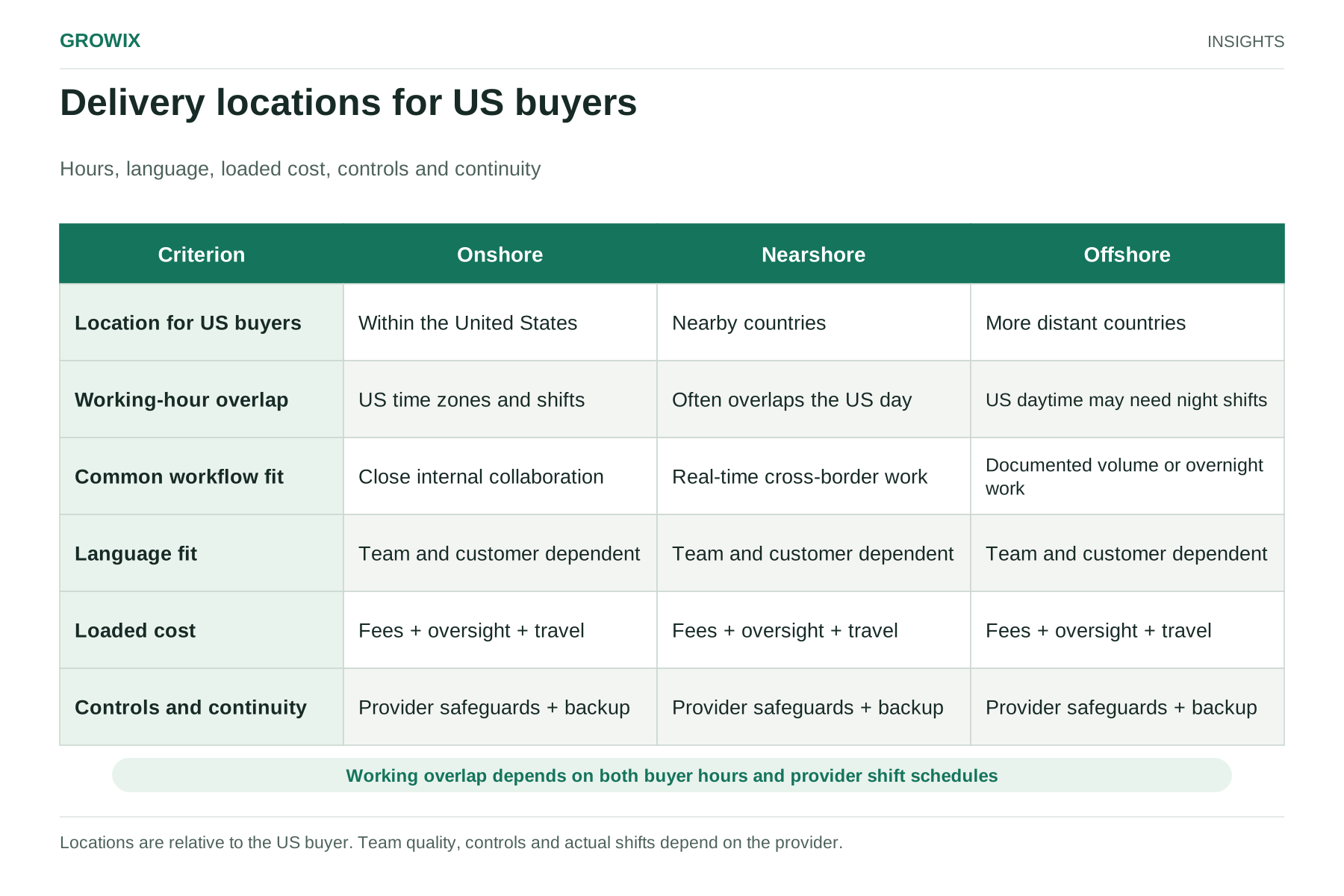
Hybrid models still need human agents, and many businesses use an outsourcing partner for some or all of that capacity. The design questions are the same as for an internal team: which segments the human team owns, how handoffs arrive, which tools agents use and how quality is measured. Make sure the provider's agents can see the AI conversation history, are trained on the escalation categories they will receive, and feed back cases where the AI failed. Contracts should reflect that human agents will handle a higher share of complex contacts once AI takes simpler ones, which usually raises average handling time per human contact even as total volume falls.
Measure the hybrid system as a whole
| Measure | Why it matters |
|---|
| Resolution rate by segment and channel | Shows where AI and humans actually solve problems |
| Repeat contacts within seven days | Catches false resolutions |
| Escalation rate and reasons | Shows where AI hits its limits |
| Customer satisfaction for AI-only and escalated contacts | Reveals whether handoffs damage experience |
| Time to resolution, including after escalation | Customers judge the whole journey |
| Cost per resolved issue | The economic comparison that matters |
| Agent workload and attrition | Harder contact mix can increase stress |
Review these monthly, and look at a sample of actual conversations as well as the numbers.
Common mistakes
- Optimizing for deflection rather than resolution.
- Hiding the route to a person, which raises frustration and complaint volumes.
- Launching AI across every contact type at once, instead of proving it on a few.
- Ignoring the change for human agents, who now handle a more difficult mix and need training and support.
Choose using quality and customer effort
Use these criteria to choose the balance for each segment:
| Criterion | Questions to ask |
|---|
| Resolution quality | Does the AI resolve the issue correctly, verified by sampling and repeat-contact rates? |
| Customer effort | How many steps, repeats and channel switches does a customer need? |
| Risk | What happens if the answer is wrong, and would you detect it? |
| Speed | Does the customer get help faster, including after escalation? |
| Cost per resolved issue | Including AI fees, maintenance, human handling and repeat contacts |
| Brand and relationship | Does this contact type build or damage loyalty? |
When each model fits
AI-led fits businesses with simple products, high volumes of repetitive questions, low cost of error and customers comfortable with self-service.
Human-led fits high-value relationships, complex or regulated products, emotionally sensitive situations and low volumes where automation would not pay back.
Hybrid fits most businesses with a mix of simple and complex contacts.
When Growix may not be the right fit: if your contacts are almost entirely simple and well documented, and your helpdesk platform already includes a capable AI agent, configuring that platform yourself may be the most economical route. Growix's support services provide human agents, who can work alongside the AI tools you choose.
Transparency, data and compliance
Hybrid support raises practical governance questions. Decide how you disclose AI use to customers, what customer data the AI may access, how long conversation logs are kept and who can review them. Some sectors and jurisdictions have specific rules on automated decisions, recorded communications or disclosures, so involve legal and compliance colleagues before AI handles anything involving payments, credit, health or personal data. Keep an audit trail of AI actions, not just messages, so you can explain any outcome to a customer or regulator. These steps take little time when designed up front and a great deal of time when retrofitted after a complaint.
Frequently asked questions
Will AI replace customer service agents?
For most businesses, not entirely. AI handles high-volume, low-risk requests well when it can check answers against your data, but complex, sensitive and high-value situations still need people, and many customers expect a route to a person. Most businesses end up with a hybrid team.
How do you compare the cost of AI and human customer service?
Use cost per resolved issue rather than cost per contact, because a channel that deflects customers without solving their problem creates repeat contacts elsewhere. Include knowledge maintenance, quality review and the cost of escalations in the AI side of the comparison.
When should an AI agent hand off to a person?
When the customer asks for a person, the AI's confidence is low, the topic is on a sensitive list such as complaints, legal threats or vulnerable customers, or the request exceeds what the AI is allowed to do. The handoff should pass the full conversation and what the AI already checked.
How to start
- Classify the last three months of contacts by reason, complexity and risk.
- Measure the current cost per resolved issue and repeat-contact rate.
- Pick one or two low-risk, high-volume reasons for AI handling, with clear escalation triggers.
- Sample AI conversations weekly and track false resolutions.
- Expand only when quality holds, and revisit the balance every quarter as products, policies and customer expectations change.
If you are also deciding how to price human support from a provider, our guide to outsourced customer support pricing compares per-agent, per-hour and per-resolution models.
Growix's Customer Support Outsourcing service provides email, chat and phone support to your standards, and our Technical Support Outsourcing team handles Level 1 and Level 2 technical support with escalation to your engineers.
Discuss your outsourcing requirements