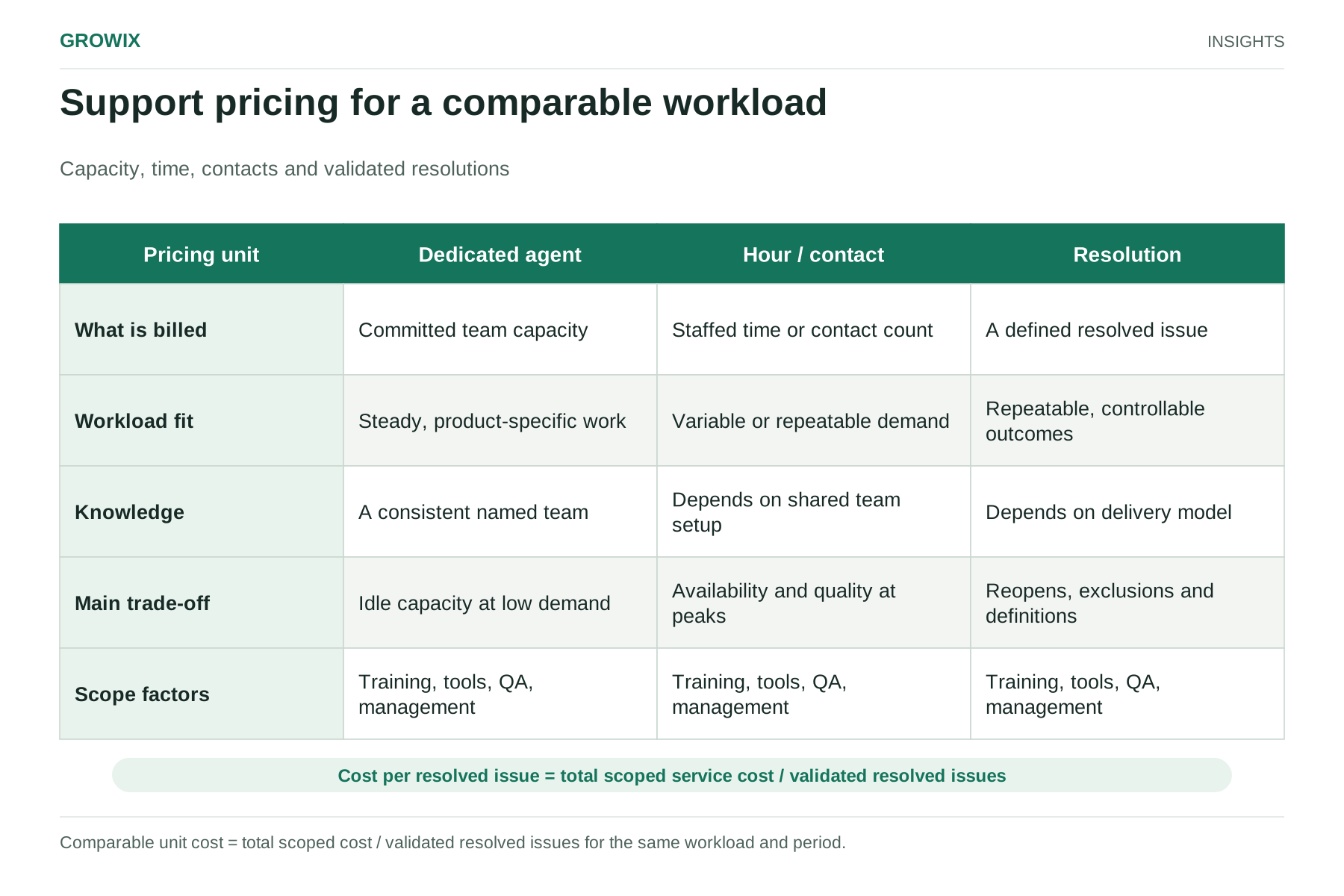
The short answer: customer service outsourcing cost depends heavily on the pricing model. Dedicated per-agent pricing usually suits steady, predictable volumes where you want a consistent team that knows your product. Per-hour pricing suits workloads that vary by season or day, provided the provider can flex staffing. Per-contact and per-resolution pricing suit well-defined, repeatable contacts where you want to pay for output and the provider can control efficiency. Many contracts combine models, for example a dedicated core team with per-hour or per-contact overflow for peaks. The total customer support outsourcing cost depends as much on what is included, and on how "resolved" is defined, as on the headline rate.
This guide defines the pricing units, compares dedicated, shared and outcome-based models, lists the costs that sit outside the rate, and models three workloads with explicit assumptions.
Define the pricing units
Per agent (dedicated). You pay a monthly fee for each full-time agent assigned to your account. The agents work only on your customers, learn your product deeply and follow your processes. You pay whether contact volume is high or low.
Per hour. You pay for agent hours, either dedicated or shared with other clients. Check whether billing covers logged-in hours or only productive hours, and how breaks, training and meetings are treated.
Per contact or per ticket. You pay a fixed price for each contact handled, sometimes varying by channel. Some providers bill per minute for phone. The provider absorbs inefficiency, so prices typically include a margin for that risk.
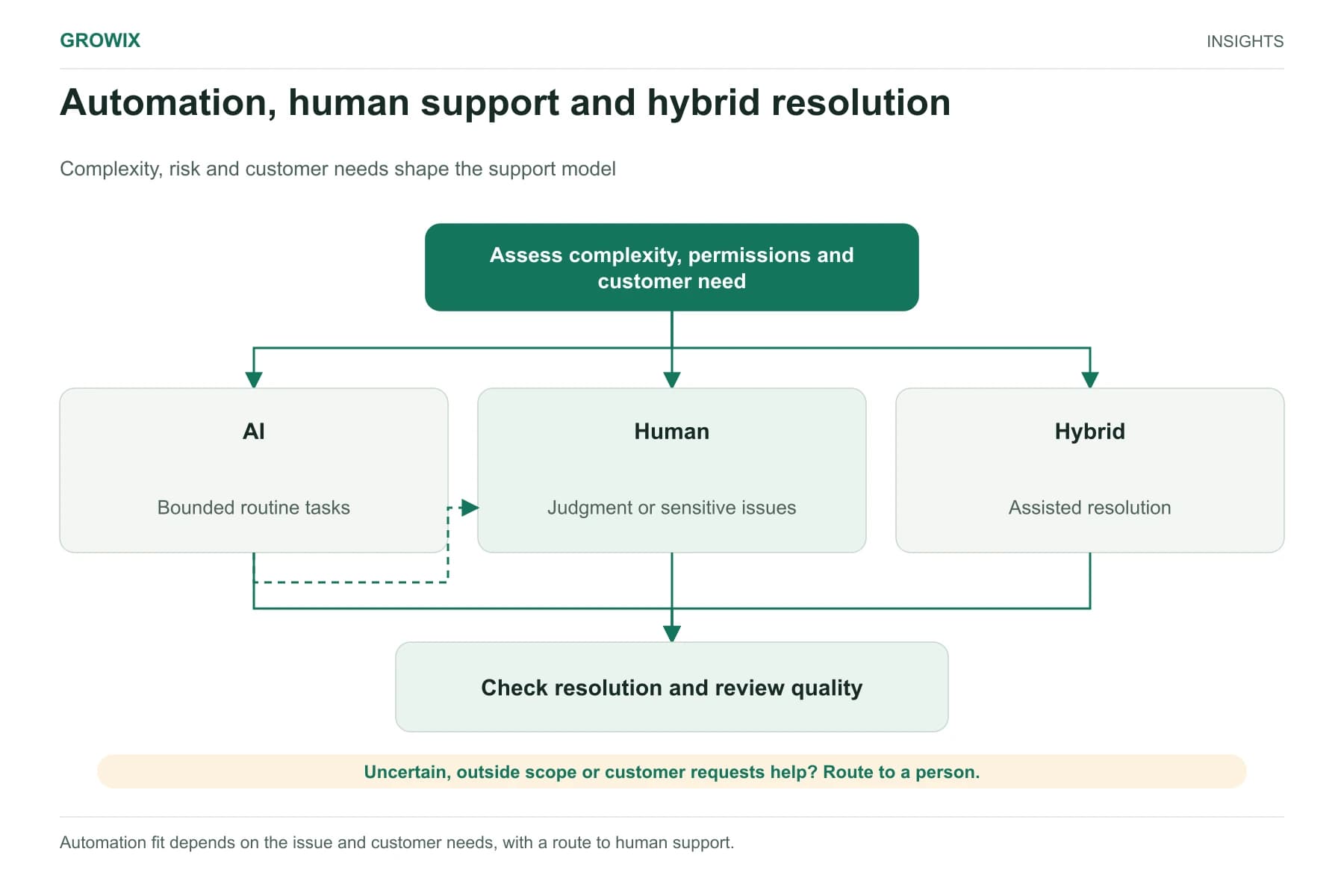
Per resolution or per outcome. You pay only when an issue is resolved according to an agreed definition. This model is common for AI agents and is appearing in human support for well-defined contact types.
Hybrid and performance-linked. A base fee plus bonuses or penalties tied to service levels, quality scores or customer satisfaction.
Agree what counts as resolved
If any part of the price depends on resolution, the definition is the contract. Agree in writing:
- The resolution test: for example, no repeat contact on the same issue within seven days, or customer confirmation, or a ticket closed without reopening within a set period.
- Exclusions: issues that require your team, such as refunds above a limit or product defects, should not count against the provider, and should not be billed as resolved.
- Partial resolutions: whether a correct escalation with complete information counts.
- Audit rights: your right to sample tickets and challenge billed resolutions.
- Disputes: how disagreements are settled, and within what time.
A loose definition rewards closing tickets rather than solving problems. As a dated example of outcome pricing in AI support, Intercom's pricing page listed its Fin AI agent at $0.99 per outcome on October 27, 2026; the page itself does not define the outcome, which illustrates why definitions need checking in the contract.
Compare dedicated, shared and outcome models
| Factor | Dedicated per agent | Shared per hour or per contact | Per resolution or outcome |
|---|
| Cost predictability | High: fixed monthly cost | Moderate: varies with volume | Varies with resolved volume |
| Flexibility for peaks | Low unless contract allows ramping | High if provider has capacity | High |
| Product knowledge | Highest | Lower; agents serve several clients | Depends on provider model |
| Quality control | Direct; you know the team | Harder; shared agents | Strong incentive to resolve, but risk of gaming definitions |
| Best for | Steady volume, complex products, brand-sensitive service | Variable volume, simpler contacts | Well-defined contact types |
| Watch for | Paying for idle capacity | Inconsistent quality, rate creep on overtime | Narrow definitions, cherry-picking easy contacts |
Two quotes with similar rates can differ widely in total cost. Ask what each includes:
- Onboarding and training: initial training hours, ongoing training for product releases, and whether they are billed.
- Tools and licenses: helpdesk seats, telephony, workforce management, quality software. Who provides them and who pays.
- Management ratio: how many agents each team lead supervises, and whether team leads, quality analysts and workforce planners are billed separately.
- Quality assurance: how many interactions are reviewed, against which scorecard, and how results are reported.
- Coverage premiums: nights, weekends, public holidays and additional languages.
- Minimums and commitments: minimum monthly hours or agents, notice periods for scaling down, and volume bands.
- Reporting: standard reports, custom dashboards and access to raw data.
- Security and compliance: background checks, data protection controls and any certifications your contracts require.
Model three workloads with explicit assumptions
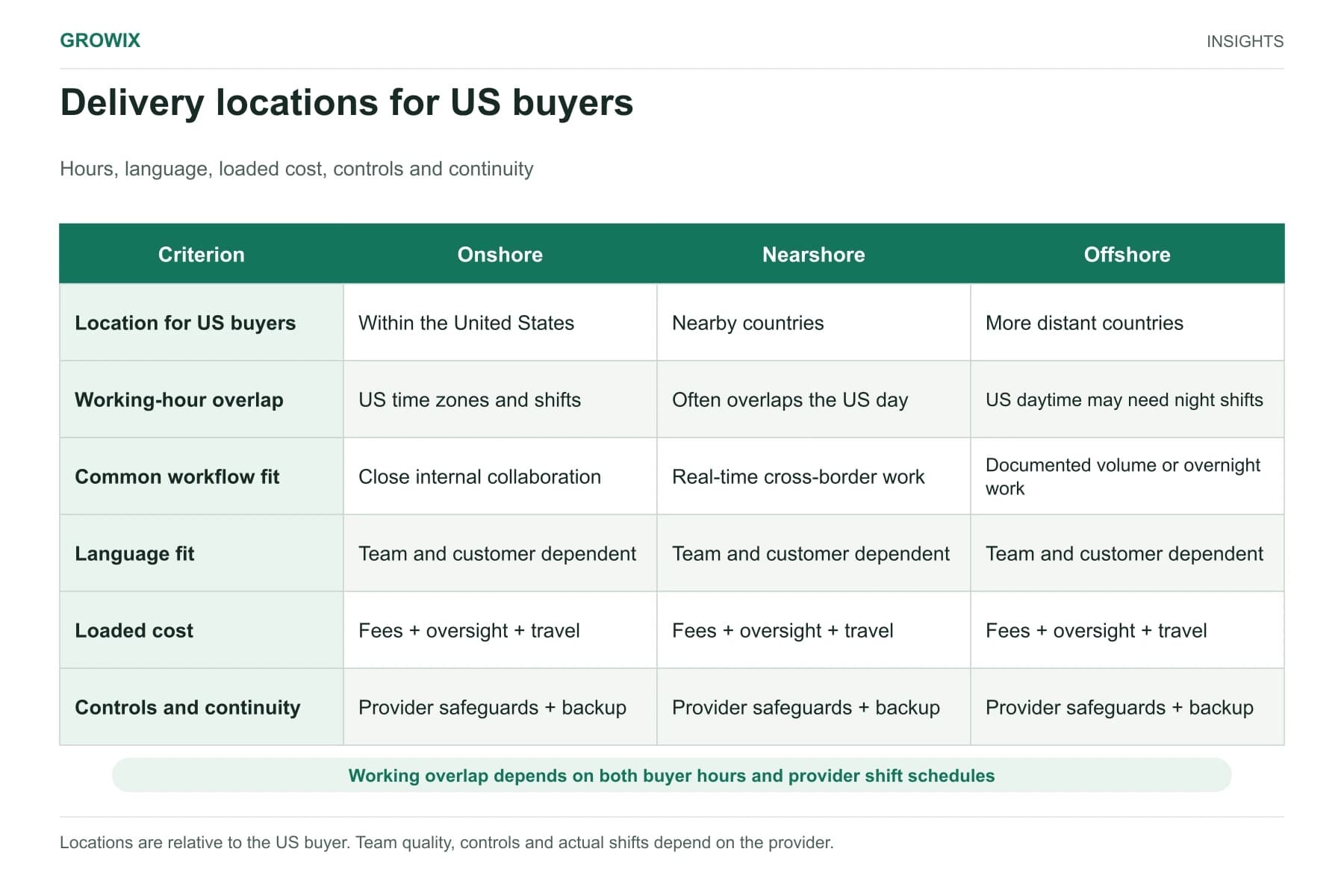
The scenarios below use invented rates purely to show how the models behave. They are not market quotes or Growix pricing. Rates vary widely by location, language, channel, complexity and contract length. For a US reference point, the Bureau of Labor Statistics reports a median wage of $21.53 an hour for customer service representatives in May 2025; provider rates add benefits, management, facilities, tools and margin, and differ substantially by delivery location, as our guide to offshore vs nearshore vs onshore outsourcing explains.
Assumed rates for all scenarios: dedicated agent $3,200 a month; shared hours $20 an hour; per contact $4.50; per resolution $7.00; each dedicated agent provides about 160 productive hours a month.
Workload A: steady e-commerce email and chat
6,000 contacts a month, 7 minutes average handling time, 75% occupancy.
- Handling time: 700 hours. Staffed hours needed: about 933, or 5.8 agents.
- Dedicated: 6 agents × $3,200 = $19,200 a month.
- Per hour: 933 hours × $20 = about $18,667 a month.
- Per contact: 6,000 × $4.50 = $27,000 a month.
- Per resolution: if each issue takes 1.2 contacts, 5,000 resolutions × $7 = $35,000 a month.
With steady volume and efficient handling, paying for capacity is cheapest. Output-based models cost more because the provider prices in the risk of variation.
Workload B: seasonal retail with a holiday peak
3,000 contacts a month for ten months, 9,000 a month in November and December, so 48,000 a year. Same handling time and occupancy.
- Dedicated, sized for peak: about 9 agents all year, 9 × $3,200 × 12 = $345,600 a year.
- Dedicated core plus seasonal ramp: 3 agents all year ($115,200), plus 6 extra agents for two months ($38,400) and an assumed $1,500 training fee per seasonal agent ($9,000) = $162,600 a year.
- Per hour, fully flexible: about 7,467 staffed hours × $20 = about $149,333 a year.
- Per contact: 48,000 × $4.50 = $216,000 a year.
Seasonality makes flexibility valuable. A dedicated team sized for the peak wastes most of its cost; a core team with seasonal ramp or flexible hours is far cheaper, provided the provider can actually supply trained people for the peak.
Workload C: low-volume SaaS technical support
800 tickets a month, 25 minutes average handling time, 70% occupancy.
- Handling time: about 333 hours. Staffed hours: about 476, or 3 agents.
- Dedicated technical agents at an assumed $4,200 a month: 3 × $4,200 = $12,600 a month.
- Per ticket at an assumed $15: 800 × $15 = $12,000 a month.
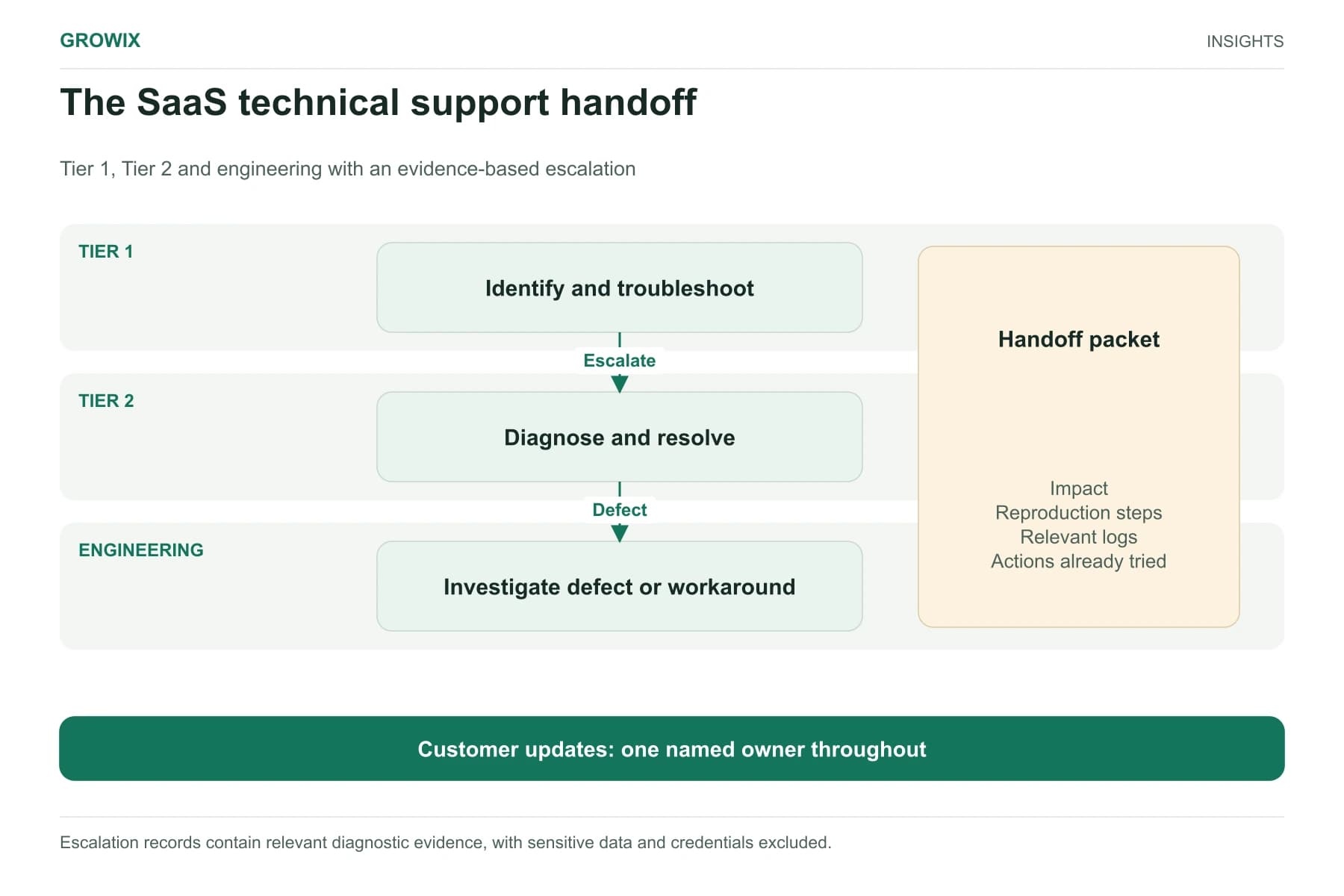
- Per resolution: usually unsuitable, because many technical tickets need your engineers to fix defects, which the provider cannot control.
For complex, low-volume work, the price difference between models is small; product knowledge and escalation quality matter far more. A dedicated team usually builds that knowledge faster. Our guide to SaaS technical support outsourcing covers the handoff design.
Blended structures that often work
Real contracts rarely use one model for everything. Common blends include:
- Dedicated core plus flexible overflow: a stable team handles normal volume and complex contacts; per-hour or per-contact capacity absorbs peaks and after-hours demand.
- Dedicated team with a performance component: a fixed base fee, with a modest bonus or credit linked to quality scores, customer satisfaction or resolution rates.
- Channel-specific pricing: dedicated agents for phone and chat, where real-time service matters, and per-ticket pricing for email backlogs.
Blends work best when each component has its own scope and reporting, so you can see what each part of the spend delivers.
Contract terms that change cost over time
The first-year price is only part of the story. Check:
- Annual rate increases: whether rates rise by a fixed percentage, an index or by negotiation.
- Currency: for providers outside the United States, whether prices are fixed in US dollars or exposed to exchange-rate changes.
- Volume bands: whether per-contact prices step up when volume falls below a band, and step down when it rises.
- Ramp and scale-down notice: how much notice is needed to add or remove agents, and whether ramp training is charged.
- Service credits: whether missed service levels reduce the invoice, and by how much.
- Term and termination: minimum term, renewal terms and the cost of leaving early, including knowledge transfer back to you or a new provider.
Red flags in a quote
- A low hourly rate with high minimum hours or long commitment periods.
- No clear statement of what is included in training, tools and quality assurance.
- Per-resolution pricing without a written, auditable resolution definition.
- Service levels without reporting on how they are measured.
- Vague answers about where agents are located, how they are employed and how customer data is protected.
Making a pilot meaningful
Many providers offer a pilot period. Use it to test the assumptions that drive cost: actual handling times on your contacts, quality scores against your scorecard, escalation accuracy and the provider's ability to staff to forecast. Agree the pilot's measures and decision date in advance, and compare results with your own team's baseline on the same contact types. A pilot that only proves agents can log in and answer easy questions tells you little about the full contract.
How to choose
- Measure your workload: monthly and daily volume patterns, handling time by contact type, channel mix and hours of coverage.
- Classify contacts by complexity and how well they are documented.
- Match models to segments: dedicated for complex or brand-sensitive work; flexible hours or per-contact for variable, simpler work; outcome pricing only where resolution can be defined and audited.
- Request quotes on the same basis, using your volumes and the inclusion checklist above.
- Model total annual cost under realistic, low and high volume scenarios.
- Check the contract for minimums, ramp notice, quality commitments and exit terms.
When Growix may not be the right fit: if you need fewer than one full-time agent's worth of coverage, or only occasional after-hours cover for a handful of contacts, a shared-service or answering-service provider may be more economical than a dedicated team.
Frequently asked questions
How much does it cost to outsource customer service?
It depends on the pricing model, location, skills, hours of coverage and your contact volumes. Providers price per dedicated agent, per hour, per contact or per resolution, and two quotes with similar rates can differ widely once training, tools, quality assurance and management are included. Model each quote against your own workload.
Which customer service pricing model is best?
Per-agent pricing usually suits steady volumes and a consistent team, per-hour pricing suits seasonal or variable workloads, and per-contact or per-resolution pricing suits well-defined, repeatable contacts with a tight definition of resolved. Many contracts blend a dedicated core with flexible overflow.
What should be included in an outsourced customer service quote?
Check onboarding and ongoing training, team leads and quality analysts, workforce planning, reporting, tools and licenses, after-hours premiums, minimum commitments, annual rate increases and notice periods. Ask how each is priced, not just the headline agent rate.
Next step
Export three to twelve months of contact data and calculate volume, handling time and seasonality by contact type. With that, any provider can quote accurately, and you can compare models on total cost rather than headline rates. If AI is part of your plan, see AI customer support vs human agents vs a hybrid team for how the split affects human workload and cost.
Growix's Customer Support Outsourcing service delivers email, chat and phone support to your tone, policies and service levels, and our Technical Support Outsourcing team provides Level 1 and Level 2 technical support with escalation to your engineers. If missed calls and inconsistent service differ by location, see customer journey mapping for multi-location businesses.
Discuss your outsourcing requirements