SaaS Technical Support Outsourcing: Building a Tier 1 and Tier 2 Handoff Process
Outsourced support succeeds or fails at the handoffs. Define what each tier owns, share access and knowledge safely, set escalation and incident rules, then audit quality and engineering load.
For a growing SaaS company, technical support often starts with engineers answering tickets between releases. That works until it does not: response times slip, engineers lose focus, and customers in other time zones wait overnight. Outsourcing first- and second-line technical support can fix that, but only if the handoffs between the outsourced team and your own engineers are designed carefully. Poor handoffs produce the worst of both worlds: customers repeat themselves, engineers still receive vague tickets, and nobody owns the outcome.
This guide covers how to define support tiers and ownership, share system access and knowledge safely, specify handoff and incident criteria, and audit resolution quality and engineering load.
Step 1: Define support tiers and ownership
Tier names vary between companies. What matters is that everyone agrees what each tier owns and where it stops.
Tier
Typical scope in a SaaS company
Usually owned by
Tier 0: self-service
Help center, in-app guidance, status page, community
Product, support operations
Tier 1
Triage, how-to questions, account and billing administration, known issues with documented fixes, gathering diagnostic information
Outsourced or internal support team
Tier 2
Deeper troubleshooting: reproducing problems, reviewing logs and configuration, integration and data issues, workarounds
Outsourced technical team or internal specialists
Tier 3
Product defects, code changes, infrastructure problems, data repairs
Your engineering team
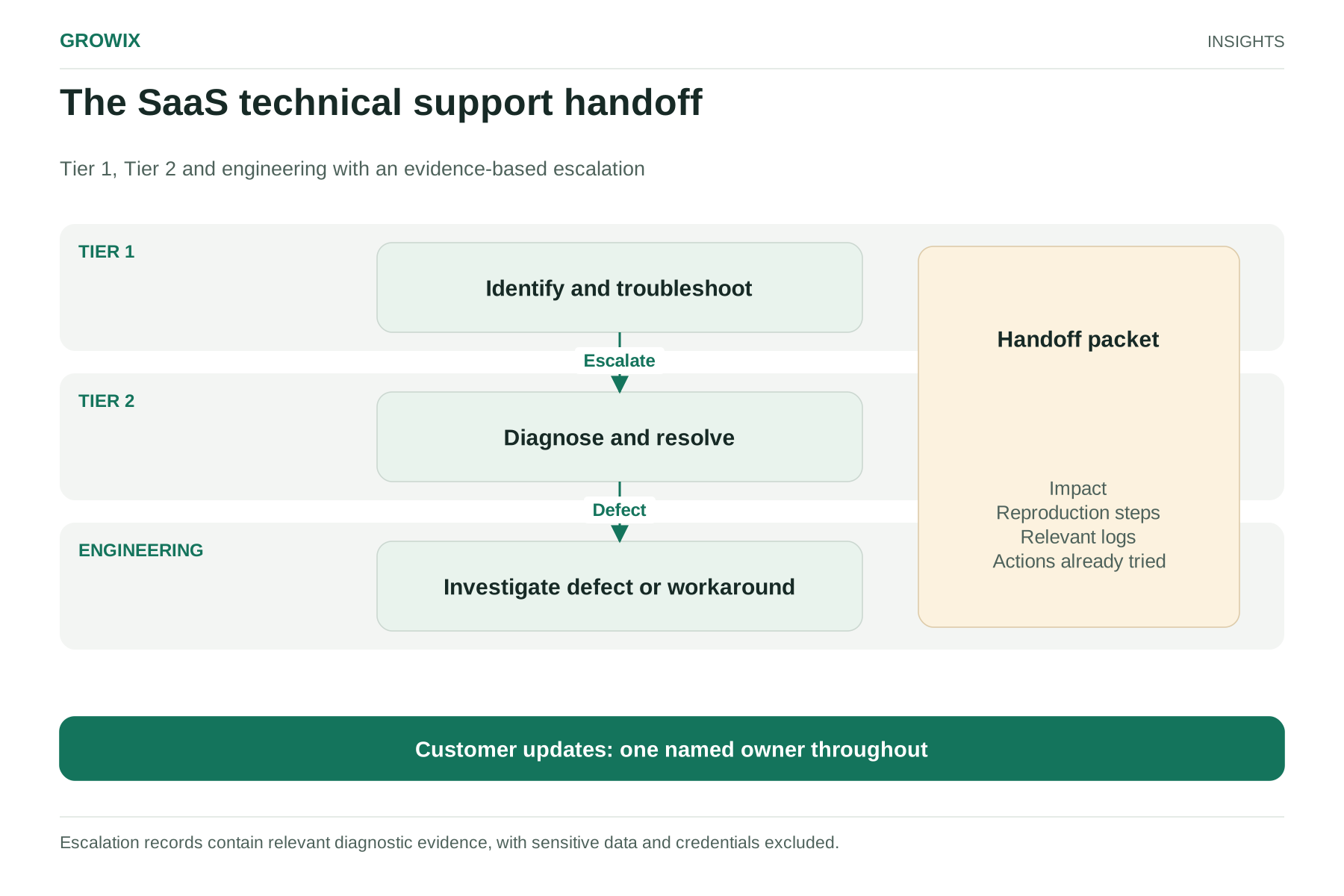
Tier 1 vs Tier 2 support is the boundary most outsourcing arrangements are built around. Tier 1 resolves what can be resolved with documented knowledge and standard tools. Tier 2 investigates what is not documented, using deeper access and product knowledge, and either resolves it or prepares a clean escalation for engineering.
Write down the ownership rules explicitly:
Who owns the ticket end to end? Many SaaS companies keep ticket ownership with the support tier that first responded, even when engineering is working on the fix, so the customer has one point of contact.
What can each tier change? For example, Tier 1 may reset passwords and update billing contacts; Tier 2 may adjust configuration with the customer's consent; only engineering may modify data.
What is out of scope for outsourced tiers? Security incidents, legal requests, refunds above a threshold and contract changes often stay internal.
Step 2: Share access and knowledge safely
Technical support needs access to customer accounts and diagnostic tools. That access is also a security and privacy risk. Design it deliberately:
Role-based access in admin tools: create support roles with only the permissions each tier needs. Avoid shared administrator accounts.
Single sign-on and multi-factor authentication for every support tool, tied to individual identities that can be revoked immediately.
Customer impersonation with consent and logging: if agents can view the product as the customer sees it, require consent where appropriate, restrict it by role and log every session.
No direct production database access for outsourced tiers; provide read-only diagnostic views or tools instead.
Masking of sensitive data in logs and tools wherever possible.
Device and location requirements agreed with the provider, including secure devices and policies on where work can be done.
Joiner and leaver process: access granted on a named basis and removed the same day someone leaves the account.
Knowledge needs the same care. Methods such as Knowledge-Centered Service (KCS), maintained by the Consortium for Service Innovation, treat knowledge as a by-product of solving customer issues: agents capture and improve articles as they resolve tickets, so the knowledge base grows from real problems. Whatever method you use, give outsourced agents the right to create and flag articles, not just read them, and review new articles regularly with your product experts.
Step 3: Specify handoff and incident criteria
Escalation criteria
Define when a ticket moves from Tier 1 to Tier 2, and from Tier 2 to engineering. Common triggers:
Tier 1 to Tier 2: no documented solution exists; reproduction or log review is needed; the issue involves integrations, data imports or configuration; the customer's plan or contract specifies a higher service level.
Tier 2 to engineering: the problem is reproducible and appears to be a defect; it requires a code, infrastructure or data change; several customers report the same new problem.
A standard escalation template
Engineers lose hours to escalations that lack basic information. Require a template before a ticket can move to engineering:
Field
Example
Customer, plan and environment
Account ID, plan tier, region, browser or API client
Summary
One sentence describing the problem
Steps to reproduce
Numbered steps, with test account details where possible
Number of users affected, business impact, any deadline
Workaround
Offered and accepted, or none available
Severity
Using the agreed severity definitions
If an escalation arrives without the required fields, engineering returns it. Track that bounce-back rate; it is one of the clearest measures of handoff quality.
Severity and incident definitions
Agree severity levels with example targets. The figures below are illustrations; set your own based on contracts and capacity.
Severity
Definition
Example response expectation
Severity 1
Service unavailable or data at risk for many customers
Immediate escalation to on-call engineering; status page update
Severity 2
Major feature broken or degraded with no workaround
Escalation within the same business day; engineering acknowledgment set by agreement
Severity 3
Feature impaired with a workaround available
Normal queue; scheduled into engineering work
Severity 4
Question, minor issue or feature request
Resolved in support or logged for product review
For Severity 1 incidents, support's role is to detect patterns quickly, escalate through the incident process, communicate with customers using approved messages and avoid duplicate investigations. Make sure the outsourced team knows how to recognize an incident, often from a sudden cluster of similar tickets, and has authority to trigger the incident process.
The SaaS technical support handoff. Escalation records contain relevant diagnostic evidence, with sensitive data and credentials excluded. View full size
Onboarding an outsourced support team
Technical support depends on product knowledge that takes time to build. Plan a structured ramp rather than a switch-over:
Product training: core workflows, common configurations, integrations and the data model at the level agents need.
Shadowing: outsourced agents observe your current team handling live tickets, then handle tickets with review before sending.
Graduated scope: start with the most documented contact reasons, then add categories as quality scores meet the agreed bar.
Named experts: give the provider a named product specialist for questions during the first months, with agreed response times.
Regular calibration: weekly ticket reviews between your support lead and the provider's team lead in the early period.
Expect quality to dip slightly during the ramp. Agree in advance what level triggers a pause in adding scope.
Common failure modes
Outsourcing undocumented knowledge. If answers live only in engineers' heads, the provider cannot resolve tickets, and escalation rates stay high.
Ownership gaps. Tickets bounce between the provider and engineering without anyone updating the customer.
Over-restricted access. Agents who cannot see enough to diagnose problems escalate everything; balance security with the access needed to do the job, using logging rather than blanket denial.
Measuring speed only. Fast responses that do not solve problems increase reopen rates and frustrate customers.
Covering more hours
Customers in other time zones may need help outside your engineers' working day. Options include an outsourced team covering evenings and weekends, a follow-the-sun model across regions, or 24/7 Tier 1 coverage with engineering on call only for Severity 1. The more hours the outsourced team covers alone, the more important clear runbooks, documented workarounds and the authority to declare incidents become.
Step 4: Audit resolution quality and engineering load
Measure the support system as a whole, not just the provider's response times:
Measure
What it shows
First response time and resolution time by tier
Speed against agreed levels
First-contact resolution rate at Tier 1
Whether documented knowledge is sufficient
Escalation rate from Tier 1 to Tier 2, and Tier 2 to engineering
Whether tiers are working at the right depth
Escalation bounce-back rate
Quality of escalations
Reopen rate
Whether problems were really solved
Customer satisfaction by tier and contact reason
Customer experience
Quality review scores
Accuracy, tone and process compliance from sampled tickets
Engineering hours spent on support
Whether outsourcing is protecting engineering time
New knowledge articles created and used
Whether knowledge is improving
Review these monthly with the provider, and hold a deeper quarterly review that covers trends in contact reasons. Recurring contact reasons are product feedback: they belong in your product team's planning.
Hypothetical example: designing the split
The following scenario is invented for illustration and shows a design, not results.
A B2B SaaS company with customers in North America and Europe receives about 3,000 tickets a month. Most are how-to and account questions, about a fifth involve integrations or data imports, and a small share are genuine defects. Engineers currently handle anything beyond basic questions.
The company outsources Tier 1 for extended hours and a small Tier 2 team for integration and configuration issues, keeping ticket ownership with support. It creates two support roles in its admin console, adds logged impersonation, writes escalation and severity definitions, and requires the escalation template before engineering accepts a ticket. Engineering commits to acknowledging Severity 2 escalations within an agreed time. After the first quarter, the company will review escalation rates, bounce-backs and engineering hours spent on support to decide whether Tier 2 should take on more.
Responsibilities
Head of support: tier definitions, provider management, quality and knowledge.
Engineering lead: escalation acceptance, severity process, incident response and fixes.
Security: access design, audits and incident handling for any security issue.
Product: knowledge accuracy, recurring issue review and roadmap decisions.
Provider team lead: staffing, training, quality and reporting.
Frequently asked questions
What is the difference between Tier 1 and Tier 2 support?
Tier 1 resolves issues that have a documented answer: how-to questions, known issues, account and configuration basics. Tier 2 investigates problems that need reproduction, log review, integration or data troubleshooting, and escalates confirmed defects to engineering with a complete template.
Should a SaaS company outsource technical support?
Outsourcing Tier 1, and sometimes part of Tier 2, works well when answers are documented, access can be limited by role and escalation criteria are clear. Keep product-critical diagnosis and incident command close to engineering, and outsource undocumented knowledge only after writing it down.
How long does it take to onboard an outsourced technical support team?
Plan a structured ramp rather than a switch-over: product training, shadowing, handling simple ticket types under review, then adding scope as quality holds. Expect quality to dip slightly during the ramp and agree in advance what level pauses further expansion.
Next steps
Pull the last three months of tickets and classify them by tier and reason. That analysis shows how much could move to an outsourced Tier 1 and Tier 2, what knowledge and access they would need, and how much engineering time is at stake.