Offshore vs Nearshore vs Onshore Outsourcing: Comparing Cost, Time Zones and Service Quality
Location changes more than the hourly rate. Compare loaded cost, working-hour overlap, language and culture fit, data handling and supervision, then score providers by work type.
The short answer: for US businesses, offshore delivery usually offers the lowest rates and suits high-volume, well-documented work, including overnight coverage. Nearshore delivery costs more than offshore but offers working hours that overlap with the US, which suits time-sensitive, collaborative or customer-facing work. Onshore delivery costs most and suits work with strict data, regulatory or cultural requirements, or where customers expect a local presence. The right choice depends on the type of work more than on the rate card, and many companies use more than one location.
Define the delivery models from a US perspective
Onshore: the provider's team works in the United States.
Nearshore: the team works in a nearby country with similar time zones, commonly in Latin America or the Caribbean, and sometimes Canada.
Offshore: the team works in a distant country, commonly in Asia, Eastern Europe or Africa, often with large time differences.
Hybrid or multi-shore: a provider combines locations, for example offshore for overnight and back-office work, nearshore for daytime customer contact and onshore for escalations.
Recent survey data shows many finance leaders weighing these options. Grant Thornton's 2026 analysis of outsourcing and AI, published by its outsourcing practice and citing its first-quarter 2026 CFO survey, reported that 64% of CFOs were implementing or evaluating offshoring or nearshoring, while 36% planned to remain fully US-based. Respondents ranked the ability to support complex processes (96%) and talent availability (94%) as the most important factors when choosing locations. The same analysis described offshore hubs as suited to high-volume transactional work and nearshore teams as suited to time-sensitive, high-touch work that benefits from real-time collaboration.
Compare loaded costs, overlap and language needs
Time-zone overlap
Time differences shape what each model can do well:
Location example
Difference from US Eastern time
Practical implication
Colombia
Same as Eastern standard time; one hour behind during US daylight saving time
Near-full overlap with US business hours
Mexico City
One hour behind Eastern standard time; two hours behind during US daylight saving time
Near-full overlap with US business hours
India
10.5 hours ahead (9.5 during US daylight saving time)
US daytime coverage requires night shifts; natural fit for overnight work
Philippines
13 hours ahead (12 during US daylight saving time)
US daytime coverage requires night shifts; natural fit for overnight work
Many offshore teams work US hours on night shifts, and providers are experienced at running them. Night shifts can affect attrition and supervision, though, so ask how providers manage them.
Overlap also matters for your own team, not only for customers. Daily handoffs, live coaching, calibration sessions and quick questions to your product or finance staff all depend on shared working hours. If the outsourced work needs frequent input from your people, count the overlap hours you will realistically have, not just the customer coverage hours.
Loaded cost, not hourly rate
Compare the full cost of each option, including your own oversight effort:
Provider rates for agents, team leads, quality analysts and workforce planners.
Your oversight time: managers who brief, review and calibrate with the provider. Greater distance and time difference usually require more structured oversight.
Travel for onboarding, calibration and relationship reviews.
Ramp and attrition costs: training time lost when agents leave.
Quality costs: rework, repeat contacts and escalations if quality slips.
Technology: tools, telephony and secure connectivity.
Hypothetical monthly comparison for a 10-agent team
The figures below are invented assumptions for illustration, not market quotes or Growix pricing. For an onshore reference point, the Bureau of Labor Statistics reports a median wage of $21.53 an hour for US customer service representatives (May 2025), before benefits, management, facilities, tools and provider margin.
Item
Onshore
Nearshore
Offshore
Assumed blended hourly rate
$38
$20
$13
10 agents × 160 hours
$60,800
$32,000
$20,800
Your oversight (assumed)
$2,000
$4,000
$6,000
Travel, averaged monthly (assumed)
$0
$500
$1,500
Monthly total
$62,800
$36,500
$28,300
On these assumptions, offshore remains the lowest-cost option, but the gap narrows once oversight and travel are included. If quality problems create repeat contacts or rework, the gap narrows further. Model your own figures with real quotes.
Language and cultural fit
For customer-facing work, assess spoken and written English proficiency, familiarity with US customer expectations, idioms and holidays, and the ability to handle emotionally charged conversations. For bilingual English and Spanish support, nearshore locations often have strong talent pools. Test this in a pilot with your real contacts rather than relying on general reputation.
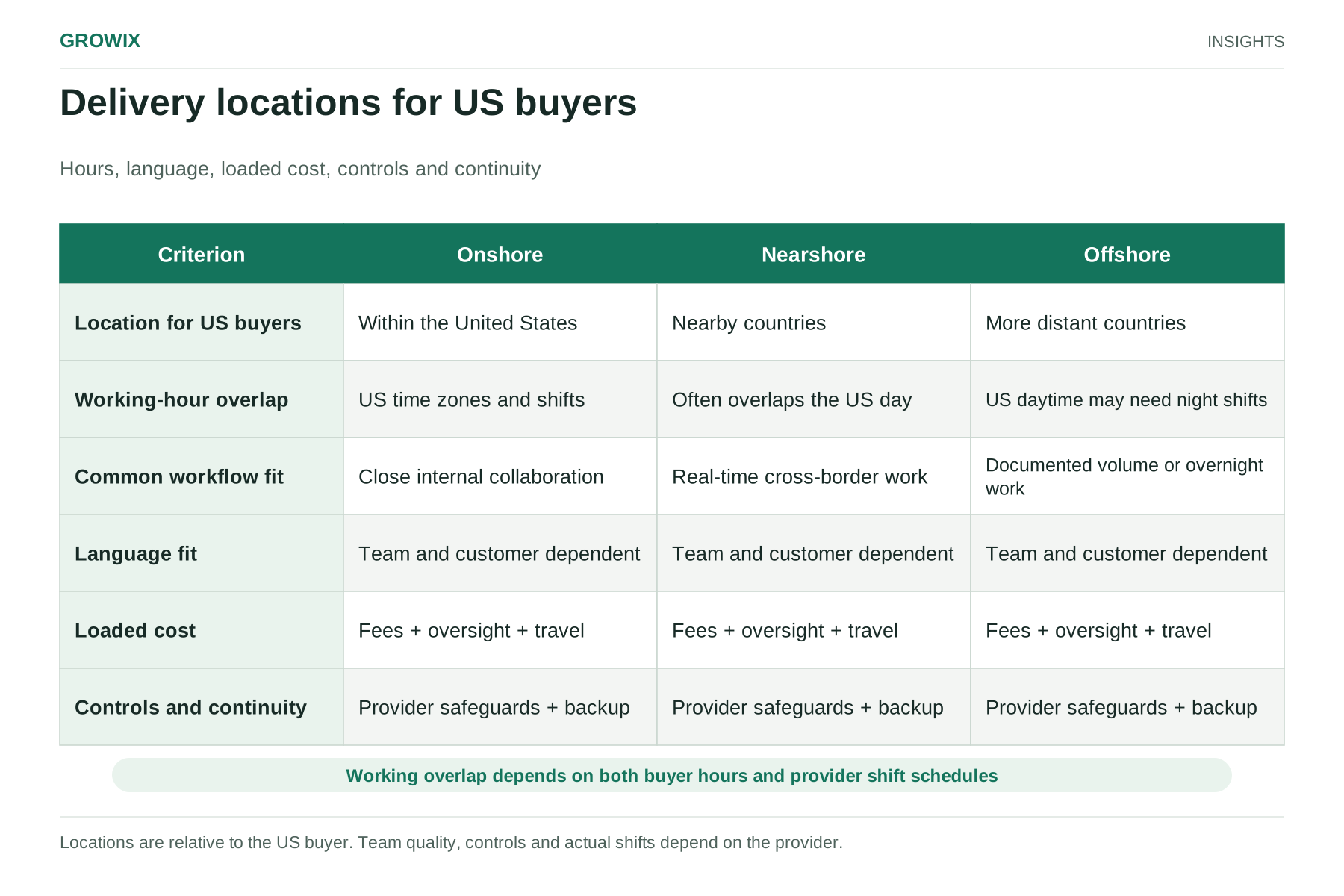
Delivery locations for US buyers. Locations are relative to the US buyer. Team quality, controls and actual shifts depend on the provider. View full size Read this comparison as a table
Criterion
Onshore
Nearshore
Offshore
Location for US buyers
Within the United States
Nearby countries
More distant countries
Working-hour overlap
US time zones and shifts
Often overlaps the US day
US daytime may need night shifts
Common workflow fit
Close internal collaboration
Real-time cross-border work
Documented volume or overnight work
Language fit
Team and customer dependent
Team and customer dependent
Team and customer dependent
Loaded cost
Fees + oversight + travel
Fees + oversight + travel
Fees + oversight + travel
Controls and continuity
Provider safeguards + backup
Provider safeguards + backup
Provider safeguards + backup
Evaluate data handling, continuity and supervision
Data handling. Confirm how customer data will be accessed and protected: secure devices, restricted access, no local storage, audit logs and background checks. Check whether any contracts, regulations or customer commitments restrict where data can be accessed. Healthcare, financial services and government work often have specific requirements.
Continuity. Ask about the provider's business continuity plans for power, connectivity, weather events and political disruption; whether they operate from more than one site; and how quickly work can move between sites.
Supervision and quality. Ask about team lead ratios, quality assurance sampling, calibration sessions with your team and how performance issues are handled. Closer time zones make live calibration and joint reviews easier; with offshore teams, plan structured written feedback and overlapping meeting windows.
Attrition. Ask for attrition rates on comparable accounts and what the provider does to retain agents. High attrition means constant retraining and inconsistent quality, wherever the team sits.
Pros and cons at a glance
Model
Main advantages
Main drawbacks
Onshore
Same time zones and culture; simplest data and compliance position; easy site visits
Highest cost; tighter labor markets can limit scaling
Nearshore
Strong overlap with US hours; shorter travel; bilingual talent pools; moderate cost
Higher cost than offshore; talent pools vary by country and city; some currency and regulatory variation
Offshore
Lowest rates; large talent pools; natural overnight coverage
Night shifts for US daytime work; more structured oversight needed; longer travel; data and continuity questions to resolve
These are tendencies, not rules. A well-run offshore team can outperform a poorly run onshore one; the provider's management quality often matters more than the country.
Questions to ask providers about location
In which cities and sites will our agents work, and can that change without our approval?
Are agents employees of the provider or subcontractors?
What are typical attrition rates for accounts like ours at that site?
How are night shifts staffed, supported and supervised?
What happens to service if a site loses power or connectivity?
Which data security controls and audits apply at that site?
Can we visit, and how often do your managers travel to us?
Plan the transition
Moving work to a new location, or between providers, carries risk regardless of the destination. Start with a pilot on a limited set of contact types or processes, run it alongside your current arrangement and compare results on agreed measures. Document processes and knowledge before the move rather than relying on shadowing alone. Agree a ramp plan that adds scope only when quality targets are met, and plan for a short dip in performance while the new team learns. Communicate with customers only if their experience will change noticeably, such as new hours or a different phone number.
Cost efficiency; less need for real-time collaboration
Daytime customer support, especially chat and phone
Nearshore or onshore
Time-zone overlap; easier supervision
Bilingual English and Spanish support
Nearshore or onshore
Talent availability
Complex escalations and high-value accounts
Onshore or experienced nearshore teams
Close collaboration with internal teams
Regulated work with data location requirements
Onshore, or wherever rules permit
Compliance constraints
Build a location and provider scorecard
Weight criteria to reflect your work, then score each shortlisted provider and location from 1 to 5:
Criterion
Example weight
What to check
Total monthly cost
25
Rates plus your oversight, travel and expected quality costs
Working-hour overlap
15
Hours of real-time overlap with your teams and customers
Language and customer fit
15
Pilot results on real contacts
Data security and compliance
15
Controls, audits and any location restrictions
Quality management
10
QA sampling, calibration, reporting
Continuity and scalability
10
Multiple sites, ramp capacity, continuity plans
Attrition and retention
10
Rates on comparable accounts; retention practices
Multiply scores by weights and compare totals, then run a pilot with the top two before committing to a full contract.
Measure performance the same way everywhere
If you use more than one location, compare them on identical measures so decisions rest on evidence rather than assumptions about countries:
Quality scores from the same scorecard and calibration sessions.
Customer satisfaction and repeat-contact rates by location and contact type.
Handling time and resolution rate, remembering that harder contacts may be routed to certain sites.
Schedule adherence and staffing to forecast, especially for night shifts.
Attrition and time to proficiency for new agents.
Total cost per resolved contact or processed item, including your own oversight time.
Review these quarterly and be willing to move work between locations as the evidence develops. Location decisions made once and never revisited often outlive the reasons for them.
When each model fits
Choose offshore for high-volume, well-documented processes, overnight coverage and cost-sensitive work where real-time collaboration matters less.
Choose nearshore for daytime customer contact, work needing frequent collaboration with US teams and bilingual support.
Choose onshore for regulated or data-sensitive work, complex escalations, and situations where local knowledge or presence matters to customers.
Combine locations when you need both extended coverage and close collaboration, with clear rules about which work goes where.
When Growix may not be the right fit: if your contracts or regulators require all work to be performed within the United States, confirm a provider's delivery locations before anything else. Ask every provider, including Growix, exactly where the people on your account will be based and how data access is controlled.
Frequently asked questions
What is the difference between nearshore and offshore outsourcing?
For a US business, nearshore teams work in nearby countries with similar time zones, commonly in Latin America or the Caribbean, while offshore teams work in more distant countries, commonly in Asia, Eastern Europe or Africa, often with large time differences. Nearshore typically costs more but overlaps more with US working hours.
Is nearshore outsourcing more expensive than offshore?
Usually, yes, on provider rates. The gap narrows once you include your own oversight time, travel, night-shift premiums and the cost of slower handoffs across time zones, so compare loaded costs rather than hourly rates.
When is onshore outsourcing the right choice?
Onshore delivery costs most and suits regulated or data-sensitive work, contracts that require US-based staff, complex escalations and situations where local knowledge or presence matters.
Next step
Classify the work you plan to outsource by type, volume and required hours, then use the scorecard to shortlist locations before shortlisting providers. Our guide to outsourced customer support pricing explains how to compare quotes once you have them.
Growix's Customer Support Outsourcing service delivers email, chat and phone support to your standards, and our Back-Office Operations team runs administrative and operational processes behind the scenes.