AI Readiness Assessment vs an AI Pilot: Where Should Your Business Start?
An assessment tells you where AI fits and what blocks it; a pilot proves one use case works. Use this decision tree to pick the right first step, or combine them.
The short answer: start with a bounded AI pilot when you already have one clear, valuable use case, the data it needs is accessible, the risk of errors is manageable and someone owns the outcome. Start with an AI readiness assessment when you have many ideas and no agreed priorities, when your data or processes are poorly understood, when the use cases touch regulated or sensitive areas, or when leadership needs a roadmap and investment case before committing. Many businesses do best with a short, focused assessment that ends by selecting and scoping the first pilot.
The two are not rivals. An assessment without a pilot produces a document; a pilot without an assessment can prove something that does not matter. This guide helps you choose the right first step.
The options defined
AI readiness assessment. A structured review of where AI could create value in your business and what stands in the way. It typically covers strategy and use cases, data availability and quality, processes, technology, skills, governance and risk. The output is a prioritized list of opportunities, the gaps to close and a roadmap. Large consultancies sell this as a defined service, such as PwC's enterprise AI readiness assessment, but the scope can be scaled down considerably for a smaller business.
AI pilot. A time-boxed implementation of one use case with real users and real data, designed to test whether it delivers measurable value and can be run safely. A good pilot has a baseline, success criteria, a limited scope and a decision at the end: scale, adjust or stop.
Compare deliverables, time and cost drivers
Factor
AI readiness assessment
AI pilot
Main question
Where should we use AI, and what must change first?
Does this specific use case work here?
Deliverables
Opportunity map, readiness gaps, risk review, roadmap, business case
Working solution for a limited group, results against baseline, scale-up plan
Typical duration
A few weeks for a focused review; longer for large organizations
Often six to twelve weeks including setup and measurement
Main cost drivers
Number of functions and interviews, depth of data review
Integration work, data preparation, evaluation, user time, tool costs
Internal time needed
Leaders and process owners for interviews and workshops
A business owner, users, IT and data support throughout
Risk if skipped
Pilots chosen for enthusiasm rather than value; repeated blockers
Roadmap built on untested assumptions
Evidence produced
Structured judgment
Measured results in your environment
Durations depend heavily on scope; treat them as planning guides rather than benchmarks.
Assess data, process and ownership gaps
Whichever you choose, the same gaps tend to decide success. Ask:
Data
Is the data the use case needs digital, accessible and reasonably clean?
Do you know where it lives, who owns it and what restrictions apply?
Does using it with an AI tool raise privacy, confidentiality or contractual issues?
Process
Is the process documented well enough to know where AI would fit?
Is there a baseline: how long the work takes, how often it goes wrong, what it costs?
Would the process need to change to capture the benefit?
Ownership
Is there a named business owner who will use the result and be accountable for the outcome?
Who will run and maintain the solution after the pilot?
Who approves risk decisions?
Technology and cost
Are approved tools available, with appropriate security and contract terms?
Can the solution connect to the systems involved?
Has anyone estimated ongoing running costs? In McKinsey's State of AI 2026 survey, about one in five respondents said AI-related operating costs, including tokens, constrain their AI use.
If most answers are yes for a particular use case, a pilot is likely ready. If many are no or unknown, an assessment, or at least a focused readiness check on that use case, should come first.
When a bounded pilot is enough
A pilot can be the right first step when:
One use case clearly stands out on value, and leaders agree on it.
The data is available and can be used under existing policies.
Errors would be caught before reaching customers or causing harm.
A business owner is committed and users have time to take part.
The organization is small enough that a full assessment would mostly confirm what leaders already know.
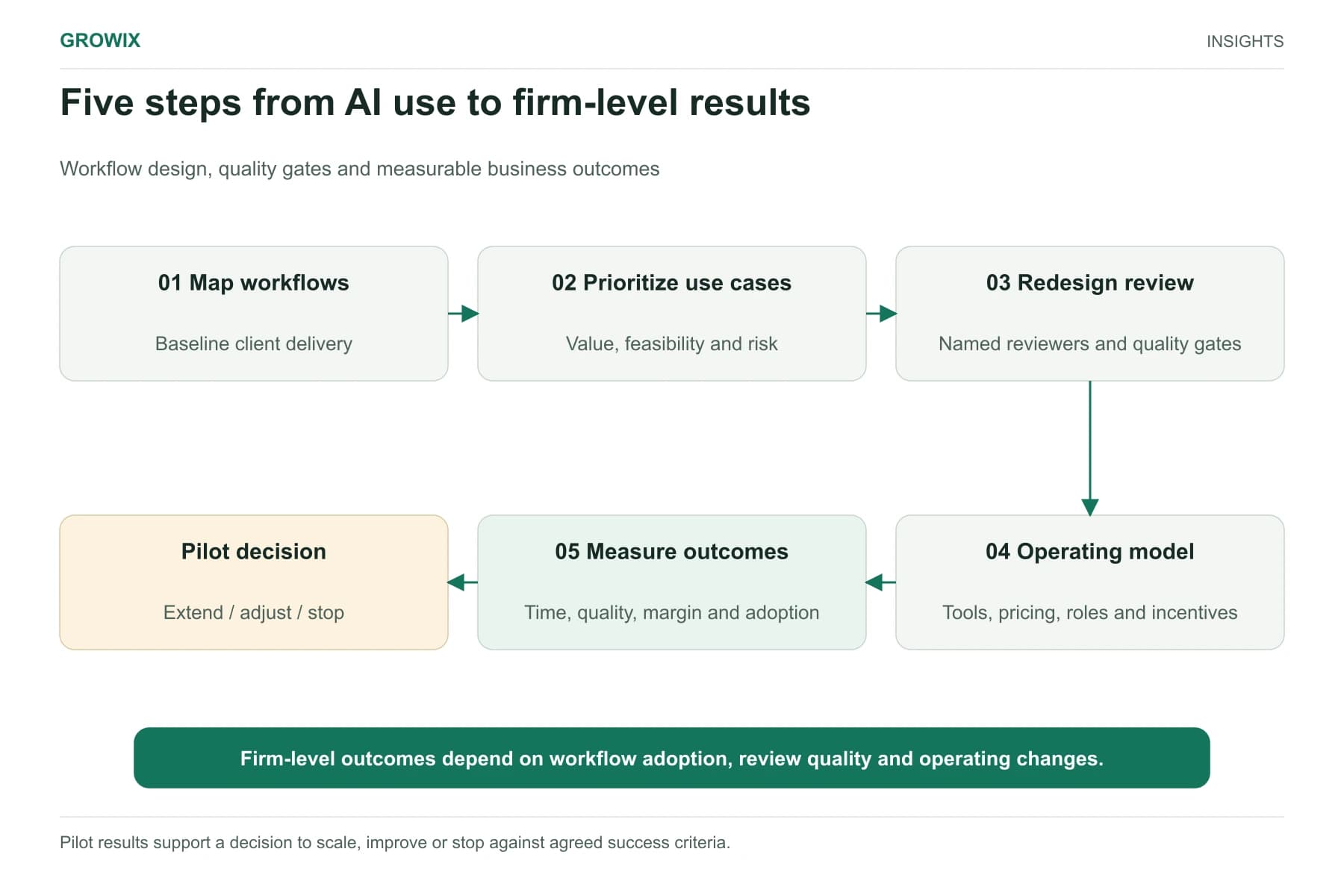
Keep the pilot bounded: one process, one team, a fixed period, a baseline and pre-agreed success criteria. Decide in advance what result would lead you to scale it, change it or stop it.
What a good pilot plan contains
Write a one- or two-page plan before any build work starts:
Problem and baseline: the process, its current volume, time, cost and error rate.
Scope: which users, which cases and which systems are included, and what is explicitly out of scope.
Success criteria: measurable thresholds, for example handling time reduced by an agreed percentage with no increase in errors.
Controls: human review rules, escalation paths and how errors will be logged.
Running cost estimate: model, hosting, monitoring and review time at pilot and at full scale.
Decision date: when leaders will decide to scale, adjust or stop, and who decides.
A pilot without these elements tends to drift into an open-ended experiment that is hard to evaluate or end.
When an assessment should come first
Start with an assessment when:
There are many competing ideas and no shared view of priorities.
Data quality and ownership are uncertain across systems.
Use cases touch regulated activities, sensitive personal data or high-stakes decisions.
Several departments would be affected and need a common approach to tools and governance.
Leadership or a board needs an investment case and roadmap.
Previous pilots stalled for reasons nobody fully diagnosed.
Red flags in assessment proposals
Be cautious if an assessment proposal:
Produces a generic maturity score without naming specific use cases and their value.
Does not involve the people who run the processes being assessed.
Ends with a recommendation to buy a particular product the assessor sells.
Has no clear output that would let you start a pilot the following month.
A useful assessment ends with decisions, owners and a scoped first project, not a slide deck of possibilities.
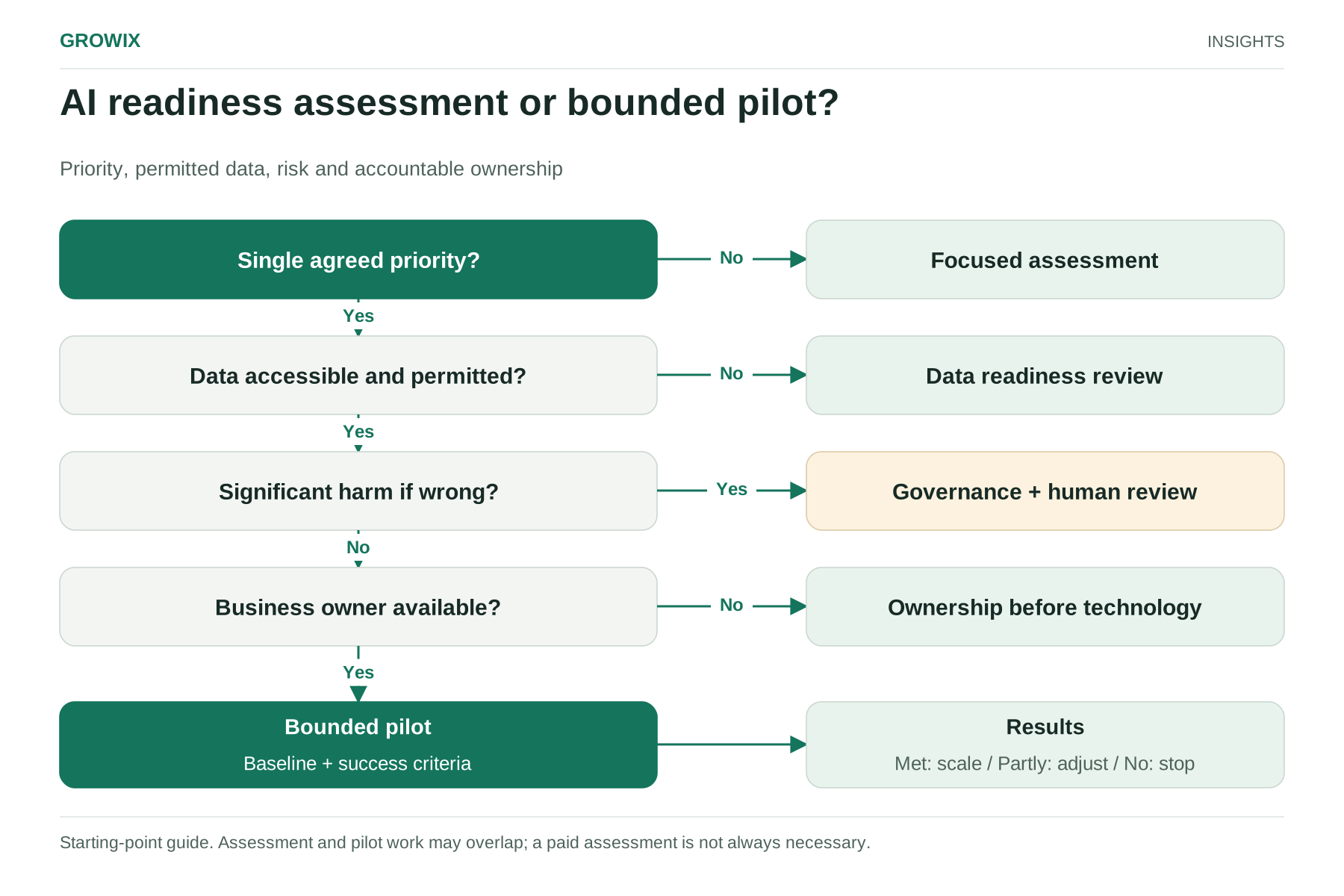
A readiness and pilot decision tree
Work through these questions in order:
Do you have a single use case that leadership agrees is the priority?
No: run a focused readiness assessment to prioritize.
Yes: go to question 2.
Is the required data accessible and permitted for this use?
No: run a data readiness review for this use case before piloting.
Yes: go to question 3.
Could an error cause significant harm to customers, finances or compliance?
Yes: define review controls and governance first, then pilot with human review of every output.
No: go to question 4.
Is there a business owner with time and authority to run the pilot?
No: resolve ownership before spending on technology.
Yes: run a bounded pilot with a baseline and success criteria.
After the pilot, did it meet the criteria?
Yes: plan scale-up, including running costs, support and training.
Partly: adjust and extend for a defined period.
No: stop, record what you learned and return to your priority list.
AI readiness assessment or bounded pilot?. Starting-point guide. Assessment and pilot work may overlap; a paid assessment is not always necessary. View full size
Hypothetical example
The following scenario is invented for illustration.
A regional distribution company has twelve AI ideas from different departments. Two stand out: answering customer questions about order status, and extracting data from supplier invoices. A two-week readiness review finds that order data is clean and accessible through an existing API, while supplier invoices arrive in many formats with inconsistent purchase order references. The company pilots the customer question use case first, with human review of answers for the first month, and starts a separate project to standardize purchase order references before attempting invoice extraction.
When each fits, and when Growix may not
Choose an assessment when you need priorities, a roadmap or a shared governance approach across the business.
Choose a pilot when one use case is clearly ready and you need evidence, not more analysis.
Combine them when you want a short assessment that ends with a scoped pilot ready to start.
When Growix may not be the right fit: if you already know your use case and only need a specific software product configured, the vendor's own implementation team may be the quickest route. And if you need a formal audit against a specific regulatory framework, use a specialist assurance provider.
Frequently asked questions
What is an AI readiness assessment?
An AI readiness assessment is a structured review of where AI could create value in a business and what stands in the way: data quality and access, process documentation, ownership, technology, security and governance. A useful one ends with prioritized use cases, owners and a scoped first project.
What should an AI pilot include?
A one- or two-page plan covering the problem and baseline, scope, success criteria agreed in advance, data and tool approvals, the review process for outputs, the owner, a fixed time box and what happens if it succeeds or fails. Without these, a pilot drifts into an open-ended experiment.
Should you start with an AI assessment or a pilot?
Start with a pilot when one valuable use case stands out, the data is accessible, errors are manageable and someone owns the outcome. Start with an assessment when there are many competing ideas, data and ownership are unclear or the use cases touch regulated or sensitive work.
Next step
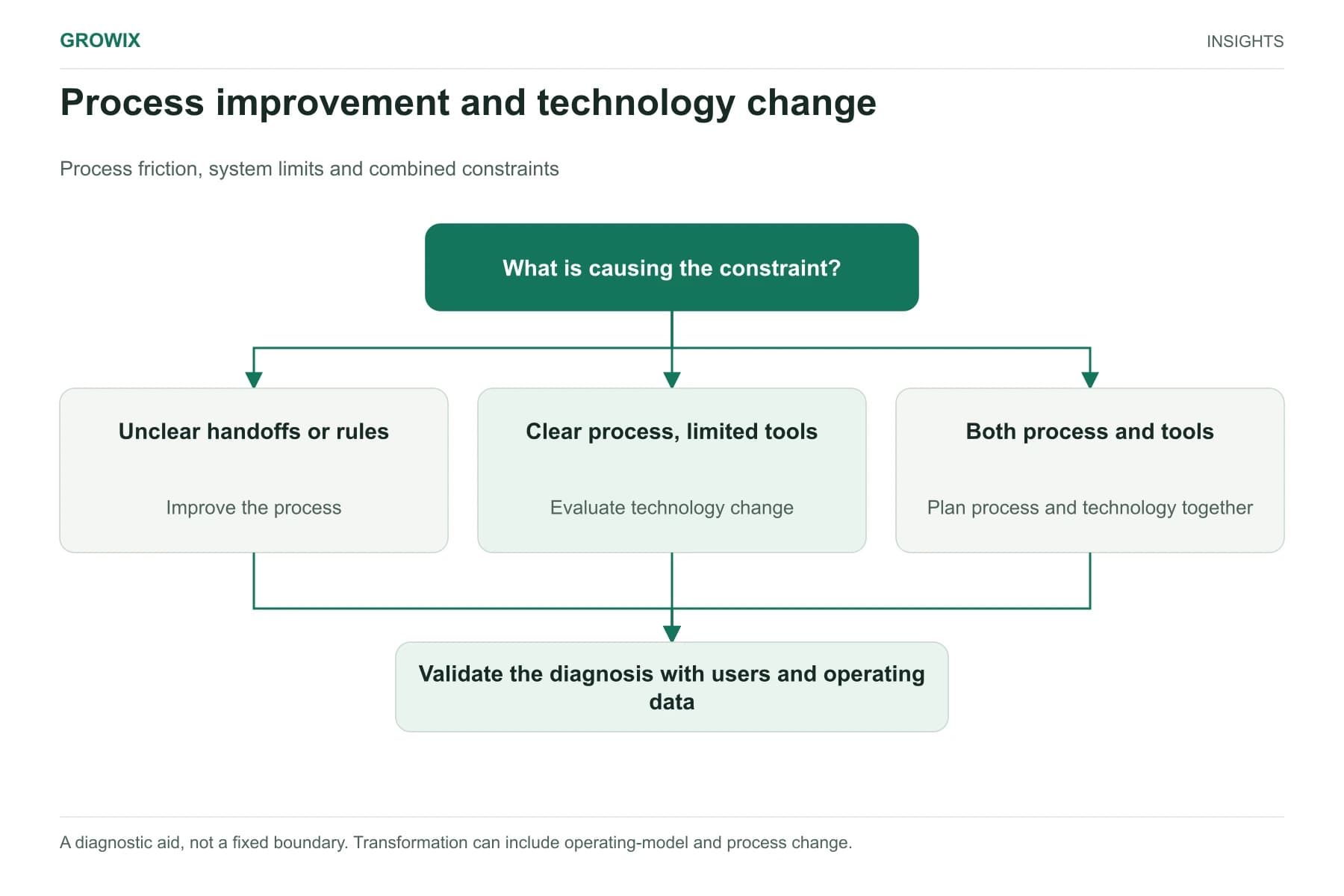
List your AI ideas, then answer the decision tree questions for the top three. If the answers are mostly unknown, start with a focused assessment; if one use case passes every question, scope a bounded pilot. Our guide to digital transformation vs process improvement can help if the real blockers turn out to be process rather than technology.
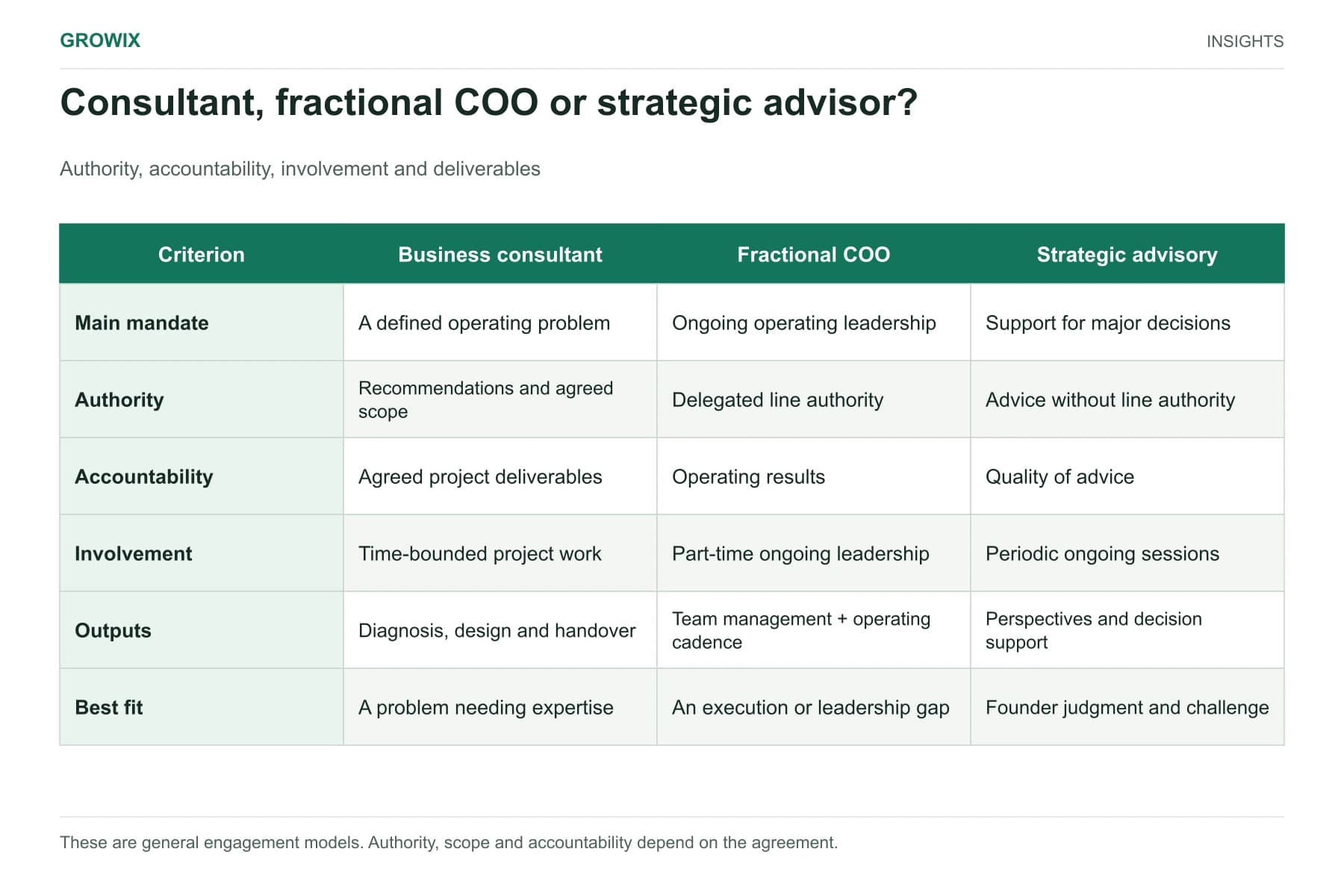
Growix's Digital Transformation team plans and runs technology-enabled change across strategy, process, technology and capability, and our Strategic Business Advisory provides ongoing senior counsel on high-stakes decisions such as where to invest in AI. When a pilot needs building, our AI Development & Integration team can implement it.