The short answer: start with process improvement when work is slow, error-prone or inconsistent but your systems could support a better way of working. Start with digital transformation when the technology itself prevents the business from operating or growing as it needs to, for example when systems cannot share data, cannot scale or cannot support a new business model. In most organizations, the right answer is a sequence: fix and simplify the most important processes, then use technology to change them more fundamentally, then keep improving. Digitizing a broken process usually just makes it fail faster.
The terms defined
Process improvement makes existing work flow better: fewer steps, fewer handoffs, clearer ownership, less rework and more consistent outcomes. Methods range from simple process mapping to structured approaches such as Lean or Six Sigma. It can include small technology changes, but its focus is how the work is done.
Business process redesign is a deeper version: rethinking a process from the outcome backward rather than tuning the existing steps.
Digital transformation uses technology to change how the business operates or creates value: new or replaced core systems, connected data, automation at scale, digital customer channels or new digital products. It typically changes processes, roles, skills and sometimes the business model itself.
The distinction matters because the two differ in cost, duration, risk and the kind of leadership they need.
Identify process and technology constraints
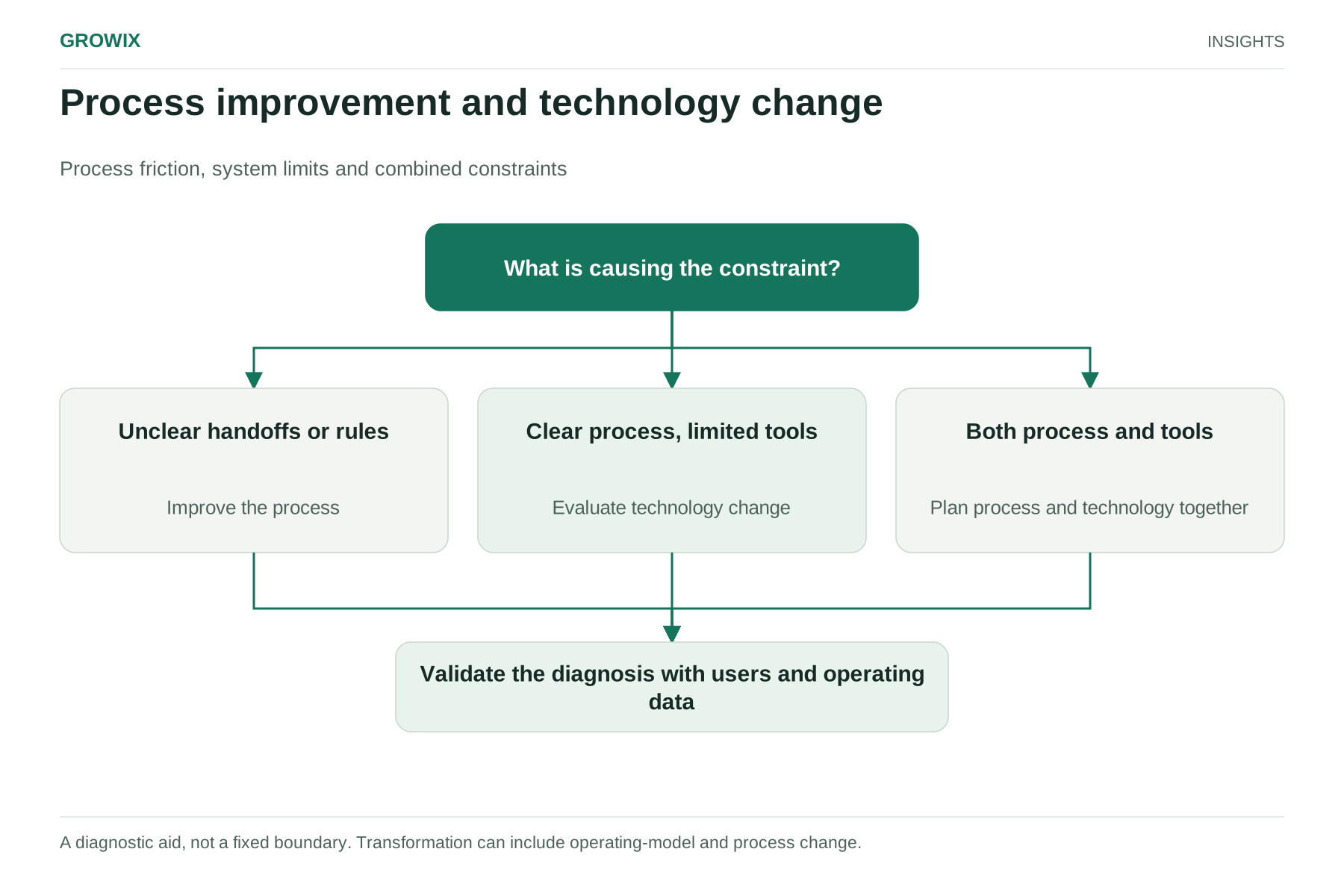
Diagnose before choosing. These signals help separate the two:
| Symptom | Likely constraint | Usual first move |
|---|
| Different teams do the same task in different ways | Process and standards | Process improvement |
| Work waits for approvals or handoffs | Process and decision rights | Process improvement |
| High rework because information is incomplete at the start | Process design | Process improvement |
| Staff re-key data between systems that cannot connect | Technology integration | Targeted digital change or integration |
| Systems cannot handle volume, new products or new markets | Technology platform | Digital transformation |
| Leaders cannot get reliable data for decisions | Both: definitions and systems | Process and data standards first, then technology |
| Customers expect digital self-service you cannot offer | Technology and operating model | Digital transformation |
A useful test: if you gave the team perfect software tomorrow, would the problem disappear? If the honest answer is no, because nobody agrees how the process should work, start with the process.
Compare scope, cost and disruption
| Factor | Process improvement | Digital transformation |
|---|
| Typical scope | One process or value stream at a time | Multiple processes, systems and functions |
| Typical duration | Weeks to a few months per process | Many months to several years |
| Cost profile | Mostly people's time and facilitation; modest tools | Significant technology, integration, data and change costs |
| Disruption | Low to moderate; changes to how teams work | Moderate to high; system cutovers, new roles, retraining |
| Risk | Lower; small reversible changes | Higher; dependencies, delays and adoption risk |
| Value | Faster, cheaper, more reliable existing operations | New capabilities, scale, new revenue models |
| Leadership required | Process owners and managers | Executive sponsorship across functions |
Transformation programs carry well-documented risk. Boston Consulting Group's 2020 research on digital transformation, based on its work with 70 companies and a survey of 825 senior executives, found that 70% of digital transformations fell short of their objectives. It identified factors that improved the odds, including an integrated strategy with clear goals, leadership commitment from the CEO through middle management, high-caliber talent, agile governance, effective monitoring of progress toward defined outcomes, and a business-led modular technology and data platform. Many of those factors are easier to establish once core processes are understood and owned.
Check prerequisites and dependencies
Before committing to either path, confirm:
- Process ownership: each important process has a named owner with authority to change it.
- Baseline measures: cycle time, cost, error rates and customer outcomes for the processes in scope.
- Data definitions: shared definitions of key terms such as customer, order, active account or revenue.
- Leadership capacity: enough senior time to sponsor and govern the change.
- Change capacity: whether teams can absorb new ways of working alongside their day jobs.
- Technology dependencies: contracts, end-of-support dates and integration constraints that affect timing.
Missing prerequisites are not reasons to do nothing, but they shape the sequence. A transformation launched without process owners and data definitions usually stalls in arguments about requirements.
Choose a sequence with measurable milestones
A practical sequence for most mid-sized businesses:
- Diagnose (weeks 1 to 4): map the top three to five value streams, measure baselines and identify constraints.
- Stabilize and simplify (months 1 to 4): improve the processes with the biggest gaps; standardize, remove steps and clarify ownership.
- Define the target operating model (months 2 to 5): decide how the business should run in two to three years and what technology that requires.
- Transform in increments (months 4 onward): replace or connect systems one value stream at a time, each with defined outcomes.
- Embed continuous improvement: once new systems are live, keep improving processes using the data they now produce.
Attach measurable milestones to each step, such as order-to-cash cycle time reduced by an agreed amount, manual re-keying eliminated for a named process, or a new self-service channel handling a set share of requests. Review them monthly at a governance meeting with the authority to change course.
Hypothetical example
The following example is invented for illustration.
A professional services company wants to replace its project management and billing systems because invoices are late and often wrong. Diagnosis shows that the systems are dated but capable; the real issue is that project managers record time and expenses inconsistently and approve them late. The company first standardizes time recording and approval deadlines, and agrees billing rules with finance. Invoice accuracy and timeliness improve within two months. It then replaces the systems with a clearer specification, knowing which problems the new technology must solve and which were never technological.
How to measure progress
Choose measures that show whether the business works better, not just whether projects finish:
| Measure | Process improvement | Digital transformation |
|---|
| Cycle time for key processes | Primary measure | Still essential |
| Error and rework rates | Primary measure | Still essential |
| Cost per transaction | Useful | Useful, especially after automation |
| Manual handoffs and re-keying | Reduced through redesign | Eliminated through integration |
| Adoption of new ways of working | Team compliance with new standards | Active use of new systems and channels |
| New capabilities delivered | Rarely relevant | Self-service, new products, new markets |
| Customer outcomes | Satisfaction, complaints, on-time delivery | Same, plus digital engagement |
Report them against the baseline captured during diagnosis. A program that delivers its technology on schedule but leaves cycle times unchanged has not succeeded.
Common mistakes
- Buying software to fix a disagreement. If teams do not agree how a process should work, a new system will encode one side's view or a messy compromise.
- Improving processes that are about to be replaced. Coordinate with the technology roadmap so effort is not wasted on steps a new system will remove.
- Running too many initiatives at once. BCG's 2026 analysis of transformation priorities argues, based on its authors' experience, that companies can often capture most of a transformation's value from a minority of initiatives.
- Treating change management as communication only. People need training, time, revised roles and incentives, not just announcements.
- Ending improvement when the system goes live. New systems produce data that shows where the next improvements are; use it.
When each option fits
Process improvement first when problems are about consistency, handoffs and ownership, and current systems are adequate.
Digital transformation first when technology is the binding constraint: end-of-life systems, inability to scale, or a strategic need for new digital capabilities.
Both in sequence in most other cases, particularly when a technology change is coming anyway.
When Growix may not be the right fit: if you need a specific packaged system implemented to a known specification, the vendor or a certified implementation partner may be the most efficient choice. And if a single process needs a quick fix, an internal improvement team may be enough without outside help.
Questions for the leadership team
Before approving either path, leaders should be able to answer:
- Which three processes matter most to customers and cash flow, and who owns each?
- What would we measure to know they have improved?
- Which technology constraints are real deadlines, and which are frustrations?
- How much change can our teams absorb in the next twelve months?
- Who will sponsor the work, and how much of their time can they give?
If the answers differ widely around the table, the first job is alignment, not a program.
Frequently asked questions
What is the difference between digital transformation and process improvement?
Process improvement makes existing work flow better: fewer steps, handoffs and errors, usually with current systems. Digital transformation uses technology to change how the business operates or creates value, such as replacing core systems or enabling a new business model, and costs more, takes longer and carries more risk.
What is a digital transformation strategy?
A digital transformation strategy sets out which business outcomes technology change must deliver, which processes and systems change in what order, who owns each part, and how progress is measured. It should rest on a diagnosis of whether process or technology is the real constraint.
Why do digital transformations fail?
Boston Consulting Group's 2020 research found that 70% of digital transformations fell short of their objectives. Common causes include unclear goals, weak leadership commitment, poorly understood processes and technology bought to fix disagreements that are really about how work should be done.
Next step
Pick the process that causes the most customer or cash-flow pain, map it with the people who do the work, and measure its baseline. The map will usually show whether you are dealing with a process problem, a technology problem or both. If you are weighing where AI fits into this, see AI readiness assessment vs an AI pilot. If the real gap is leadership capacity to drive the change, see fractional COO vs business consultant.
Growix's Operating Models & Business Process Optimisation team improves and redesigns processes, governance and decision rights, and our Digital Transformation team runs technology-enabled change as a business program.
Discuss your growth and operating priorities