AI Transformation for Professional Services Firms: Redesigning Workflows and Measuring Results
Individual AI productivity rarely becomes firm-level margin on its own. Map client delivery workflows, redesign review and pricing around AI, and measure results against a baseline.
Most accounting, legal, consulting and marketing firms now use AI somewhere. Fewer can show what it has done for the firm. Thomson Reuters' 2026 AI in Professional Services report, drawing on more than 1,500 professionals globally and published in April 2026, found organization-wide AI adoption had risen from 22% to 40%, yet only 18% of firms were tracking AI's business value.
That gap is the difference between AI adoption and AI transformation. Adoption gives individuals faster tools. Transformation changes how client work flows through the firm, who reviews it, how it is priced and how results are measured. McKinsey's State of AI 2026 points in the same direction across industries: nearly three-quarters of the organizations it classed as AI high performers reported fundamentally redesigning workflows around AI, compared with about a quarter of other respondents.
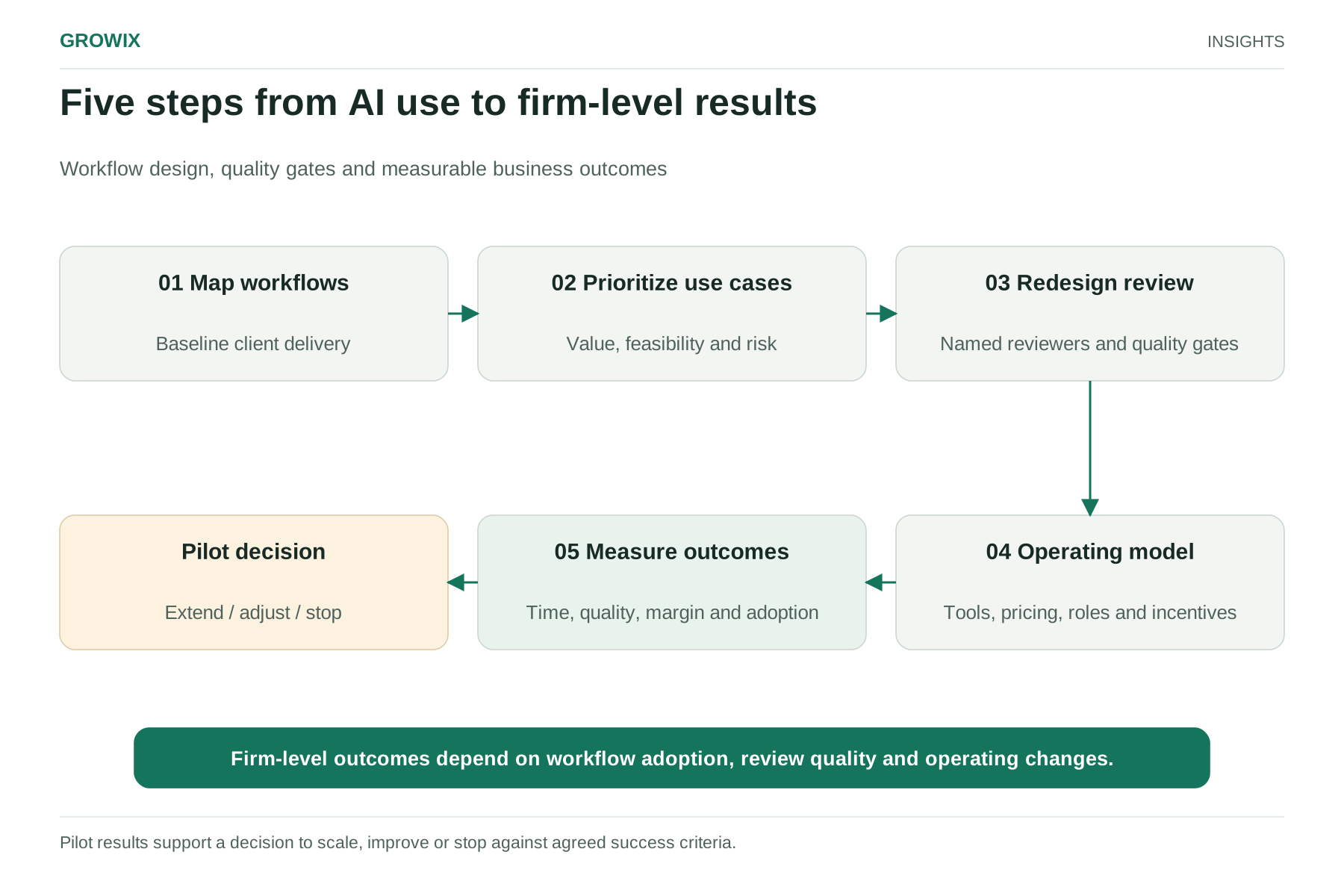
This guide sets out a practical approach for professional services firms: map delivery workflows, prioritize measurable use cases, redesign review roles and quality gates, adjust the operating model, and measure outcomes against a baseline.
Why individual productivity does not become firm results
In a firm that bills by the hour, an associate who drafts a memo in half the time does not automatically improve the firm's results. The saved time may be absorbed by other work, written off, or turned into lower bills. Meanwhile, partners may spend more time checking AI-assisted work they do not trust. Without changes to workflow, review and pricing, AI can make individuals faster while leaving margins, turnaround times and client experience unchanged.
Transformation therefore needs to answer three questions together: which steps of client delivery change, who is accountable for quality at each step, and how the firm captures the value.
Step 1: Map client delivery workflows
Pick one or two service lines that matter commercially, and map how a typical engagement moves from start to finish. A generic professional services workflow often looks like this:
Stage
Typical activities
Who does it today
Intake and scoping
Understand the request, check conflicts or independence, agree scope and fees
Partner or manager
Information gathering
Collect documents and data from the client
Junior staff and client contacts
Research and analysis
Research rules, precedents, markets or data; analyze
Associates and seniors
Drafting
Prepare memos, reports, filings, models or creative work
Associates and seniors
Review
Check accuracy, judgment, compliance and quality
Managers and partners
Delivery and advice
Present findings and recommendations
Partner or manager
Billing and close-out
Record time, invoice, archive
Staff and finance
For each stage, record a baseline using recent engagements: elapsed time, hours by role, rework loops, write-offs and common client complaints. That baseline is what you will measure against later. Without it, any claimed improvement is anecdote.
Step 2: Prioritize measurable use cases
List the places where AI could change the work, then score them. A simple approach uses four factors from 1 to 5:
Value: hours, cycle time or quality improvement at that stage, multiplied by volume.
Feasibility: data availability, tool readiness and how well the task suits current AI.
Risk: consequences of an error reaching a client, regulator or court (score low risk as 5).
Measurability: whether you can track the effect cleanly.
Examples by profession, for illustration only:
Profession
Candidate use case
Notes
Law
First-pass review of contracts against a playbook
High volume; human review of every flagged issue
Accounting
Organizing and extracting data from client documents for preparation
Clear inputs; outputs checked against source
Consulting
Research synthesis for market assessments
Requires source verification and analyst judgment
Marketing agencies
First drafts of routine content variants
Brand and factual review essential
All
Meeting notes, action tracking and status updates
Low risk; quick to adopt
When choosing the first service line, look for one with enough volume to measure results within a few months, a practice leader willing to sponsor change, and clients who will not object to new ways of working. A service with steady, repeatable engagements, such as recurring compliance work or standard assessments, usually produces clearer evidence than bespoke, one-off advisory work.
Favor use cases that are high value, feasible and measurable, and where the review step can be defined clearly. Postpone use cases where an undetected error would be costly until review standards are proven elsewhere.
Step 3: Redesign review roles and quality gates
This is where transformation succeeds or fails. When AI produces first drafts, the critical skill shifts from producing to verifying and judging. Redesign deliberately:
Define quality gates. For each redesigned workflow, write down what must be checked before work moves to the next stage, for example that every citation has been verified against the source, every number reconciles to client data, and every recommendation is supported by evidence in the file.
Assign accountable reviewers. Make clear who signs off at each gate. Professional responsibility does not transfer to a tool. The American Bar Association's Formal Opinion 512, for example, reminds lawyers using generative AI of their duties of competence, confidentiality, client communication and reasonable fees.
Keep an audit trail. Record which steps used AI, which sources were used and who reviewed the output. This supports quality control, client questions and regulatory inquiries.
Protect learning. Junior professionals learn by doing first drafts and research. If AI does more of that work, redesign how juniors build judgment, for example by having them critique and correct AI drafts with a reviewer explaining the corrections. Our guide to AI upskilling for professional services teams covers the training side.
Clarify client communication. Decide how and when clients are told about AI use, and whether engagement terms need updating.
Step 4: Adjust the operating model
Workflow changes need supporting changes in how the firm runs:
Governance: a small steering group with practice leaders, risk, IT and finance that approves use cases, tools and standards.
Data and tools: approved tools with appropriate contractual protections, document management that makes firm knowledge accessible, and clear data classification.
Pricing: where AI substantially reduces effort, consider fixed fees, value-based pricing or subscription arrangements for suitable services, so efficiency improves margin or competitiveness rather than simply reducing billable hours.
Staffing model: the ratio of junior to senior staff, and the skills you hire for, may change as drafting time falls and review time becomes more important.
Incentives: if people are rewarded only for billable hours, they have little reason to adopt workflows that reduce hours.
Step 5: Measure business outcomes against the baseline
Measure the redesigned workflow against the baseline from step 1, over enough engagements to be meaningful:
Measure
What it shows
Cycle time from intake to delivery
Client-visible speed
Hours by role per engagement
Change in effort and leverage
Realization and write-offs
Whether efficiency turns into margin
Review findings and rework
Quality effect
Client satisfaction and repeat work
Client-perceived value
Margin per engagement or service line
Firm-level financial result
Adoption of the redesigned workflow
Whether the change has actually happened
Compare like with like: engagements of similar size, complexity and client type, run before and after the change. Where volumes are small, combine quantitative measures with structured reviewer feedback rather than drawing conclusions from two or three engagements.
Report results to partners in business terms, not tool usage statistics. A finding such as "market assessments now take eight working days instead of fourteen, with no increase in review findings, and margin per assessment rose" is far more persuasive than logins per month.
Five steps from AI use to firm-level results. Pilot results support a decision to scale, improve or stop against agreed success criteria. View full size
Hypothetical example: a 60-person strategy consultancy
The following example is invented for illustration.
A consultancy delivers market assessments that typically take three weeks and involve a team of three. Mapping shows that roughly half of the hours go on research gathering and synthesis, and that partners rewrite a large share of draft sections because sources are unclear.
The firm redesigns the workflow:
Analysts use an approved research tool to gather and summarize sources, with every claim linked to its source document.
A new quality gate requires a manager to verify a sample of claims against sources before drafting begins.
Drafting uses templates built from the firm's best past reports.
Partners review the argument and recommendations rather than rewriting sections.
The firm moves this service from time-based billing to a fixed fee.
It measures cycle time, hours by role, review findings and margin for the next ten assessments against the previous ten, and decides whether to extend the approach to due diligence work.
Common obstacles and how to handle them
Partner skepticism. Senior professionals often distrust AI output because they have seen confident errors. Involve them in designing the quality gates, and show them reviewed results from real engagements rather than demonstrations.
The billable-hour conflict. If a practice is measured on hours billed, faster work looks like lost revenue. Address pricing and incentives early, even if only for one service line as a test.
Scattered experiments. Many firms have dozens of individual experiments and no shared standards. Consolidate them into a short list of priority workflows with owners, and retire the rest or leave them as personal productivity aids.
Knowledge that is hard to find. AI is most useful when it can draw on the firm's own precedents, templates and past work. If documents are scattered across personal drives and inconsistent folders, fixing document management may be the first real step.
Client concerns. Some clients restrict AI use in their engagements. Track client-specific restrictions centrally so teams know where redesigned workflows may and may not be used.
A 90-day starting plan
Period
Focus
Days 1 to 30
Choose one or two service lines; map workflows; capture baseline from recent engagements; confirm approved tools and data rules
Days 31 to 60
Redesign the workflow with practice leaders; define quality gates and reviewer roles; train the pilot team; decide pricing for the pilot
Days 61 to 90
Run the redesigned workflow on live engagements; measure against baseline; review findings with partners; decide whether to extend, adjust or stop
Ninety days is enough to produce evidence from real client work. It is not enough to transform a firm, but it gives leadership a defensible basis for the next investment decision.
Responsibilities
Managing partner or CEO: sponsorship, priorities and pricing decisions.
Practice leaders: workflow redesign, quality gates and adoption in their teams.
Risk and general counsel: professional obligations, client terms and audit trails.
IT and security: tools, data protection and access.
Finance: baseline, measurement and pricing analysis.
Learning and development: skills for new roles in the workflow.
Frequently asked questions
What is AI transformation?
AI transformation is changing how a business delivers its work and makes money with AI: redesigning workflows, review roles, pricing and governance so that faster individual tasks turn into better margins, shorter cycle times or higher quality for the firm, not just for individual users.
What is the difference between AI adoption and AI transformation?
AI adoption gives people faster tools. AI transformation changes the work itself: which steps of client delivery change, who is accountable for checking AI-assisted output, and how the firm prices, staffs and measures engagements so the time saved shows up in results.
How do you measure the ROI of AI in a professional services firm?
Capture a baseline from recent engagements first: elapsed time, hours by role, rework, write-offs and margin. Then compare the redesigned workflow against that baseline over enough similar engagements, and report in business terms such as margin and cycle time, not tool usage.
Next steps
Choose one service line, map its delivery workflow and capture a baseline from recent engagements. That exercise alone usually reveals two or three high-value use cases and the review changes they require. For the systems side of the firm, such as connecting CRM, billing and onboarding, see our guide to client onboarding automation for professional services firms.