Fractional COO vs Business Consultant: Which Fits Your Next Stage of Growth?
A fractional COO runs operations part-time with real authority; a consultant diagnoses and designs, then hands over. Match the model to whether your gap is direction or execution.
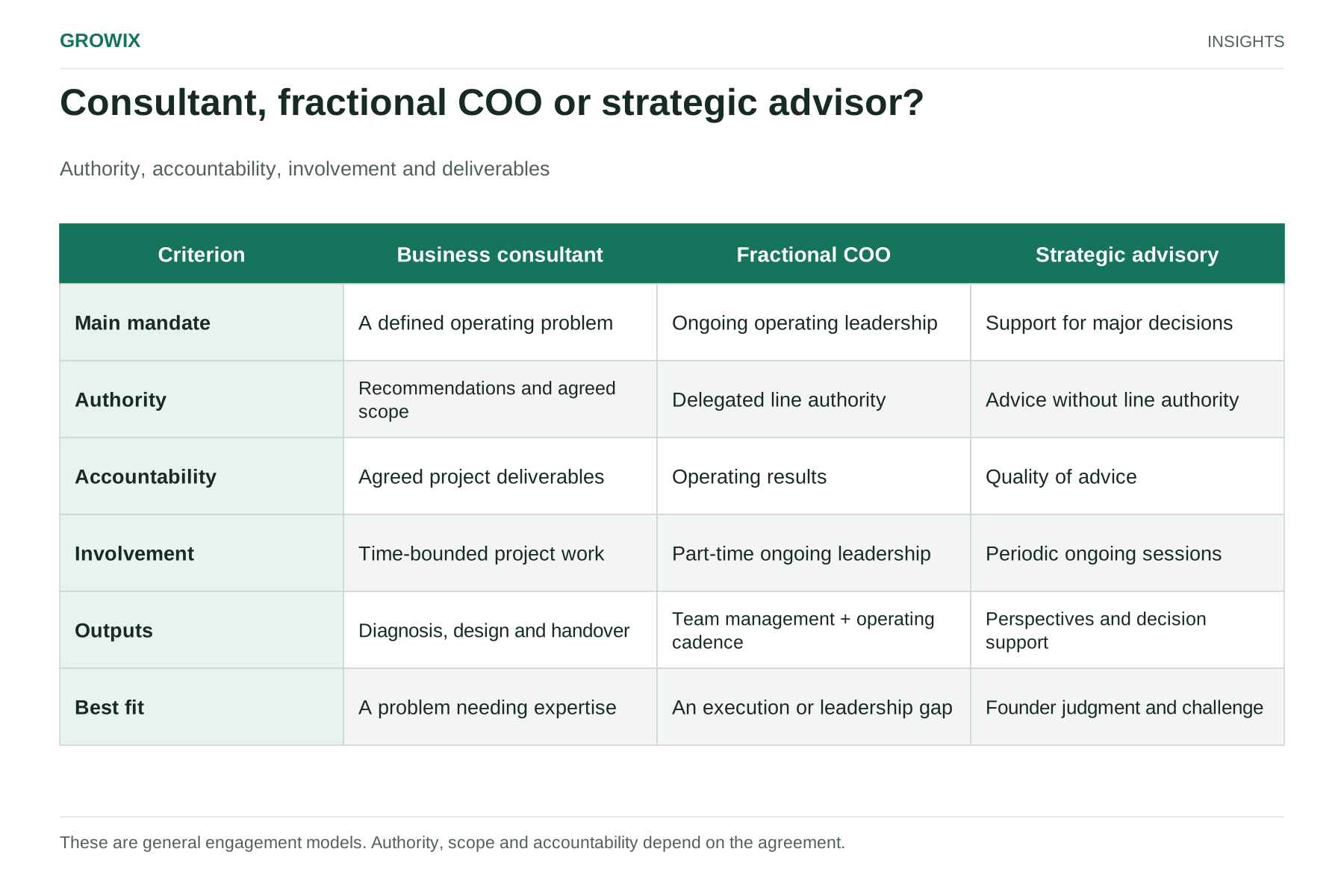
The short answer: hire a fractional COO when you need someone to run operations part-time with real authority: managing people, owning operating metrics and making day-to-day decisions, typically for months or longer. Hire a business consultant, or an operations consultancy, when you need a defined problem diagnosed and solved: an operating model designed, processes redesigned or a plan built, with your own team responsible for running it afterwards. If you need ongoing senior input on decisions without handing over operational authority, a strategic advisory arrangement sits between the two.
The deciding question is whether your gap is in knowing what to do or in getting it done every week.
The options defined
Fractional COO. An experienced operations executive who works part-time for your company, often one to three days a week, in an executive role. A fractional COO typically has line authority over operations teams, attends leadership meetings, owns operating metrics and stays involved for an extended period. They are accountable for results, not just recommendations.
Business or operations consultant. An individual or firm engaged for a defined scope: diagnosing a problem, designing an operating model, redesigning processes, preparing a plan or supporting implementation. Consultants advise and design; your managers decide and run the business. Engagements usually have a start, deliverables and an end.
Strategic advisory. Ongoing senior counsel through regular sessions and on-call support, without operational authority. It suits founders who want an experienced sounding board on the decisions that carry the most weight.
Compare authority, involvement and deliverables
Factor
Fractional COO
Business consultant
Strategic advisory
Authority
Line authority over operations, as agreed
None; recommends
None; advises
Accountability
Operating results
Quality of analysis, design and agreed deliverables
Consultant, fractional COO or strategic advisor?. These are general engagement models. Authority, scope and accountability depend on the agreement. View full size Read this comparison as a table
Criterion
Business consultant
Fractional COO
Strategic advisory
Main mandate
A defined operating problem
Ongoing operating leadership
Support for major decisions
Authority
Recommendations and agreed scope
Delegated line authority
Advice without line authority
Accountability
Agreed project deliverables
Operating results
Quality of advice
Involvement
Time-bounded project work
Part-time ongoing leadership
Periodic ongoing sessions
Outputs
Diagnosis, design and handover
Team management + operating cadence
Perspectives and decision support
Best fit
A problem needing expertise
An execution or leadership gap
Founder judgment and challenge
Model engagement costs
Pricing varies widely, and published figures are mostly from providers selling these services, so treat them as indications.
Full-time executives, for comparison. The Bureau of Labor Statistics reports a median annual wage of $213,990 for chief executives in May 2025. COO compensation varies widely by company size and often includes bonuses and equity.
Consultants. Fees are typically set per project or per day, depending on scope, seniority and the firm. Ask for a fixed price for defined deliverables where possible.
Hypothetical comparison
The figures below are assumptions for illustration, not quotes or Growix pricing. A 70-person company has operational problems: delivery deadlines slip, teams work in silos and the founder spends most of the week firefighting.
Option
Assumed cost over 12 months
What it buys
Fractional COO, two days a week
$162,000 ($13,500 a month)
Someone running operations, managing the team leads and building an operating cadence
Operations consultancy project
$60,000 for a ten-week operating model and process redesign, plus $20,000 of implementation support
A diagnosis, a new structure and processes, decision rights and a plan your managers run
Strategic advisory
$30,000 ($2,500 a month)
Monthly sessions and on-call advice for the founder
Full-time COO
Often well above the fractional cost once salary, benefits, bonus and equity are included
A permanent executive with full-time focus
The consultancy option costs least, but only works if someone inside the company has the time and authority to implement the design. The fractional COO costs more, but adds that execution capacity. Some companies do both in sequence: a consultancy designs the operating model, then a fractional or full-time COO runs it.
Exit terms and handover
Whichever you choose, agree how it ends:
Fractional COO: notice period, how responsibilities transfer to a permanent hire or internal leader, documentation of processes and decisions, and access removal.
Consultant: what is delivered, in what form, and what implementation support is included after delivery.
Advisory: review points to decide whether the arrangement is still useful.
Make sure systems, dashboards and documentation created during the engagement belong to your company and live in your tools.
Match the model to your current execution gap
Ask these questions:
Do we know what needs to change? If not, start with diagnosis by a consultant or advisor.
Do we have someone with the time and authority to make it happen? If not, you need execution capacity: a fractional or full-time COO, or a strengthened internal leader.
Is the need temporary or permanent? A transition, turnaround or scaling phase may suit a fractional role; a permanently complex operation usually needs a full-time leader eventually.
Does the founder need to let go of operations? A fractional COO can create space while the business proves it needs a permanent hire.
Is the problem a specific process or structure? A consultant with relevant expertise is usually more efficient than an executive learning the problem on the job.
Signs you need a fractional COO
The founder or CEO spends most of their time on day-to-day operations.
Team leads report to the founder directly and decisions bottleneck there.
Operating metrics exist but nobody owns them weekly.
You expect to hire a full-time COO within a year or two but are not ready yet.
Signs you need a consultant
A specific problem, such as a broken order-to-cash process or an unclear organization structure, needs expert diagnosis.
Leaders disagree about what is wrong and need an independent view.
You have capable managers who can run a new design once it exists.
How to evaluate candidates and firms
For a fractional COO, look for operating experience at your stage and in a similar business model, evidence of building teams rather than only fixing problems personally, and references from founders who worked with them part-time. Ask how they divide time across clients, how quickly they can respond to urgent issues and how they plan to hand over when the engagement ends.
For a consultant or consultancy, look for relevant problem experience, a clear method, named people who will do the work and examples of deliverables. Ask how they involve your team, how they make sure recommendations are adopted, and what implementation support is included.
For both, check how they measure success. Vague promises of "transformation" are less useful than specific commitments such as an agreed operating cadence in place within 60 days or a redesigned process live in one team within a quarter.
Making a fractional COO effective
A part-time executive succeeds only with clear scope. In the first weeks, agree:
Decision rights: what they can decide alone, what needs the CEO and what needs the board.
Reporting lines: which leaders report to them and how the founder's role changes.
Priorities: three to five operational outcomes for the first quarter.
Cadence: weekly leadership meetings, metric reviews and one-to-ones that continue on days they are not in the business.
Communication: how the team is told about the role, so people know whom to go to.
Without this, a fractional COO can become an expensive extra opinion rather than an operator.
Frequently asked questions
What is a fractional COO?
A fractional COO is an experienced operations executive who works part-time for a company, often one to three days a week, with real authority to manage people, own operating metrics and make day-to-day decisions, typically for several months or longer.
What does a fractional COO do?
Typical responsibilities include running the operating rhythm and leadership meetings, setting and tracking operating metrics, managing department heads, fixing processes and hiring plans, and preparing the business for a permanent operations leader. The exact scope depends on agreed decision rights.
How much does a fractional COO cost?
Published figures come mainly from providers and marketplaces. One marketplace reported an average advertised hourly rate of $153 across all fractional roles as of June 2026, and one fractional COO provider publishes monthly retainers of roughly $12,000 to $15,000 for companies with $1 million to $10 million in revenue. Treat both as indications and compare real proposals.
Where Growix fits, and where it does not
Growix's business consultancy work is advisory and project-based. Our Operating Models & Business Process Optimisation team designs the structure, governance and processes that let a business execute without constant escalation, and our Strategic Business Advisory provides ongoing senior counsel through regular sessions and on-call support.
If your main gap is an executive with authority to run operations week to week, evaluate that leadership requirement separately from an advisory or consulting scope. Agree decision rights, operating accountability and management involvement explicitly. The models can work together: consultancy to design the operating model, an accountable executive to run it.