Go-to-Market Strategy for B2B: A Practical Framework for 2027 Launches
Go-to-Market Strategy for B2B: A Practical Framework for 2027 Launches
A go-to-market strategy decides who you sell to first, what you say, how you reach them and how you will know it is working. Get those choices explicit before you spend on launch.
A go-to-market (GTM) strategy is the plan for bringing a product or service to a specific set of customers: who you will sell to first, what problem you solve for them, how you will price it, which channels will reach them, how the sales process will work and which measures will show whether it is working. You need one whenever you launch something new, enter a new segment or market, or find that your current approach has stopped producing growth.
Most GTM problems are not caused by weak execution. They come from choices that were never made explicitly: targeting everyone, describing features rather than outcomes, or copying a sales motion that does not fit the price point. This guide sets out a practical framework for B2B services and software companies planning launches in 2027.
When you need a go-to-market strategy
A new product or service, even if you already sell to the same customers.
A new segment, such as moving from small businesses to mid-sized companies.
A new geography, where buyers, competitors and regulations differ.
A change in pricing or packaging that changes who buys and how.
Stalled growth, where existing channels deliver less each quarter.
A GTM strategy is narrower than a business plan or annual marketing plan. It focuses on one offer and one market at a time.
Step 1: Choose the first customer precisely
Define an ideal customer profile (ICP) for the launch: the companies most likely to buy, succeed and refer others. Include industry, size, region, technology or operating characteristics, and the trigger events that create urgency, such as new regulation, expansion, leadership change or a failed system.
Then map the buying group: who feels the problem, who signs, who can block the decision and what each cares about.
Base the ICP on evidence. Look at your best existing customers, run interviews with target buyers and use public data to count how many companies fit. Our guide on how to do market research explains when desk research is enough and when to commission interviews.
Narrow is better at launch. A tightly defined first segment makes messaging sharper, references easier to collect and results faster to read.
Step 2: Write the value proposition in buyers' words
State the problem, the outcome and why your offer is better than the alternatives, including doing nothing or building in-house. Test it in customer conversations before launch.
A simple structure:
For [specific customer]
Who [problem or trigger]
Our [offer] delivers [outcome]
Unlike [main alternative], we [key difference with evidence]
Keep claims you cannot yet prove out of the launch messaging. Early customers will test every one.
Step 3: Set pricing and packaging
Price affects who buys, how long they take to decide and which sales motion you can afford. Decide:
The pricing model: per user, per usage, per project, retainer or outcome-based.
Packages or tiers that match distinct customer needs, not arbitrary feature splits.
Entry offers, such as a paid pilot, assessment or starter package, that reduce buyers' risk.
Discount rules so sales teams do not improvise.
Step 4: Match the sales motion to the price point
Motion
How it works
Fits when
Product-led
Buyers try and adopt the product themselves, with sales helping larger accounts
Low price, fast time to value, simple setup
Marketing-led, inside sales
Marketing generates demand; a sales team converts by phone and video
Resellers, integrators or referral partners sell or recommend you
Partners already own the customer relationship
Outbound-led
Sales development teams prospect target accounts directly
Defined account lists, new categories, low inbound demand
Most companies combine two motions, for example marketing-led for mid-sized accounts and outbound for a named list of larger ones. Choose deliberately: an enterprise sales team selling a low-price product will lose money on every deal.
Buyer expectations matter too. Gartner reported in a May 2026 press release that 67% of B2B buyers prefer a buying experience without a sales representative. Give buyers enough public information, such as pricing guidance, use cases and documentation, to make progress on their own.
Step 5: Pick launch channels and assets
Choose the few channels that reach your ICP efficiently and build the assets each needs:
Website: a dedicated page for the offer, with the value proposition, use cases, pricing guidance and a clear next step.
Sales enablement: a short pitch, discovery questions, objection handling, a demo or proof, and a one-page summary.
Launch content: an announcement, a practical guide on the problem you solve and early customer stories when you have permission.
Demand channels: search, LinkedIn, events, partners or outbound, depending on where your buyers are.
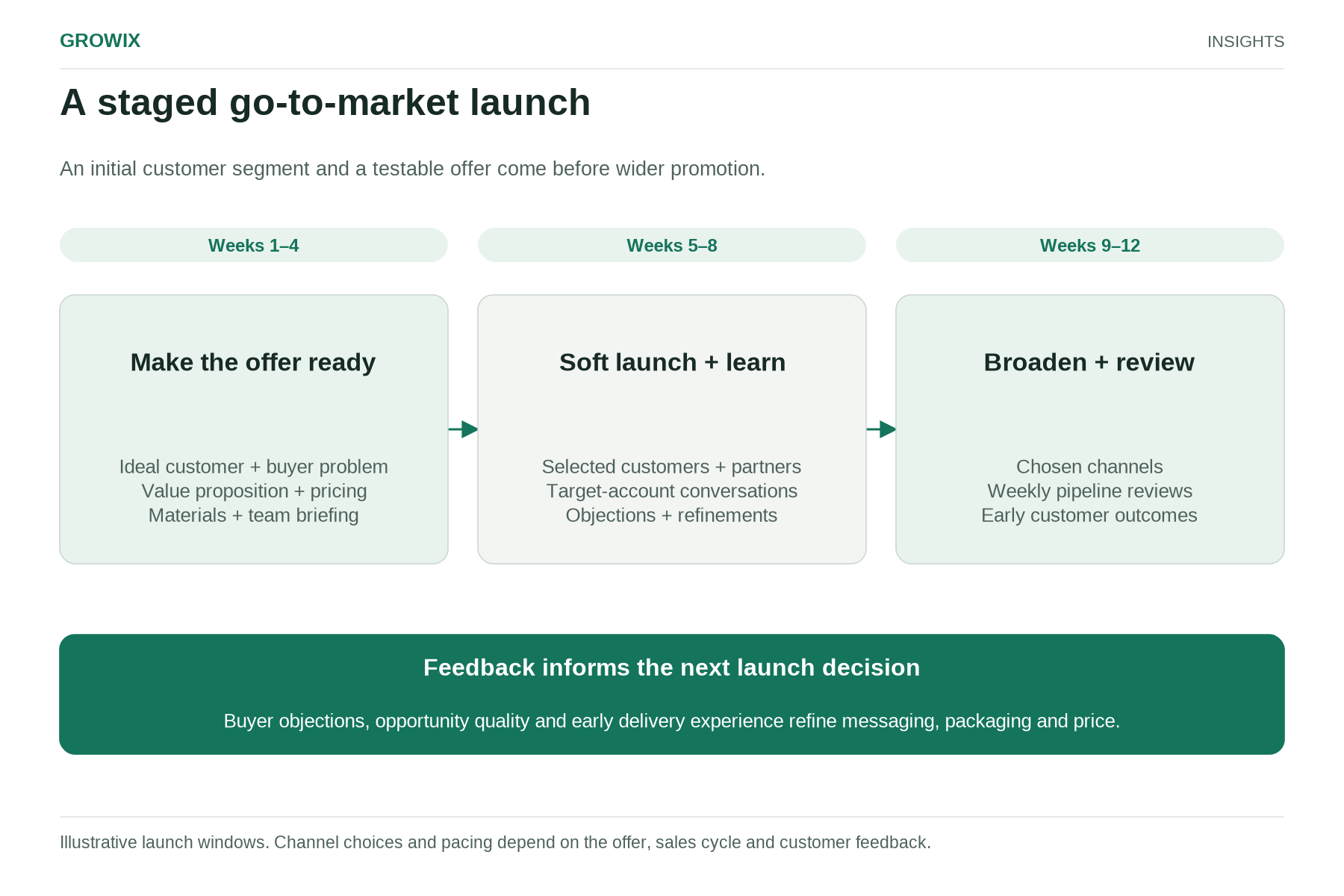
Weeks 1 to 4: finalize ICP, value proposition, pricing and sales materials; brief the team.
Weeks 5 to 8: soft launch to existing customers, partners and a target account list; collect objections and refine.
Weeks 9 to 12: broader launch through chosen channels; weekly reviews of pipeline and feedback.
Hypothetical example
The following scenario is invented for illustration.
An IT services firm launches a fixed-scope cloud cost review for mid-sized SaaS companies. Its target list contains 300 companies. It aims for 30 first meetings in the launch quarter, a 10% meeting rate, and 6 paid reviews, a 20% conversion from meeting to sale. The arithmetic: 300 × 0.10 = 30 meetings; 30 × 0.20 = 6 sales. After eight weeks it has 22 meetings but only 2 sales; interviews show buyers want a fixed price shown upfront, so it publishes pricing guidance and adds a smaller starter review.
A staged go-to-market launch. Illustrative launch windows. Channel choices and pacing depend on the offer, sales cycle and customer feedback. View full size
Early success: onboarding time, adoption and early retention for new customers.
Agree targets before launch, review weekly in the first quarter and decide in advance what result would trigger a change of segment, message or price.
Position against the real alternatives
Buyers rarely compare you only with direct competitors. They also consider doing nothing, building a solution in-house, using a tool they already own or hiring a consultant. For each alternative, write down:
Why a buyer might choose it.
Where it falls short for your ideal customer.
The evidence that shows your offer is better for that customer, such as a demo, a pilot result, a reference or a clear guarantee.
This analysis feeds directly into sales materials and objection handling. If you cannot explain why your offer beats the most common alternative, the launch is not ready.
Who owns what at launch
Role
Responsibility
Executive sponsor
Targets, budget and decisions to change course
Product or service lead
Offer definition, packaging and readiness to deliver
Marketing
Positioning, launch content, demand programs
Sales
Pipeline, discovery feedback, pricing exceptions
Customer success or delivery
Onboarding and early customer outcomes
Revenue operations
CRM setup, reporting and data quality
Agree one weekly meeting for the first quarter where these owners review the same dashboard and agree changes.
Common mistakes
Targeting everyone to avoid the risk of choosing.
Launching with feature lists instead of outcomes buyers recognize.
A sales motion that does not fit the price point.
No feedback loop from sales calls into messaging and pricing.
Judging the launch too early, before a full sales cycle has passed.
Frequently asked questions
What is a go-to-market strategy?
A go-to-market strategy is the plan for bringing an offer to a specific market: the target customer, value proposition, pricing, sales motion, channels and the measures used to track success.
What is the difference between a GTM strategy and a marketing plan?
A GTM strategy focuses on launching one offer into one market and covers product, pricing, sales and marketing choices. A marketing plan covers all of marketing's work for a year across the business.
How long does a go-to-market launch take?
Preparation often takes one to three months, depending on how much research and material is needed. Judge results over at least one full sales cycle for the new offer.
Next steps
Write your ICP, value proposition and sales motion on one page, then test them in ten conversations with target buyers before committing launch budget.