B2B Appointment Setting and Outsourced SDR Services: How to Set Them Up So Meetings Turn Into Pipeline
An outsourced SDR team can fill calendars quickly. Whether those meetings become pipeline depends on targeting, qualification rules and the handoff. A practical setup guide for B2B firms.
For many B2B services firms and SaaS companies, the constraint on growth is not closing deals but starting enough of the right conversations. Account executives and founders spend hours researching prospects, writing outreach and chasing replies, and still have thin calendars. Outsourcing sales development, the prospecting and qualification work usually done by sales development representatives (SDRs), is one way to add capacity without hiring and training an in-house team first.
It is also a function where outsourced appointment setting often disappoints. A provider can book plenty of meetings that never become pipeline: prospects who agreed to a call to be polite, companies too small to buy, or contacts with no role in the decision. This guide explains how to set up an outsourced SDR program for B2B services and SaaS so the meetings it produces are the ones your sales team wants.
What an outsourced SDR team does
A typical engagement covers some or all of the following:
List building and research: identifying target accounts and contacts that match your ideal customer profile.
Outreach: email, phone and social selling sequences, usually in your company's name.
Response handling: replying to interested prospects, answering early questions and handling objections.
Qualification: confirming that the prospect meets agreed criteria before booking a meeting.
Scheduling: booking meetings into your sales team's calendars, with confirmation and reminders.
Reporting: activity, replies, meetings booked, meetings held and feedback on messaging.
What it should not do is take over the sales conversation. The outsourced team opens doors; your people discover needs, shape solutions and close.
Why B2B services and SaaS are a particular case
Buying groups are complex. Purchases often involve several people, so a meeting with one interested contact may not represent a real opportunity.
Offers need explanation. Professional services and software are rarely bought on price alone; outreach has to convey a specific problem and outcome credibly.
Deal values justify careful targeting. A small number of well-chosen accounts can matter more than volume.
Your brand is on every message. Poorly targeted or aggressive outreach in your name damages reputation in a market where buyers talk to each other.
Step 1: Define who you want to meet
Most failed programs start with a vague target. Before engaging a provider, document:
Ideal customer profile: industry, company size range, geography, technology or operating characteristics, and trigger events such as funding, expansion, new leadership or regulatory change.
Buyer personas: the roles that feel the problem, the roles that sign, and the roles that can block a deal.
Exclusions: current customers, open opportunities, partners, competitors and accounts your sales team is already working.
Priority accounts: for higher-value offers, a named account list may be better than broad targeting.
Use your own closed-won data to build this. The characteristics of your best existing customers are more reliable than assumptions about who should buy.
Step 2: Agree what counts as a qualified meeting
Write qualification criteria down and make them part of the contract or statement of work. A practical definition includes:
Criterion
Example standard
Account fit
Matches the ideal customer profile and is not excluded
Contact role
Holds or directly influences the relevant budget or decision
Problem
Confirms a relevant problem or initiative, in their own words
Timing
Has a plausible need within an agreed horizon, such as the next two quarters
Commitment
Accepts a calendar invitation with a clear agenda
Many teams adapt established qualification frameworks covering budget, authority, need and timing. The exact labels matter less than consistency: your sales team and the provider must apply the same test.
Also define what happens to prospects who are interested but not yet qualified. They should be routed to marketing nurture, not forced into a meeting.
Step 3: Build messaging that sounds like your company
Outsourced SDRs need more than a script. Provide:
Positioning: the problems you solve, for whom, and how you differ from alternatives.
Proof you can actually use: published case studies, product capabilities and facts you can stand behind. Do not let outreach make claims your company has not approved.
Persona-specific angles: what an operations leader cares about differs from what a finance leader cares about.
Objection handling: honest answers to common pushbacks, including when to accept a "no".
Tone guidance: examples of messages you like and dislike.
Review the first sequences before launch, then review samples weekly during the first month.
Step 4: Stay within email and calling rules
Business-to-business outreach is not exempt from commercial email rules. The Federal Trade Commission's CAN-SPAM compliance guide for business states: "The law makes no exception for business-to-business email." The guide sets out requirements including not using false or misleading header information or deceptive subject lines, identifying the message as an advertisement, telling recipients where you are located, giving recipients a clear way to opt out and honoring opt-out requests within 10 business days. It also states that even if you hire another company to handle your email marketing, you cannot contract away your legal responsibility to comply.
Telephone outreach and text messages are subject to separate federal and state rules, and outreach to prospects in other countries may fall under different privacy and marketing laws. Agree with your provider who maintains suppression and opt-out lists, how they are synchronized with your CRM and how data is handled, and have counsel review the program where you are unsure. This article is general information, not legal advice.
Deliverability is a practical concern too. Sending large volumes from your primary domain can harm the reputation of the email your customers rely on. Many companies use carefully configured secondary sending domains, warm them gradually and keep volumes moderate.
Step 5: Design the handoff
The handoff is where most value is lost. Set clear rules:
Meeting notes in the CRM before the meeting: who the prospect is, why they agreed, the problem they described and any questions.
Calendar invitations that state the agenda and include your account executive, not only the SDR.
Confirmation and reminders the day before, to reduce no-shows.
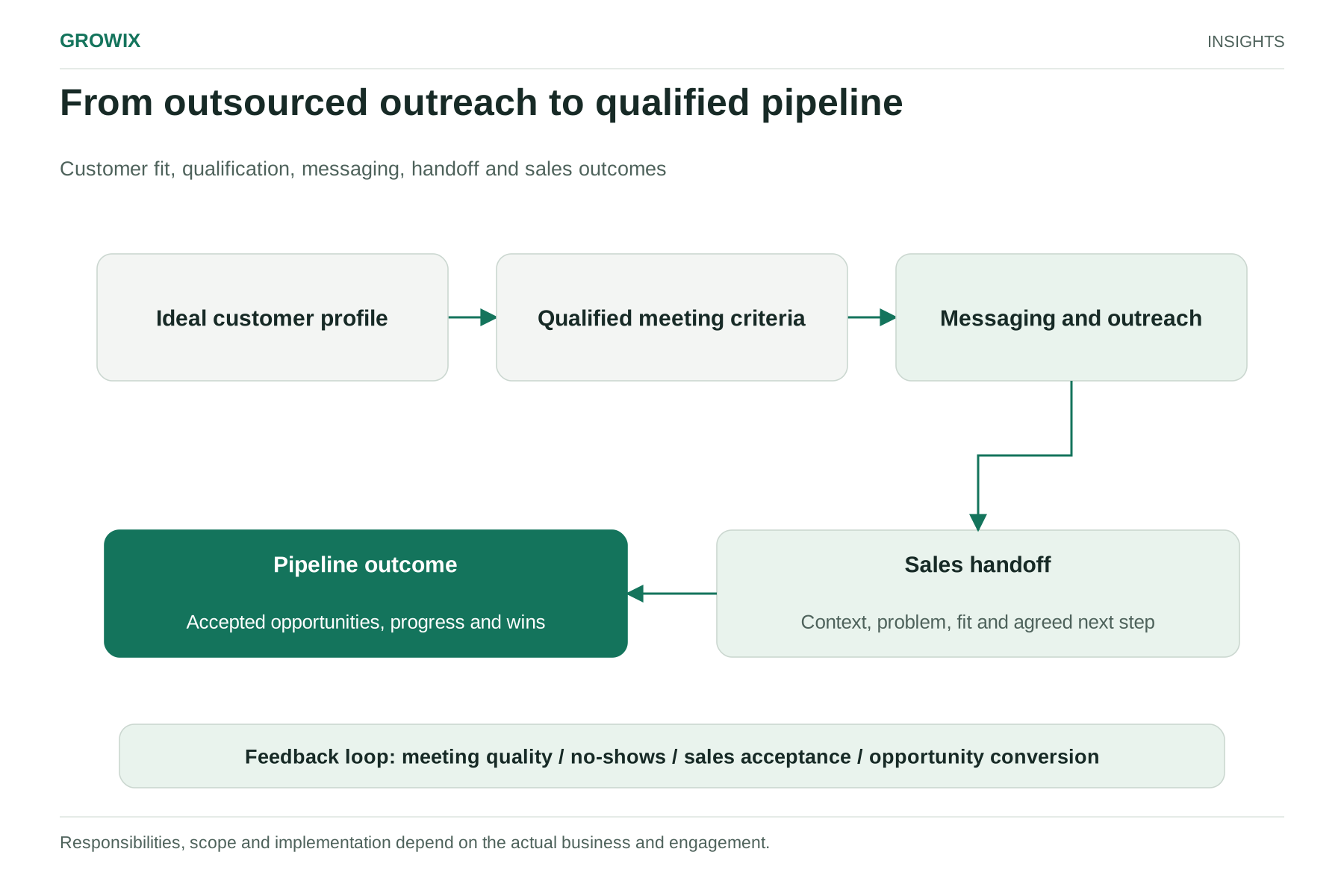
A feedback loop: within a set time after each meeting, the account executive marks it as accepted or rejected against the qualification criteria, with a reason.
A dispute process: agreed in advance, for meetings your team believes did not meet the standard.
Without the feedback loop, the provider has no way to learn what your sales team values, and disagreements about quality become arguments rather than data.
From outsourced outreach to qualified pipeline. Responsibilities, scope and implementation depend on the actual business and engagement. View full size
Step 6: Measure what matters
Activity numbers are easy to report and easy to inflate. Track the whole funnel:
Measure
Why it matters
Accounts and contacts reached
Shows coverage of the target market
Positive reply rate
Indicates whether messaging and targeting resonate
Meetings booked
Volume of output
Meetings held
Exposes no-show problems
Meetings accepted as qualified
The main quality test
Opportunities created
Whether meetings turn into pipeline
Pipeline value and closed revenue
The business result, measured over a sales cycle
Cost per qualified meeting and per opportunity
The economics that justify the program
Expect a ramp period. Lists, messaging and qualification usually need several weeks of iteration before results stabilize, and closed revenue lags meetings by at least one sales cycle.
Pricing models and how they shape behavior
Providers commonly charge in one of three ways, sometimes combined:
Retainer for dedicated capacity: a fixed monthly fee for a set number of SDRs or hours. It aligns with careful targeting but places the performance risk on you.
Pay per meeting: a fee for each meeting booked or held. It can be attractive at first but can encourage volume over quality unless qualification and dispute rules are tight.
Hybrid: a lower retainer plus a fee per qualified meeting or opportunity.
Whichever model you choose, tie payment to meetings that meet the agreed standard, not merely meetings booked.
Hypothetical example: a 40-person IT consultancy
The following scenario is invented for illustration, and all figures are assumptions.
An IT consultancy wants more conversations with operations and finance leaders at mid-sized manufacturers. It engages an outsourced SDR team on a three-month pilot covering 400 named accounts.
Whether this is good value depends on the consultancy's win rate and deal size. If it typically wins one in four opportunities, eight opportunities would be expected to yield about two clients. The leadership team compares that with its gross margin per client and the cost of hiring and training an in-house SDR before deciding whether to extend the pilot.
Common mistakes
Starting outreach before targeting and qualification are agreed.
Measuring meetings booked rather than meetings accepted and opportunities created.
Letting the provider make claims your company cannot support.
Ignoring rejected meetings instead of using them to improve targeting.
Ending a pilot too early, before messaging has been tested and refined.
Treating outsourced SDRs as separate from marketing, so nurture and outreach send conflicting messages.
When to build in-house instead
An outsourced team is often a good way to test a market, add capacity quickly or cover a gap while you hire. An in-house team may be better when your product is highly technical and conversations need deep expertise from the first call, when deal volumes are high and stable enough to justify a managed SDR function, or when you want SDRs to develop into account executives over time. Some companies use both: an outsourced team for new segments and an in-house team for core accounts.
When Growix may not be the right fit: if you do not yet have a defined offer, pricing and a sales person able to run discovery calls, adding outreach capacity will not help; settle the offer first. And if your outreach depends on large-volume consumer telemarketing, a specialist in that regulated area is a better choice.
Positioning, messaging guidance, nurture for not-yet-ready prospects
Account executives
Prepared meetings, timely feedback in the CRM
Revenue operations
CRM setup, routing, suppression lists, reporting
Outsourced SDR team
Research, outreach, qualification, scheduling and weekly reporting
Frequently asked questions
What do B2B appointment setting services do?
They research target accounts, run outreach by email, phone and social channels in your company's name, qualify interested prospects against agreed criteria and book meetings into your sales team's calendars, with notes in your CRM. Your own team runs the sales conversation from there.
How much does outsourced appointment setting cost?
Providers usually charge a monthly retainer for dedicated capacity, a fee per meeting booked or held, or a hybrid of the two. Judge cost per qualified meeting and per opportunity, not per meeting booked; in this guide's hypothetical pilot, $27,000 produced 24 qualified meetings, or $1,125 each.
Is B2B cold email legal in the US?
Commercial email rules still apply to business recipients: the FTC's CAN-SPAM guidance states that the law makes no exception for business-to-business email. Messages need accurate headers and subject lines, a physical address and a working opt-out honored promptly. This is general information, not legal advice.
Next steps
Pull your last 20 closed-won deals and write down what they had in common: industry, size, role of the first contact and the trigger that started the conversation. That becomes the brief for an outsourced SDR pilot and the standard for judging the meetings it books.