The short answer: lead generation captures interest that already exists and turns it into contacts sales can follow up. Demand generation creates that interest in the first place, by making more of the right buyers aware of a problem and of your company as a credible way to solve it. Fund lead generation first when buyers already search for what you sell and your pipeline needs results this quarter. Shift more budget toward demand generation when your category is new, your brand is unknown to the buyers you want, or your lead channels have become expensive because you are competing for the same small pool of active buyers. Most B2B companies need both, and the right split depends on how many buyers in your market are actively looking at any moment.
The terms defined
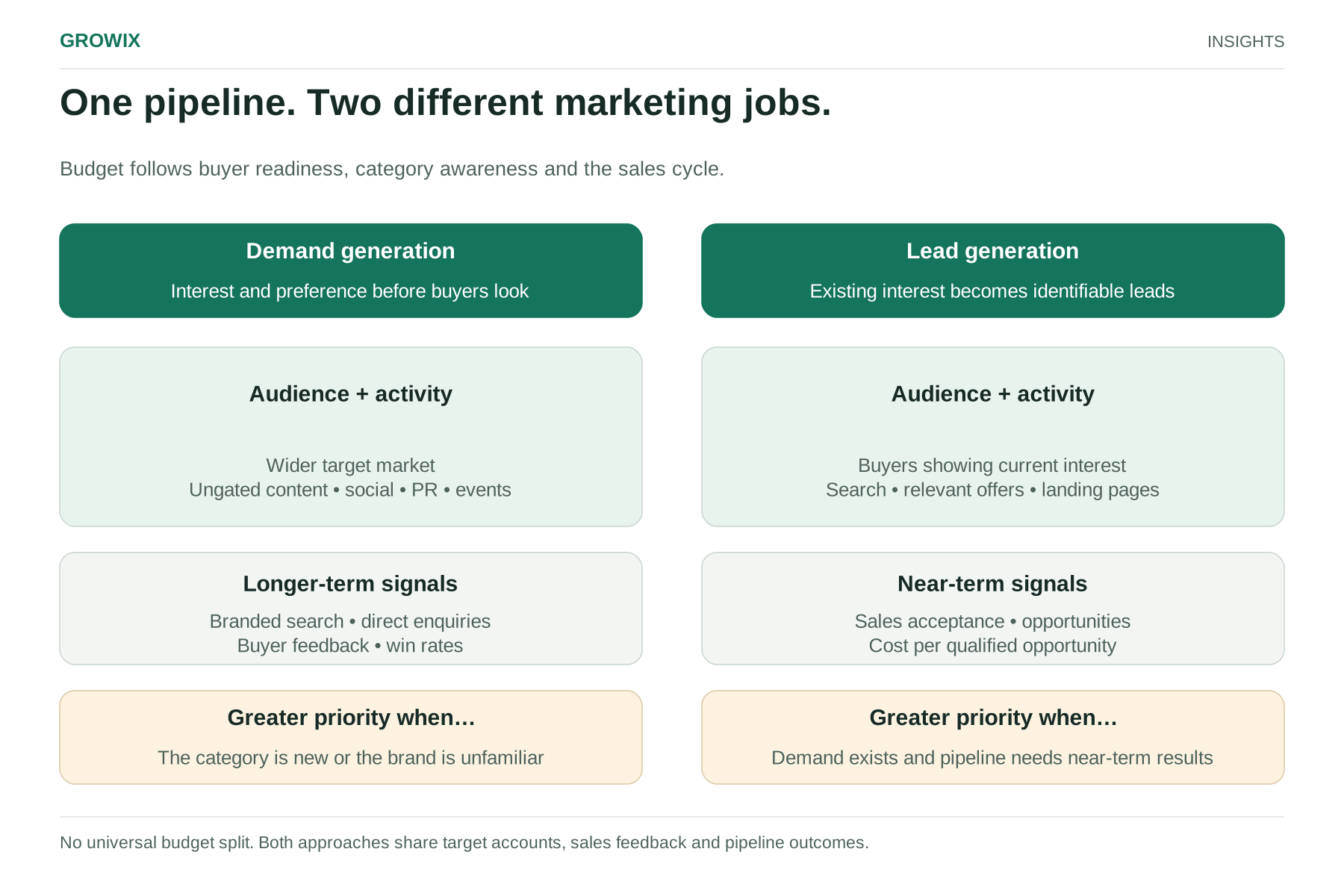
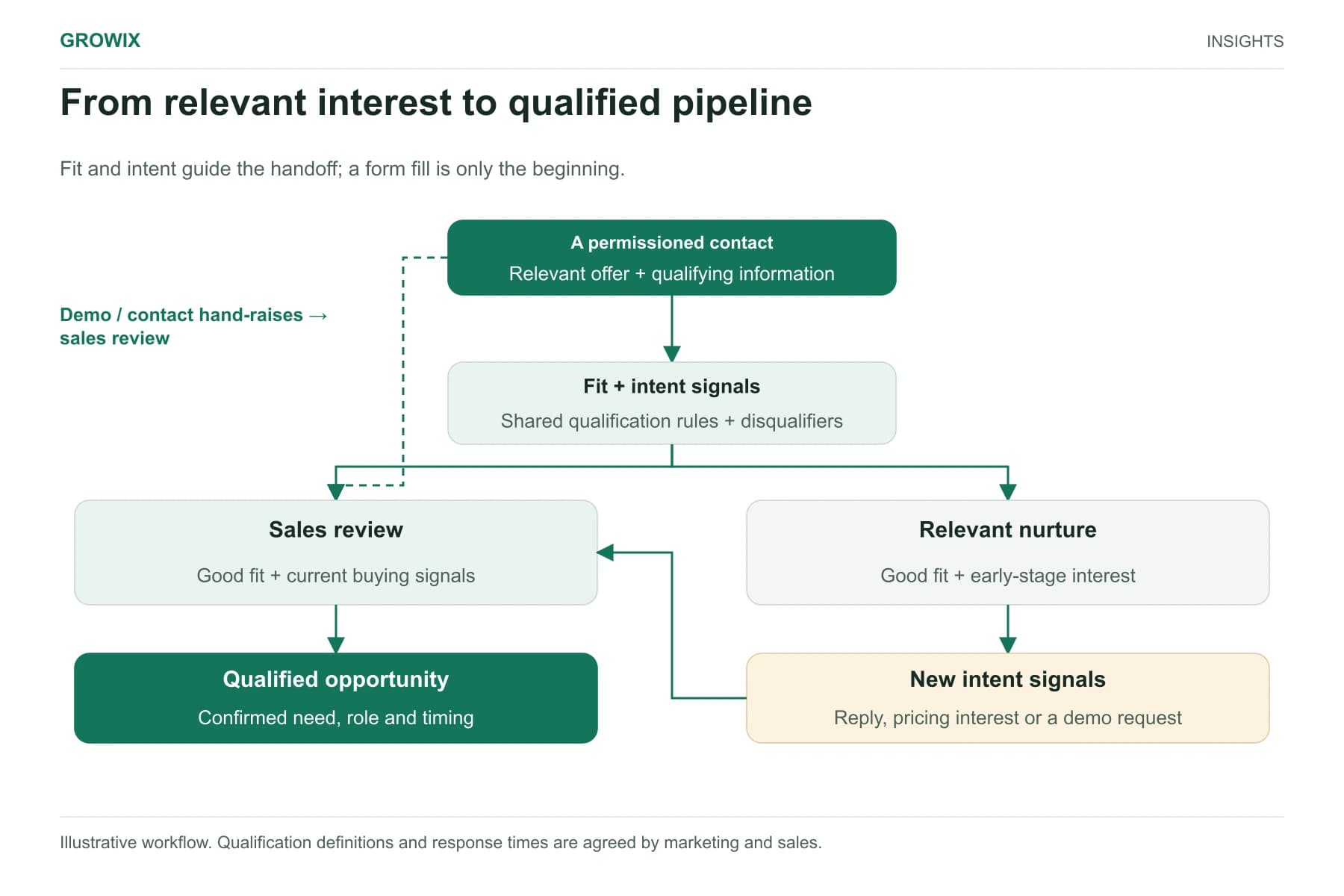
Lead generation is the set of activities that turn existing interest into identifiable leads: search ads on high-intent terms, landing pages, gated offers such as calculators and templates, webinars with registration, outbound prospecting and appointment setting. Success is measured in qualified leads, opportunities and cost per opportunity.
Demand generation is the broader work of building interest and preference among buyers who are not yet looking: ungated educational content, thought leadership, podcasts and video, social distribution, PR, community and events, and brand advertising to a defined audience. Success shows up over a longer period, in more people searching for you by name, more direct enquiries and higher conversion rates across every channel.
The two overlap. A useful article can create demand for one reader and capture a lead from another. The distinction matters mainly when you decide where the next budget goes and how you judge whether it worked.
How they compare
| Factor | Lead generation | Demand generation |
|---|
| Goal | Capture existing interest as qualified leads | Create interest and preference before buyers look |
| Audience | Buyers who are actively looking | The wider market, most of whom are not buying yet |
| Typical tactics | Search ads, gated offers, webinars, outbound | Ungated content, social, PR, events, brand ads |
| Time to results | Weeks | Months to years |
| Main measures | Qualified leads, opportunities, cost per opportunity | Branded search, direct enquiries, share of voice, win rates |
| Risk if overused | Rising cost per lead as you compete for few buyers | Spend without a clear link to pipeline |
| Risk if neglected | Pipeline gaps this quarter | A shrinking pool of buyers who know you |
Why the balance matters
In most B2B markets, only a small share of potential buyers are actively looking for a solution at any given time. Lead generation competes for that small group, often against every other vendor bidding on the same search terms and offering similar downloads. As more companies chase the same in-market buyers, costs rise.
Demand generation works on the much larger group who will buy later. When those buyers start looking, they are more likely to search for you by name, contact you directly and choose you over vendors they have never heard of. That is why companies that only fund lead generation often see their cost per lead rise year after year, while companies that only fund demand generation struggle to show a pipeline return.
Buyer behavior also pushes in this direction. Gartner reported in a May 2026 press release that 67% of B2B buyers prefer a buying experience without a sales representative. Buyers who research on their own form preferences before they ever fill in a form, so being known and trusted before that point matters more.
Measure each on its own terms
Judging demand generation by last-click leads makes it look worthless; judging lead generation by brand awareness makes it look unaccountable. Use different measures for each, and connect both to pipeline.
Lead generation measures:
- Qualified leads and sales acceptance rate, by channel and offer.
- Cost per qualified lead and per opportunity.
- Opportunity to customer conversion and sales cycle length.
Demand generation measures:
- Branded search volume and direct traffic over time.
- Self-reported attribution: what buyers say in an open "How did you hear about us?" field.
- Engagement from target accounts with ungated content.
- Win rates and deal size for buyers who engaged with content before talking to sales.
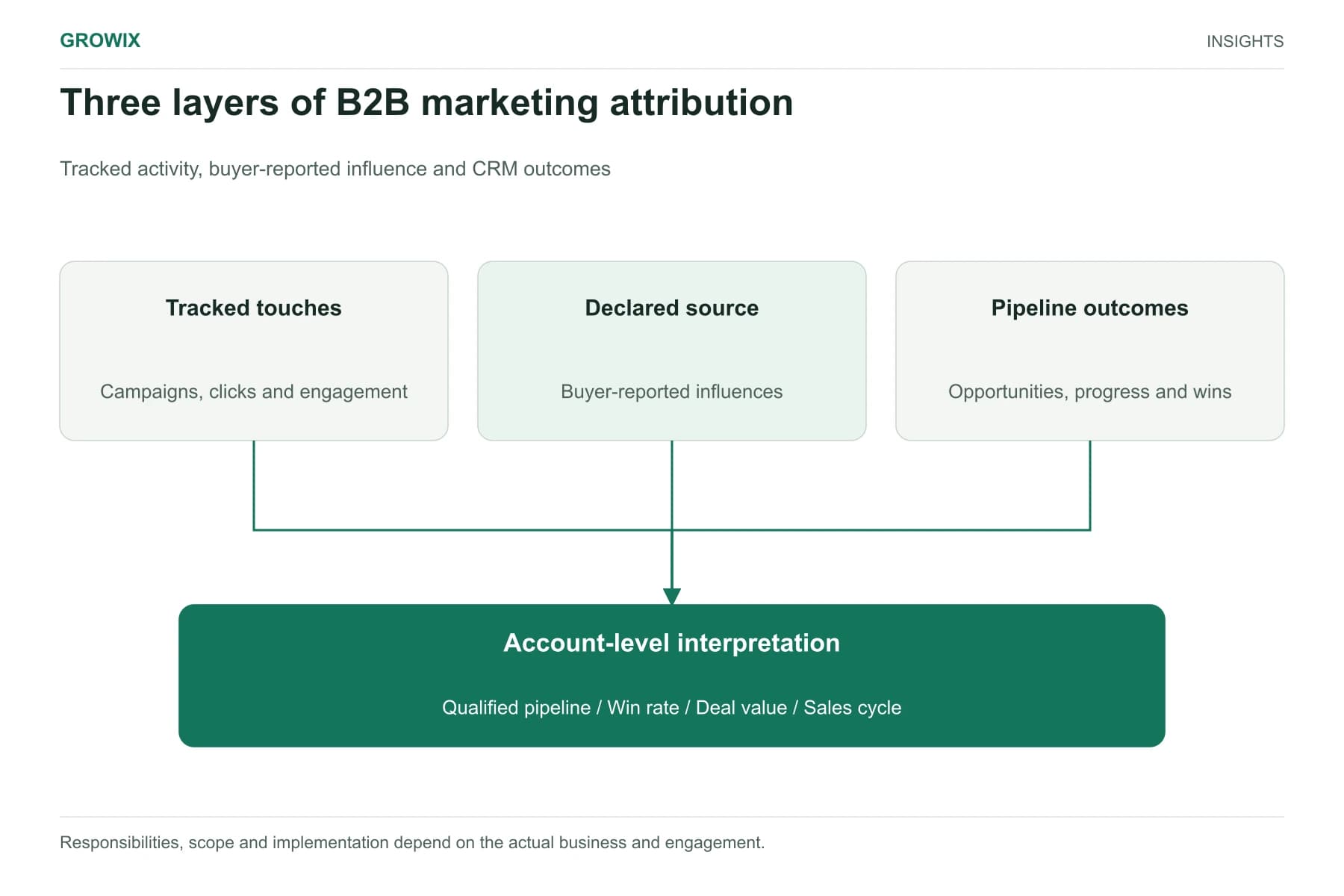
For a practical way to combine tracked data, self-reported answers and CRM outcomes, see our guide to B2B marketing attribution.
Hypothetical budget split
The following scenario is invented for illustration, and all figures are assumptions rather than benchmarks or Growix pricing.
A B2B software company spends $30,000 a month on marketing programs, all on lead generation: search ads, gated guides and webinars. Cost per opportunity has risen from $2,000 to $3,000 over two years, so the same budget now produces 10 opportunities a month instead of 15. The arithmetic: $30,000 ÷ $3,000 = 10, against $30,000 ÷ $2,000 = 15.
The company moves 30% of the budget, $9,000 a month, into demand generation: ungated practical content, a monthly expert video series distributed on LinkedIn and a small brand campaign aimed at its target accounts. The remaining $21,000 stays on the best-performing lead generation channels.
In the short term, opportunities from paid channels fall, because there is less lead generation spend. The company accepts that for two quarters and tracks branded search, direct demo requests and self-reported mentions of the video series. If those rise and cost per opportunity across all channels starts to fall, it keeps or increases the demand generation share. If nothing moves after two to three quarters, it revisits the content and audience before cutting the budget.
When each fits
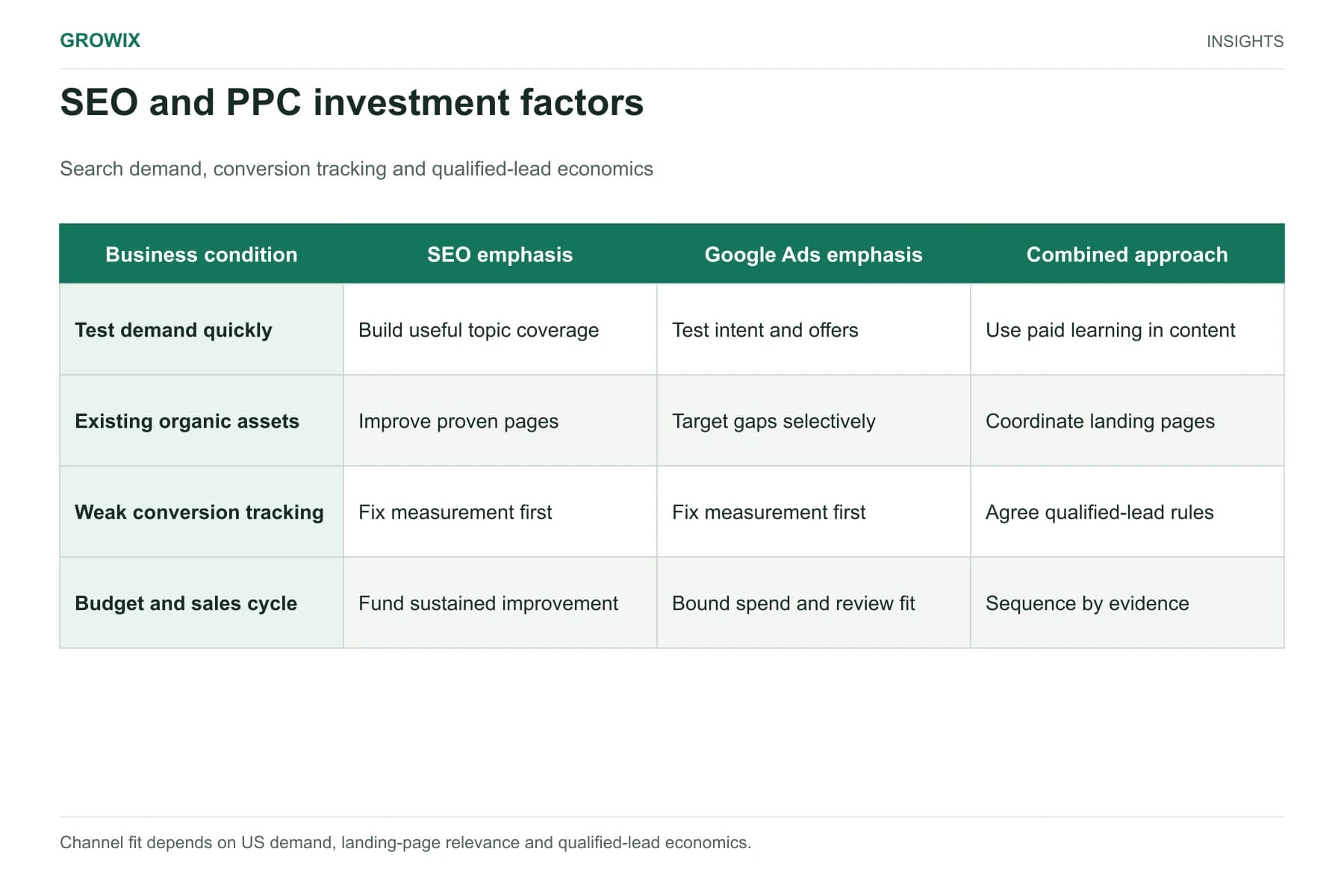
Prioritize lead generation when:
- Buyers already search for what you sell, in volumes worth capturing.
- The pipeline needs results this quarter.
- You have strong offers and a sales team ready to follow up quickly.
Prioritize demand generation when:
- Your category is new, or buyers do not yet recognize the problem you solve.
- Your brand is unknown among the buyers you want.
- Cost per lead keeps rising and lead quality keeps falling.
- Deals are large, cycles are long and buying groups are big.
Run both deliberately when you have a steady sales motion and want to make it more efficient over time, which describes most growing B2B companies. Agree the split, the measures for each and a review date in advance.
When Growix may not be the right fit: if your market is very small and every buyer is already known by name, account-based sales work and direct relationships may matter more than either marketing program. And if you need results within weeks only, demand generation will not deliver them on that timescale.
A decision checklist
- How many potential buyers in your market are actively looking at any one time, and do they search for what you sell?
- Is your cost per opportunity rising, flat or falling?
- How well known is your company among the buyers you most want?
- How long is your sales cycle, and how many people are involved in a decision?
- Can you measure branded search, direct enquiries and self-reported attribution today?
Common mistakes
- Calling every gated download "demand generation." If the main goal is a form fill, it is lead generation, and it should be measured that way.
- Cutting demand generation after one quarter because last-click reports show few leads, before branded search and direct enquiries have had time to move.
- Running demand generation without a defined audience. Broad awareness among people who will never buy is expensive and hard to connect to pipeline.
- Letting the two teams compete. Content, paid media and sales development should share one view of target accounts, messages and results.
- Ignoring sales feedback. Sales hears what buyers already believe about you, which is the clearest signal of whether demand generation is working.
Frequently asked questions
What is demand generation?
Demand generation is marketing that creates interest in a problem and in your company before buyers start actively looking: educational content, thought leadership, social media, PR, events and brand advertising to a defined audience. Its results show up later, as more people searching for you, contacting you directly and choosing you.
Is demand generation the same as brand marketing?
They overlap. Brand marketing builds recognition and associations with your name. Demand generation in B2B usually focuses on educating a defined audience of potential buyers about a problem and your approach to it, and it is expected to influence pipeline over time.
How much budget should go to demand generation?
There is no universal ratio. Start from your market: the fewer buyers who are actively looking at any one time, and the less known your brand is, the larger the share that should go to demand generation. Move budget in steps, measure for at least two quarters and adjust.
Next step
Pull your cost per opportunity by channel for the last eight quarters and your branded search trend for the same period. If costs are rising and branded search is flat, it is time to fund demand generation deliberately.
Growix's Lead & Demand Generation team creates demand in the market and converts it into qualified leads, and our Marketing Funnel Development team designs the full journey from first touch to customer as one connected system. For the mechanics of capturing and qualifying leads, see our guide to B2B lead generation.
Discuss your marketing priorities