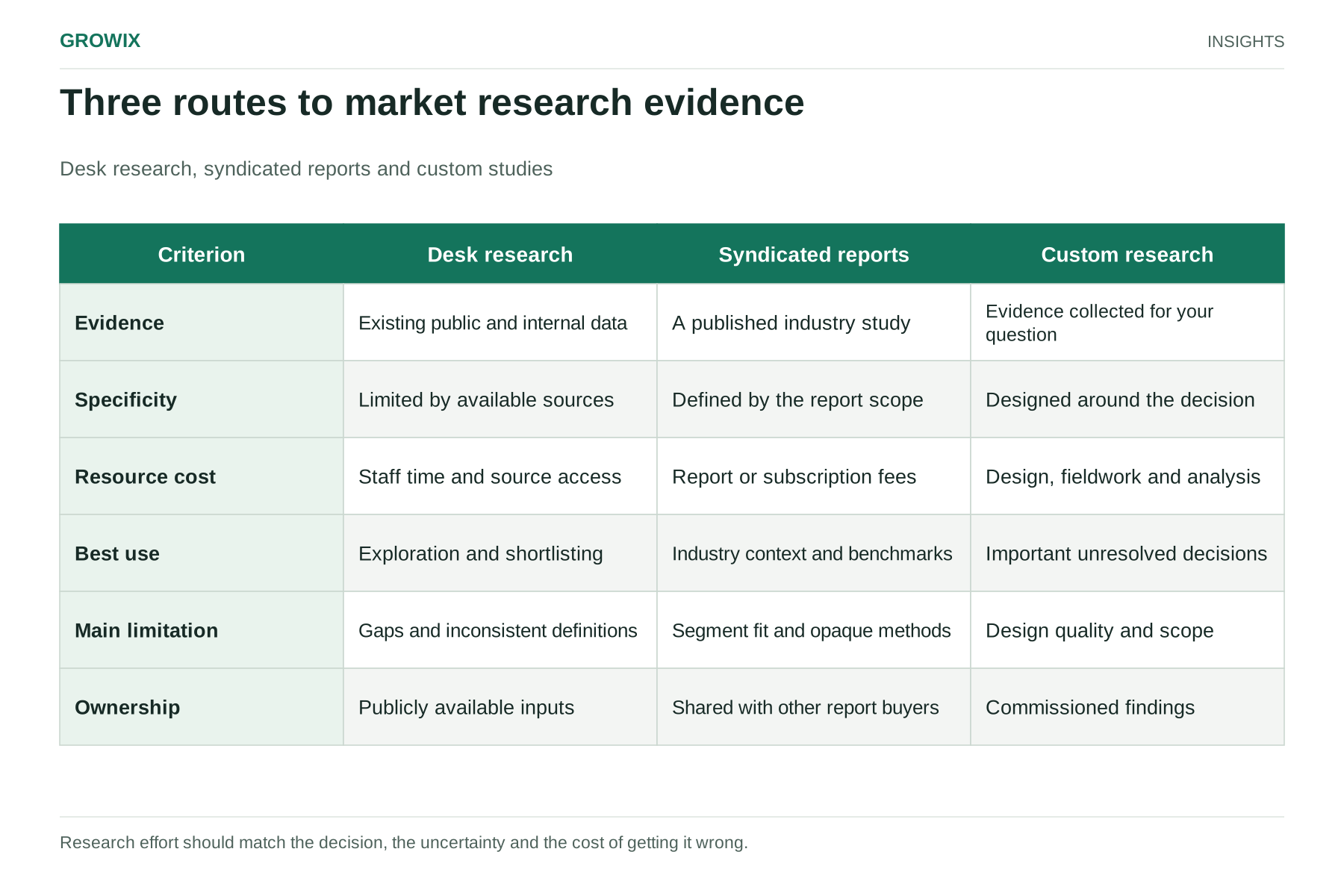
The short answer: the best way to do market research is to start with the decision, not the research method. For early exploration and modest decisions, careful desk research using free public data, company filings, trade sources and your own customer data answers more than most teams expect. Buy syndicated reports when you need an established industry view, market size estimates or benchmarks quickly and the publisher covers your exact segment. Commission custom research when the decision is large, specific to your business and depends on evidence nobody has published, such as how a particular buyer group will respond to your offer. Many good decisions use all three in sequence.
The three options defined
DIY desk research (secondary research done in-house). Your team gathers and analyzes existing information: government statistics, company websites and filings, trade association publications, news, job postings, review sites and your own sales and customer data.
Syndicated reports. Research produced by a publisher and sold to many buyers: industry reports, market size and forecast studies, analyst coverage, panel data and benchmarks. You buy access to research designed for a broad audience.
Custom research. Research designed for your specific question and owned by you: customer and prospect interviews, surveys, pricing studies, competitor analysis, field research in new markets and feasibility assessments.
How the options compare
| Factor | DIY desk research | Syndicated reports | Custom research |
|---|
| Cost | Staff time; often no direct cost | From modest single reports to substantial subscriptions | Highest; scales with scope and sample |
| Speed | Days to weeks | Immediate on purchase | Weeks to months |
| Specificity to your question | Depends on available data | Low to moderate; written for many buyers | High |
| Exclusivity | None | None; competitors can buy the same report | Yours |
| Methodology transparency | You control it | Varies; check sample and method | You specify it |
| Best for | Exploration, sizing, competitor scans, hypothesis building | Industry context, benchmarks, investor-ready market figures | Major decisions, new offers, pricing, market entry |
| Main risk | Gaps, bias, inconsistent sources | Wrong segment definitions; outdated or opaque figures | Poor design; asking the wrong question; cost |
What desk research can do well
Free and low-cost sources go further than many teams assume. In the United States, the Census Bureau's County Business Patterns program publishes annual counts of business establishments, employment and payroll by industry and geography, which is useful for sizing a business-to-business market in a region. The Bureau of Labor Statistics publishes employment and wage data by occupation and industry. Public company filings, trade association reports, competitor websites, pricing pages, job postings and customer reviews reveal how competitors position themselves and where they are investing.
Your own data is often the most valuable source of all: win and loss reasons, customer interviews conducted by sales, support tickets, web search queries on your site and the characteristics of your best customers.
Desk research works best when a skilled analyst documents sources, states assumptions and separates facts from estimates. Its weaknesses are gaps, inconsistent definitions between sources and the risk of finding what you hoped to find.
When syndicated reports are worth buying
Syndicated research earns its price when:
- You need a credible, citable market size or growth estimate quickly, for example in a board paper or investor deck.
- The publisher's segment definitions match your market closely.
- You need benchmarks, such as typical margins, pricing or adoption rates, that you could not gather yourself.
- The methodology is disclosed: sample sizes, data sources, dates and definitions.
Before buying, ask for the table of contents, the methodology section and a sample chart. Check the publication date and whether forecasts have been revised. Market size figures for the same "market" can differ widely between publishers because definitions differ; understand what is included before quoting a number.
When custom research is worth commissioning
Custom research is justified when the decision is significant and depends on information specific to your business:
- Entering a new market or segment: how buyers there currently solve the problem, what they would pay and which competitors they trust.
- Launching or repricing an offer: willingness to pay, packaging preferences and purchase drivers.
- Understanding lost deals or churn: independent interviews often reveal reasons customers will not tell your sales team.
- Testing positioning: how your proposition compares with alternatives in buyers' own words.
A useful rule: the more expensive or irreversible the decision, the stronger the case for custom evidence. Spending a modest share of an expansion budget to avoid entering the wrong market is usually good value.
Designing custom research well
- Start with the decision and the specific questions that would change it.
- Choose methods to fit: qualitative interviews to understand why and how; surveys to measure how many; experiments, such as landing page tests or pilot offers, to observe behavior.
- Recruit the right respondents: actual buyers and decision-makers, not convenient contacts.
- Avoid leading questions and separate what people say from what they do.
- Agree outputs in advance: findings tied to recommendations, with raw data and methodology.
A hypothetical example: three stages for one decision
The following scenario is invented for illustration.
A B2B equipment maintenance company considers expanding into a neighboring state.
- Desk research (two weeks): County Business Patterns data on the number of target-industry establishments in the state, competitor websites and reviews, job postings showing competitors hiring technicians, and the company's own data on what its best current customers look like.
- Syndicated report (one purchase): an industry report for benchmark service pricing and outsourcing rates, checked for segment fit and date.
- Custom research (six weeks): 20 interviews with operations managers at target companies in the new state, covering current providers, satisfaction, switching triggers and price expectations.
The desk research showed the market was large enough; the interviews revealed that buyers valued guaranteed response times more than price, which reshaped the entry offer.
Choose by decision size and confidence needed
| Situation | Suggested approach |
|---|
| Early idea; deciding whether to explore further | DIY desk research |
| Board or investor needs a market context slide | Desk research plus a carefully checked syndicated figure |
| Choosing between two or three markets to enter | Desk research to shortlist, custom interviews to choose |
| Launching or repricing a core offer | Custom research, possibly including a live test |
| Ongoing competitor monitoring | Structured desk research on a regular schedule |
When Growix may not be the right fit: if you need a large quantitative survey with a nationally representative consumer sample, or continuous panel data, a specialist research agency or panel provider is the right supplier. And if a decision is small and reversible, a short internal desk review may be all it needs.
Budgeting research in proportion to the decision
There is no standard percentage to spend on research, but the logic is simple: compare the research cost with the cost of being wrong. If a market entry would commit a year of salaries, leases and marketing, a few weeks of interviews that could change or stop the decision is cheap insurance. If the decision can be reversed next quarter at little cost, a short desk review and a small live test are usually better value than a formal study.
Before approving a budget, write down what result would change the decision. If no plausible finding would change it, the research is confirmation, not evidence, and the money is better spent elsewhere.
Questions to ask a research provider
- How will you recruit respondents, and how will you confirm they are real buyers or decision-makers?
- How many interviews or responses do you recommend, and why is that enough for this question?
- Will we receive the raw data, transcripts or recordings, and the full questionnaire?
- How will you separate what respondents say they will do from evidence of what they actually do?
- What will the final output contain: findings only, or findings tied to specific recommendations?
Gathering competitor intelligence ethically
Competitor research should rely on public and legitimately obtained information: websites, pricing pages, filings, published case studies, job postings, reviews, trade show materials and conversations with customers who choose to share their experience. Avoid misrepresenting who you are to obtain information, and do not ask new hires or candidates to share a former employer's confidential material. Apart from the legal risk, evidence gathered that way is hard to use openly in a board paper.
Turning findings into decisions
Research only creates value when someone acts on it. Ask for findings in a short decision memo: what we learned, how confident we are, what it means for the decision and what we recommend. Record the assumptions the research supported or disproved, and revisit them after launch to check whether the market behaved as expected.
Common mistakes
- Buying a report to answer a question it was not designed for.
- Quoting market size figures without understanding their definitions.
- Surveying your own happy customers and treating the results as market evidence.
- Commissioning research after the decision is made, to justify rather than inform.
- Ignoring internal data that already answers part of the question.
A decision checklist
- What decision will this research inform, and by when?
- What would we need to believe to make that decision?
- What do we already know from our own data?
- Is credible published information available for our exact segment?
- How costly would a wrong decision be?
Frequently asked questions
What are the main types of market research?
Research is usually described as secondary, which uses existing information such as government statistics, filings and reports, or primary, which collects new information through interviews, surveys and tests. Syndicated reports are secondary research sold to many buyers; custom research is primary research designed for your question.
How much does market research cost?
Desk research mainly costs staff time. Syndicated reports range from modest single reports to substantial subscriptions. Custom research costs the most and scales with scope and sample size. Size the budget against the cost of making the decision wrongly.
How can a small business do market research on a budget?
Start with your own data, such as win and loss reasons, customer interviews, support tickets and site searches, then use free public sources like Census County Business Patterns, Bureau of Labor Statistics data, competitor websites, job postings and reviews. Add a small number of customer interviews before any large spend.
Next step
Write down the decision, the date it must be made and the three questions that would most change it. Then check what your own data and free public sources can answer before paying for anything.
Growix's Market Research & Competitive Intelligence team assesses markets, industries and competitors so decisions rest on evidence, and our Business Expansion & Market Entry team tests feasibility and plans specific geographic moves. For turning research into an annual plan, see 2027 growth planning for B2B SaaS.
Discuss your growth and operating priorities