Ask a B2B leadership team which marketing activity produces revenue, and you often get three different answers. The analytics dashboard credits paid search, because that was the last click before the form. Sales credits the event where they met the buyer. The buyer, if asked, mentions a podcast, a peer recommendation or an AI assistant's summary that no tool recorded.
All three can be partly right. B2B marketing attribution is difficult because buying cycles last months, several people from the buying company are involved, much of the research happens where you cannot track it, and the outcome that matters, a signed contract, happens in a CRM long after the website visit. Perfect attribution is not achievable. Useful attribution is: a consistent view that is good enough to shift budget from what does not work toward what does.
This guide sets out a practical three-layer approach for B2B services and software companies, explains what current analytics tools can and cannot do, and shows how to report on pipeline rather than clicks.
Why click-based attribution misleads in B2B
Most analytics attribution assigns credit to the website visits that preceded a conversion, such as a form submission. In B2B that creates predictable distortions:
- The conversion is the wrong event. A form fill is not revenue. Many leads never become qualified opportunities, and the channels that produce the most form fills are not always the ones that produce the most pipeline.
- The buying group is invisible. Five people at the buying company may research independently on different devices. Analytics sees five strangers.
- Untracked influence is large. Word of mouth, communities, events, podcasts, review sites and AI assistants shape decisions without leaving a click trail.
- Time windows are too short. A deal that closes nine months after first contact falls outside many default lookback windows.
- Privacy controls reduce tracking. Consent requirements, browser restrictions and ad blockers mean some visits are never recorded.
Analytics tools have also simplified their options. Google's documentation on attribution in Google Analytics states that three attribution models are available in its Attribution reports: data-driven attribution, paid and organic last click, and Google paid channels last click. The first click, linear, time decay and position-based models were removed in November 2023. Data-driven attribution can help within the tracked web journey, but it cannot see what happens outside your site or inside your sales process.
A three-layer approach
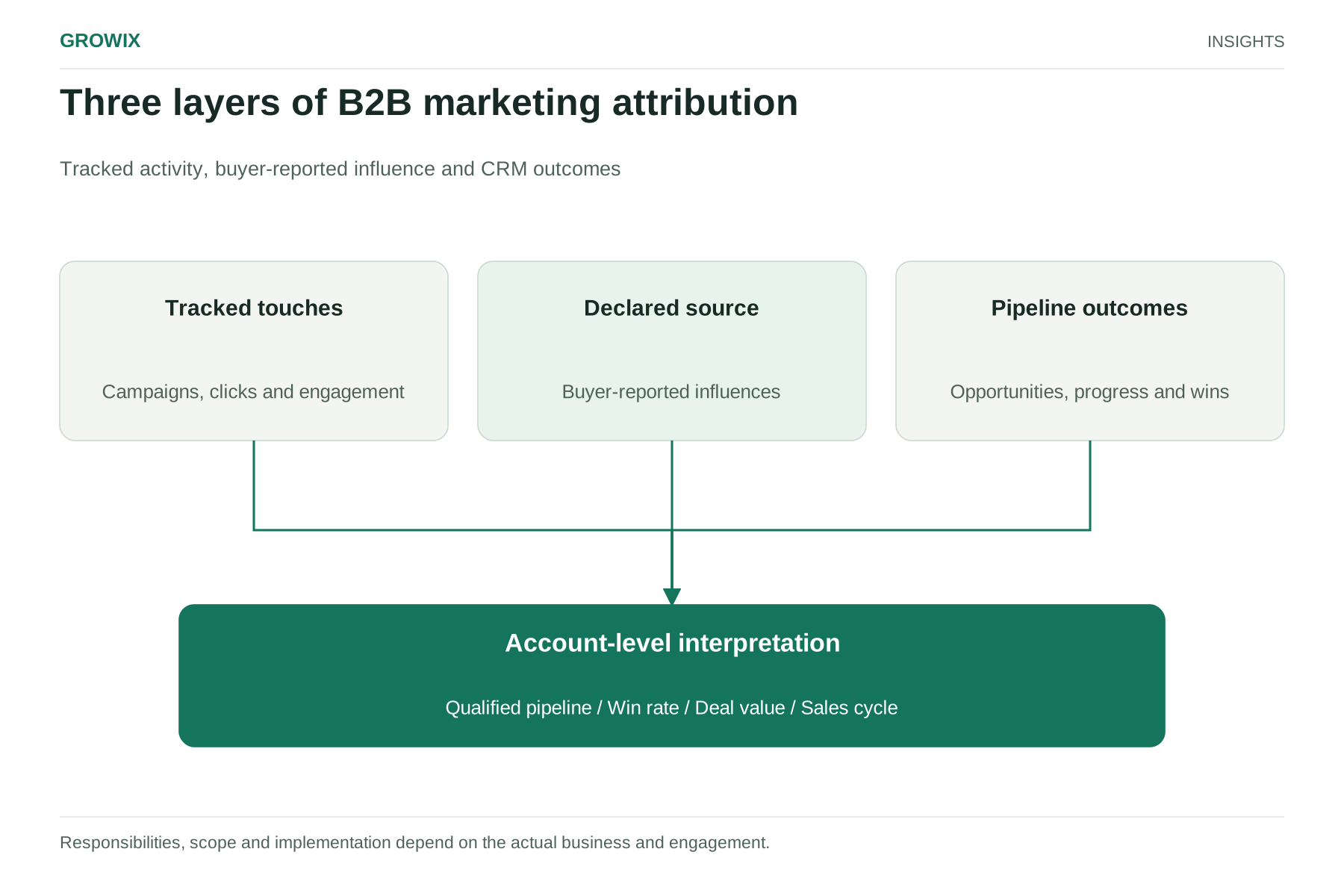
Rather than searching for one perfect model, combine three imperfect sources of evidence and look for agreement between them.
| Layer | What it captures | Where it lives | Main weakness |
|---|
| 1. Tracked touches | Campaign clicks, website visits, content engagement | Analytics, ad platforms, marketing automation | Misses offline and untracked influence |
| 2. Declared source | What buyers say brought them to you | Form field, sales discovery notes | Memory is imperfect and often names the most recent touch |
| 3. Pipeline outcome | Which opportunities were created, progressed and won, with value | CRM | Only as good as the data entered by sales |
When the three layers agree, for example a channel that drives tracked visits, is mentioned by buyers and appears on won deals, you can invest with confidence. When they disagree, investigate before cutting anything.
Layer 1: Tidy up tracked touches
Standardize campaign tagging. Agree a naming convention for UTM parameters (source, medium, campaign and content) and enforce it. Inconsistent tags such as "LinkedIn", "linkedin" and "li" fragment reports. A shared tagging sheet or a URL builder that enforces values solves most of the problem.
Capture first and last touch on the lead record. When someone submits a form, store the original source of their first visit and the source of the converting visit in hidden fields, and pass both into the CRM. This keeps marketing context attached to the person even when analytics data expires.
Track meaningful engagement, not just forms. Pricing page views, demo video completions and return visits from target accounts are useful signals of intent.
Connect ad platforms to real outcomes. Most ad platforms can receive offline conversions, such as qualified opportunities or closed deals from your CRM, so that bidding optimizes for pipeline rather than form fills. Setting this up requires capturing click identifiers on the lead and sending stage changes back on a schedule.
Respect consent. Configure tracking according to your consent policy and the laws that apply to your audience, and accept that some data will be missing.
Layer 2: Ask buyers what influenced them
Add a required, open-text question to demo and contact forms: "How did you hear about us?" Open text works better than a dropdown, because buyers name things your list did not anticipate, such as a specific podcast episode, a colleague, a community thread or an AI assistant. Categorize responses monthly.
Reinforce this in sales discovery calls with a consistent question, such as "What prompted you to look at this now, and where did you first come across us?" Record the answer in a CRM field rather than in free-form notes.
Self-reported attribution often reveals channels that tracking misses entirely, especially word of mouth, communities, events and content consumed off-site. It is also biased toward memorable and recent influences, which is why it works best alongside the other two layers.
Layer 3: Report on pipeline in the CRM
The CRM is where marketing influence becomes revenue, so it needs reliable structure.
- Associate contacts with opportunities, so that every person in the buying group who engaged with marketing is linked to the deal.
- Record the opportunity's primary source using clear rules, for example the first-touch source of the earliest associated contact, or the declared source if available.
- Keep consistent stage definitions so that "qualified" means the same thing every month.
- Record dates for each stage, so you can measure time from first touch to opportunity and to close.
- Capture lost reasons, which often reveal targeting or messaging problems.
From this structure, report on:
| Measure | Why it matters |
|---|
| Qualified pipeline created by source | The core measure of marketing contribution |
| Win rate by source | Some channels create pipeline that rarely closes |
| Average deal value by source | Channels differ in the size of deals they attract |
| Sales cycle length by source | Faster cycles are worth more for cash flow |
| Cost per qualified opportunity by channel | Combines spend data with pipeline outcomes |
| Influenced pipeline | Opportunities where any contact engaged with a campaign, read as directional |
Look at accounts, not just leads
In B2B, the buyer is usually a company, not a person. Account-level reporting groups all contacts, visits and engagement by company, which gives a truer picture of how a deal developed. Practical steps include matching contacts to accounts consistently in the CRM, tracking engagement from target accounts over time, and reviewing a sample of won deals each quarter to reconstruct how the buying group found and evaluated you. Those deal reviews, done with the sales team, are often more revealing than any dashboard.
Most companies can implement this approach with tools they already have: an analytics platform, the ad platforms' conversion imports, a marketing automation system and the CRM. Dedicated attribution software can help when data volumes are large, channels are many and the team has capacity to maintain it. It cannot fix inconsistent tagging, missing CRM data or unclear stage definitions, so get those right first. Start with spreadsheets or CRM reports if necessary; consistent data matters more than sophisticated software.
Hypothetical example: a B2B services firm
The following scenario is invented for illustration.
A 90-person engineering services firm spends most of its marketing budget on paid search because analytics shows it produces the most leads. After adding a required "How did you hear about us?" field and standardizing CRM source rules, it reviews six months of data. Paid search does produce the most form fills, but a large share are small jobs outside the firm's focus. Many of the qualified opportunities with the highest value come from buyers who mention industry association events, a technical guide the firm published and referrals from existing clients.
The firm does not abandon paid search. It narrows targeting to its core services, imports qualified opportunities into Google Ads so bidding favors better leads, and shifts part of the budget to association events and content that its best clients said influenced them. It then reviews the same pipeline measures quarterly.
Responsibilities
- Marketing operations: tagging standards, form fields, integrations and reporting.
- Sales operations: CRM structure, stage definitions and data quality.
- Sales team: recording declared source and contacts on opportunities.
- Marketing leadership: interpreting results and adjusting budget.
- Finance: agreeing cost allocation by channel.
Common mistakes
- Treating one model's output as truth rather than evidence to weigh.
- Optimizing for lead volume instead of qualified pipeline and revenue.
- Changing definitions mid-year, which makes trends meaningless.
- Ignoring declared source because it is messy text rather than tidy data.
- Expecting precision from small numbers of deals; with a few dozen opportunities a quarter, look at trends over several quarters.
- Leaving sales out of the design, so fields go unfilled and the CRM layer never becomes reliable.
Frequently asked questions
What is marketing attribution?
Marketing attribution is the process of assigning credit for conversions, pipeline and revenue to the marketing activities that influenced them. In B2B, it works best as a combination of tracked touches, what buyers say influenced them and opportunity data in the CRM.
Which attribution models does Google Analytics 4 offer?
Google's documentation lists data-driven attribution, paid and organic last click, and Google paid channels last click. The first click, linear, time decay and position-based models were removed in November 2023, so older guides that recommend them no longer apply.
What is the best attribution model for B2B?
No single model is reliable for long B2B sales cycles. Combine tidy campaign tagging with first- and last-touch fields, an open "How did you hear about us?" question and pipeline reporting in the CRM, and act where the three sources agree.
Next steps
This month, add an open "How did you hear about us?" question to your main forms, agree a UTM naming convention, and check that every opportunity in the CRM has associated contacts and a source. Those three changes make the next quarter's budget conversation much more grounded.
Growix's Marketing Analytics & Attribution team sets up tracking, attribution modeling and dashboards that connect marketing to pipeline and revenue, and our CRM & Marketing Automation team configures the CRM and automation that keep lead data consistent. For deciding where budget should go once you can see results, read SEO vs PPC for B2B lead generation.
Discuss your marketing priorities