In-house Marketing vs an Agency: Comparing Total Cost, Capabilities and Accountability
The choice is rarely all or nothing. Compare loaded costs, the specialist skills you need each month and who owns results, then design the in-house, agency or hybrid split that fits.
The short answer: keep strategy, brand ownership and knowledge of your customers in-house as soon as marketing matters to growth. Use an agency for specialist skills you need regularly but not full time, such as paid media, technical SEO, analytics or production, and for capacity you cannot hire quickly. Build a fully in-house team when the work is steady, deeply tied to your product and large enough to keep specialists busy. For most growing businesses, the answer is a hybrid: a small internal team that owns direction and results, supported by external specialists.
This guide compares the options on total cost, skills and accountability, and shows how to set up whichever model you choose so that results are clearly owned.
The options defined
In-house marketing team. Employees plan and execute marketing. You control priorities directly and build institutional knowledge, while carrying salaries, benefits, recruitment, tools and management.
Agency. An external firm plans and executes some or all marketing under a retainer, project fee or performance arrangement. You gain access to specialists and established processes; you manage through briefs, reporting and reviews.
Hybrid team. Internal staff own strategy, budget, brand and coordination, and agencies or freelancers handle specialist execution. The success of this model depends on clearly dividing responsibilities.
Compare fully loaded costs
Salary is only part of what an employee costs, and a retainer is only part of what an agency relationship costs.
In-house costs to include: salaries, payroll taxes and benefits, recruitment, software and data tools, training, freelance or production support, management time, and the cost of vacancies when people leave.
Agency costs to include: retainer or project fees, media management fees if separate, production costs, tool access, and the internal time needed to brief, review and manage the agency.
The following figures are illustrative. Salaries use the BLS medians above with the 0.70 loading; tools, freelance and agency fees are assumptions, not market quotes or Growix pricing.
Item
Fully in-house
Agency-led
Hybrid
Internal staff
Manager and two specialists: $463,300
Manager only: $238,271
Manager and one specialist: $350,786
Agency or external specialists
—
$180,000 ($15,000 a month)
$96,000 ($8,000 a month)
Tools and data
$30,000
$10,000
$20,000
Freelance and production
$40,000
Included in agency fee (assumed)
Included in external fees (assumed)
Annual total
$533,300
$428,271
$466,786
The totals matter less than what each buys. Two internal specialists are unlikely to cover paid media, SEO, content, analytics and design at a specialist level. An agency retainer may cover several specialisms, but each at a fraction of a person's time. The hybrid buys internal ownership plus targeted external depth. Compare each option against the capabilities you actually need.
Costs that are easy to miss
On the in-house side:
Vacancy cost. When a specialist leaves, the channel they ran may stall for months during recruitment and onboarding.
Tool sprawl. Each specialist tends to bring preferred software, and subscriptions accumulate.
Skills currency. Paid media platforms, search and analytics change constantly; training time and budget are a real cost.
Management time. Someone must set priorities, review work and develop people.
On the agency side:
Ramp-up time. Agencies need weeks to learn your product, customers and data; switching agencies repeats that cost.
Coordination overhead. Briefing, feedback and approvals consume internal time, especially with several agencies.
Scope creep and change requests. Work outside the agreed scope is usually billed separately.
Diluted attention. A retainer buys a share of people's time, not their full focus.
How agencies typically charge
Model
How it works
Watch for
Monthly retainer
Fixed fee for a defined scope and hours
Unclear scope; unused hours
Project fee
Fixed price for a defined deliverable
Change requests; little ongoing support
Percentage of media spend
Fee scales with ad budget
Incentive to increase spend rather than efficiency
Performance-based
Fee tied to leads, sales or other outcomes
Disputes over attribution and lead quality
None of these is inherently better. The right model is the one whose incentives align with the outcome you care about and whose scope is written clearly.
Map specialist skills and ownership
List the capabilities your plan requires and how many hours a month each needs:
Capability
Typical monthly need for a growing B2B company
Often best placed
Strategy, positioning and budget
Ongoing
In-house
Customer and product knowledge
Ongoing
In-house
Paid search and paid social
Ongoing, specialist
Agency or in-house specialist at scale
Technical SEO
Periodic, specialist
Agency
Content creation
Ongoing
Either; in-house for product depth, external for volume
Marketing analytics and attribution
Setup intensive, then ongoing
Agency for setup; shared for ongoing
Design and video production
Variable
Agency or freelancers
Marketing operations and CRM
Ongoing
In-house, with external setup support
A capability needed for less than about half a person's time is usually more efficient to buy externally. A capability that requires deep product knowledge or daily coordination is usually better owned internally.
Hypothetical example: choosing a split
The following scenario is invented for illustration.
A 120-person B2B software company has one marketing manager and spends most of its budget on paid search, managed by the manager in spare hours. Leads have plateaued, the website has technical SEO problems, and nobody can say which campaigns produce qualified pipeline.
Listing capabilities and hours shows three gaps: paid media management needs roughly half of a specialist's time, technical SEO needs an intensive two-month fix and then a few hours a month, and attribution needs a setup project followed by light maintenance. None justifies a full-time hire on its own. The company keeps strategy, messaging and the content calendar with its manager, hires one content marketer who knows the product, and brings in external specialists for paid media, the technical SEO fix and the attribution setup, with all accounts owned by the company. After a year it reviews whether paid media has grown enough to bring in-house.
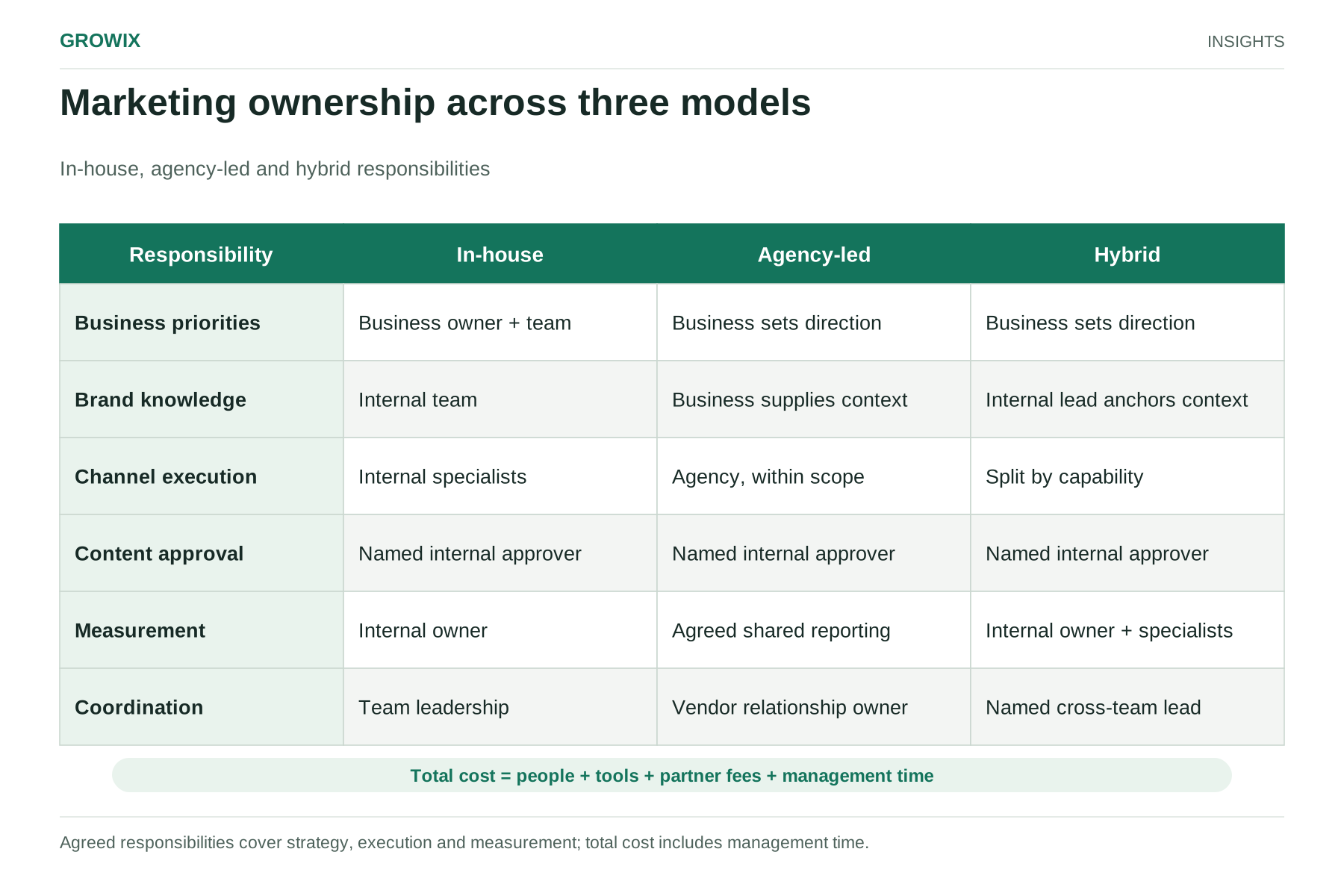
Marketing ownership across three models. Agreed responsibilities cover strategy, execution and measurement; total cost includes management time. View full size Read this comparison as a table
Responsibility
In-house
Agency-led
Hybrid
Business priorities
Business owner + team
Business sets direction
Business sets direction
Brand knowledge
Internal team
Business supplies context
Internal lead anchors context
Channel execution
Internal specialists
Agency, within scope
Split by capability
Content approval
Named internal approver
Named internal approver
Named internal approver
Measurement
Internal owner
Agreed shared reporting
Internal owner + specialists
Coordination
Team leadership
Vendor relationship owner
Named cross-team lead
Evaluate hybrid arrangements
Hybrids fail when responsibilities blur. Write down, for each channel or activity:
Who decides strategy, budget and targets.
Who executes day to day.
Who reports results and how often.
Who owns assets and accounts: ad accounts, analytics properties, content files, CRM configuration.
Insist that advertising accounts, analytics properties and creative files are owned by your business, with the agency granted access. Changing agencies then does not mean losing history or data.
Set reporting and accountability
Whichever model you choose, accountability depends on agreeing in advance what success means.
Agree outcome measures. For lead generation, that is usually qualified leads, pipeline and cost per qualified lead rather than clicks or impressions. For e-commerce, revenue, contribution margin and customer acquisition cost.
Separate leading and lagging indicators. Content and SEO show results slowly; report on leading indicators such as rankings for target pages and engaged visits, alongside the lagging ones.
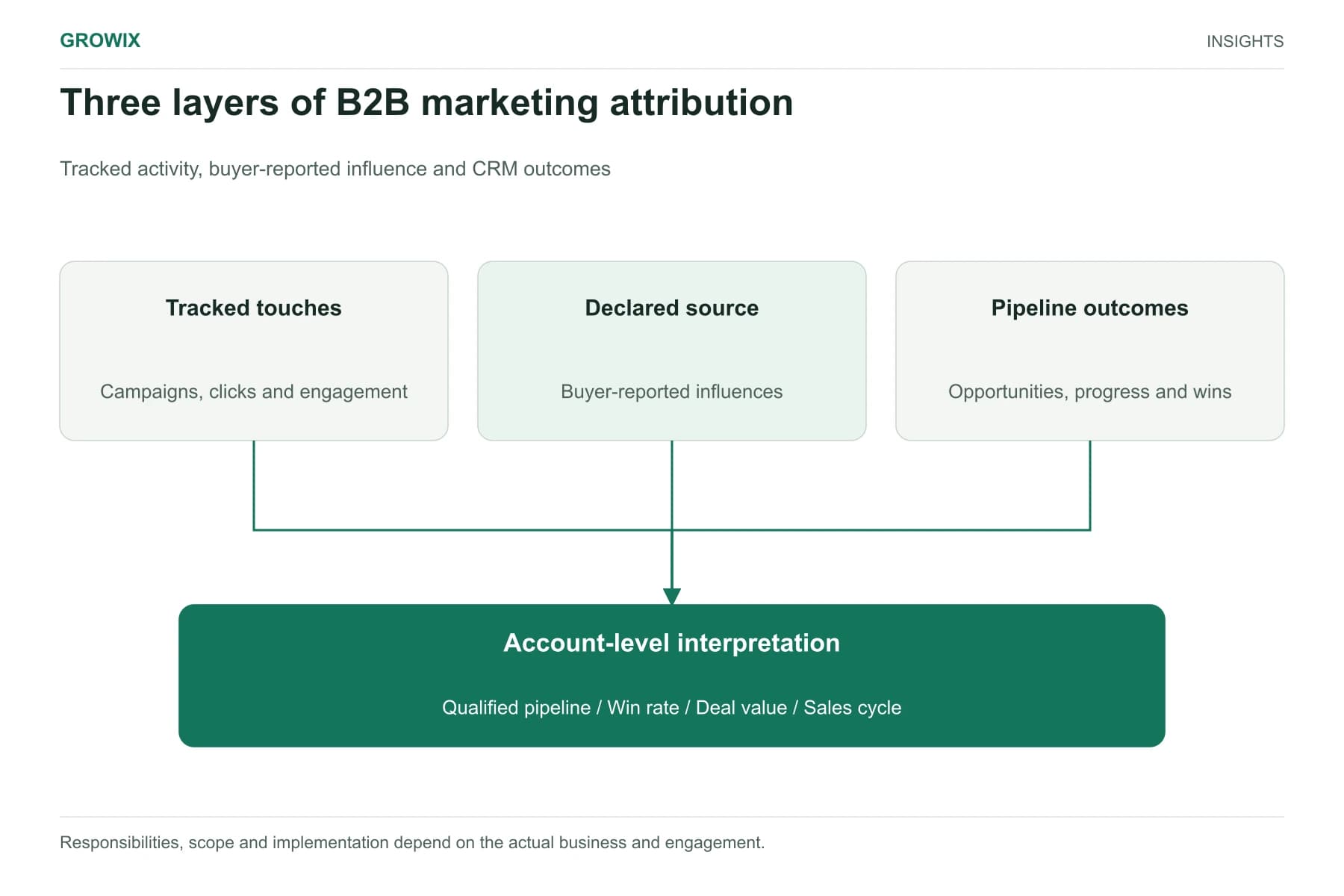
Use one source of truth. Agencies should report from your analytics and CRM, not from their own dashboards alone. A clear analytics and attribution setup makes performance discussions about decisions rather than data disputes.
Hold monthly and quarterly reviews. Monthly for performance and next actions; quarterly for strategy, budget allocation and whether the arrangement still fits.
When each model fits
Fully in-house fits when marketing volume is large and steady, product knowledge is complex, speed of internal coordination matters, and you can recruit and retain specialists.
Agency-led fits when you need several specialisms quickly, workload is variable, or you are testing channels before committing to hires. An internal owner is still essential.
Hybrid fits when you have enough work for a small internal team but not for every specialism, which describes most growing businesses.
When Growix may not be the right fit: if your marketing needs are mostly a single, steady activity, such as daily social posting or one content stream, a dedicated hire or a specialist freelancer is often more economical than a multi-discipline agency.
Moving between models
Most companies change model as they grow. A common path is agency-led in the early stage, hybrid once there is a marketing lead, and increasingly in-house as specific channels become large enough to justify specialists. Plan transitions deliberately: transfer account ownership and documentation, run a handover period where both parties work together, and agree in advance what the agency will hand over, such as campaign structures, keyword research, content calendars and reporting templates. Treat knowledge transfer as a deliverable, not an afterthought.
Questions to ask before choosing an agency
Who will actually work on our account, and how much of their time?
Which outcome measures will you report against, from which data source?
Is it cheaper to use a marketing agency or build an in-house team?
It depends on how much specialist work you need. Compare fully loaded costs on both sides: salaries, benefits, tools, recruitment and vacancy risk in-house, against fees, production costs and internal coordination time for an agency. Agencies are often cheaper for skills you need regularly but not full time.
What is a hybrid marketing team?
A hybrid team keeps strategy, budget, brand and coordination with internal staff, while agencies or freelancers handle specialist execution such as paid media, technical SEO, analytics or production. It suits most growing businesses, provided ownership of each activity is written down.
What should always stay in-house?
Ownership of strategy, brand, customer knowledge and targets, plus your advertising accounts, analytics properties and creative files. Agencies should be granted access to your accounts rather than owning them, so you keep your data if you change partners.
Next step
List the capabilities you need for the next twelve months with an estimate of hours for each, then build loaded costs for the in-house, agency-led and hybrid versions. The comparison usually makes the right split obvious.