Many B2B SaaS content strategies still revolve around the blog: publish articles on broad topics, rank for informational keywords and hope readers eventually request a demo. That approach was always weaker for software than its traffic charts suggested, and it is weaker still now that buyers ask AI assistants to summarize options, compare vendors and explain pricing.
The underlying behavior is well documented. In Gartner's survey of 645 B2B buyers, published in a May 2026 press release and conducted in August and September 2025, 45% said they used generative AI during a recent purchase, mainly to gather information on vendors and products, and buyers used an average of seven information sources. TrustRadius's 2026 B2B Buying Disconnect report, a global survey of 1,862 technology buyers conducted in January 2026, found that 63% used AI during their purchase journey and 94% of those said they fact-check its answers at least some of the time. The same report found that 83% shortlisted three or fewer products, and that transparent pricing has topped buyers' wish lists for vendors four years running.
Put simply: buyers use AI to build a shortlist quickly, then check the facts. A strong SaaS content marketing strategy makes sure the facts they check, and the facts AI systems summarize, come from accurate, specific pages you control, as well as from credible third parties.
Map buying questions to page types
Start by listing the questions your buyers actually ask. Good sources include sales call recordings and notes, demo request forms, support tickets from trial users, lost-deal reasons, procurement and security questionnaires, and review-site comments about you and competitors.
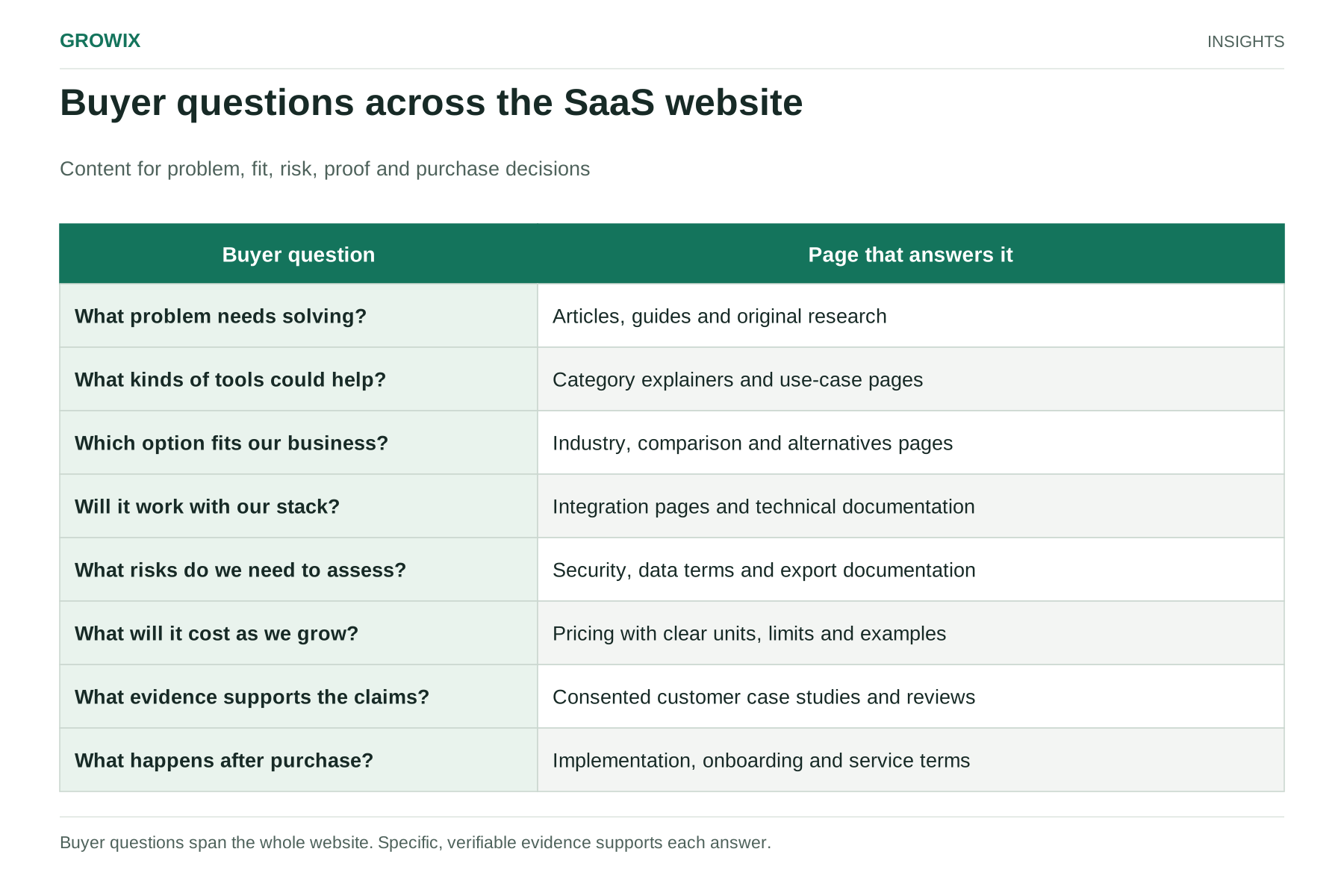
Then assign each question to the page type that should answer it. Most will not belong on the blog.
| Buying stage | Typical questions | Page type that should answer |
|---|
| Problem | Why is this process slow or costly? What do others do about it? | Articles and guides; research based on your own data |
| Solution category | What kinds of tools solve this? Build or buy? | Category explainers; use-case pages |
| Shortlist | Which products fit a company like ours? How do they differ? | Use-case and industry pages; comparison and alternatives pages |
| Fit and feasibility | Does it integrate with our stack? Can it handle our volume? | Integration pages; documentation; technical architecture pages |
| Risk | Is it secure? Where is data stored? What happens if we leave? | Security and trust center; data processing terms; export documentation |
| Commercial | What will it cost? How is it priced as we grow? | Pricing page with clear units, limits and examples |
| Proof | Has it worked for companies like us? | Case studies with named customers who agreed to participate; public reviews |
| Purchase | What does onboarding involve? How long until value? | Implementation pages; onboarding guides; service-level terms |
A useful exercise is to take the twenty questions your sales team hears most often and check which have a clear, public, current answer on your site. The gaps are your content plan.
Build use-case, integration and comparison evidence
Three page types do disproportionate work for software buyers and AI summaries alike.
Use-case pages describe a specific job for a specific type of customer: the situation, the workflow in your product, the outcome and its limits. They should show the product, not describe it in general terms. Screenshots, short walkthroughs described in text and sample outputs help.
Integration pages should exist for every meaningful integration, with what syncs, in which direction, how often, what requires a higher plan and where the documentation lives. Thin "we integrate with X" pages create more questions than they answer.
Comparison and alternatives pages are where many teams get nervous, and where honesty pays. A useful comparison:
- States who each product is best for, including when a competitor is the better choice.
- Compares on criteria buyers care about, with dated facts and links to sources where possible.
- Avoids claims you cannot support, and is reviewed whenever either product changes.
AI assistants and buyers both cross-check comparison claims. Overstated claims tend to be contradicted by reviews and documentation, which undermines the rest of your content.
Make product facts easy to verify
Because buyers verify, factual pages matter as much as persuasive ones:
- Pricing: publish units, tiers, limits and what triggers a price change. If you cannot publish exact enterprise prices, explain how pricing is calculated.
- Documentation: keep public documentation crawlable and current. It is often the most specific source of truth about what your product does.
- Security and compliance: describe certifications you actually hold, data locations, sub-processors and your incident process.
- Changelog: a dated public changelog helps buyers and AI systems distinguish current capabilities from outdated ones.
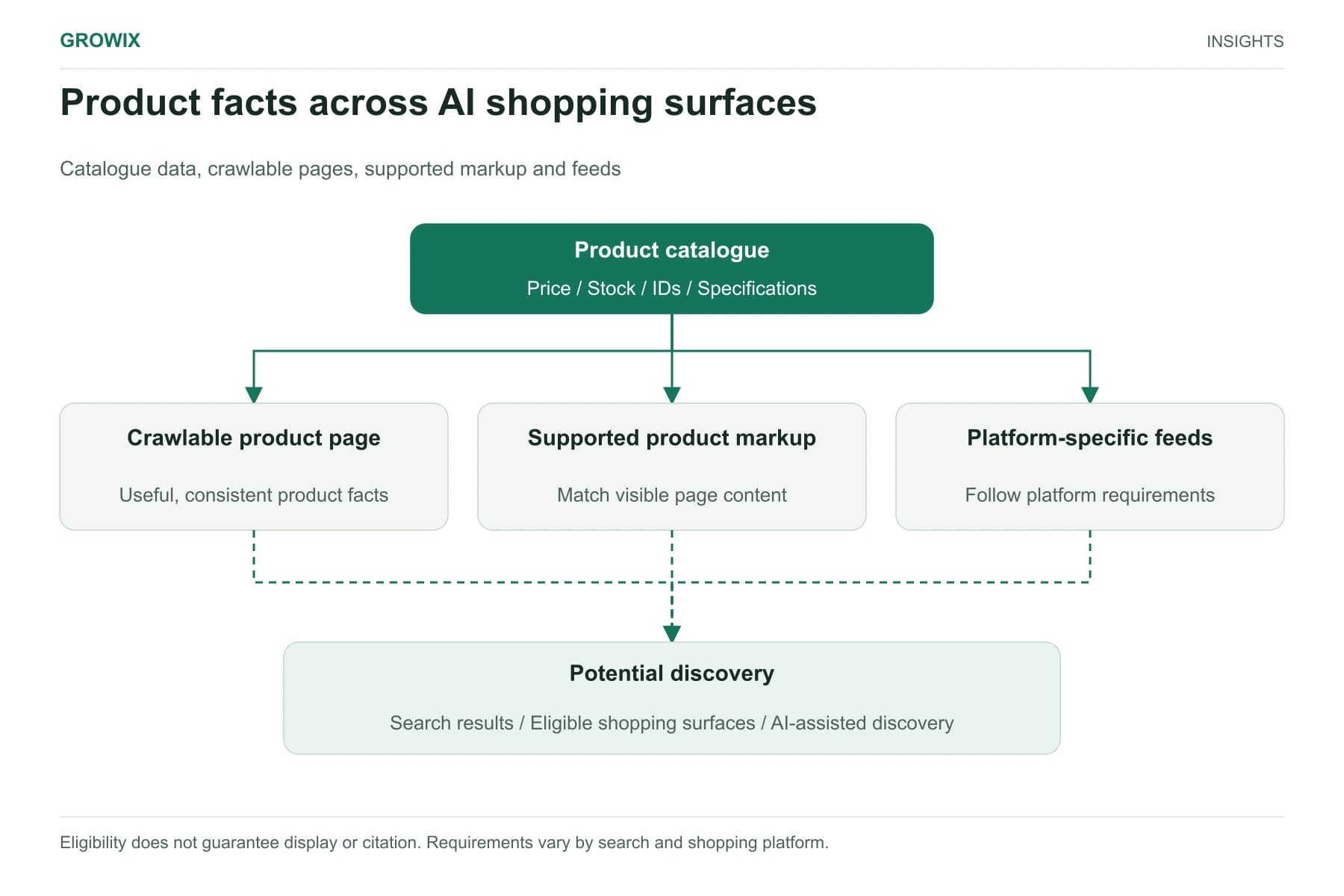
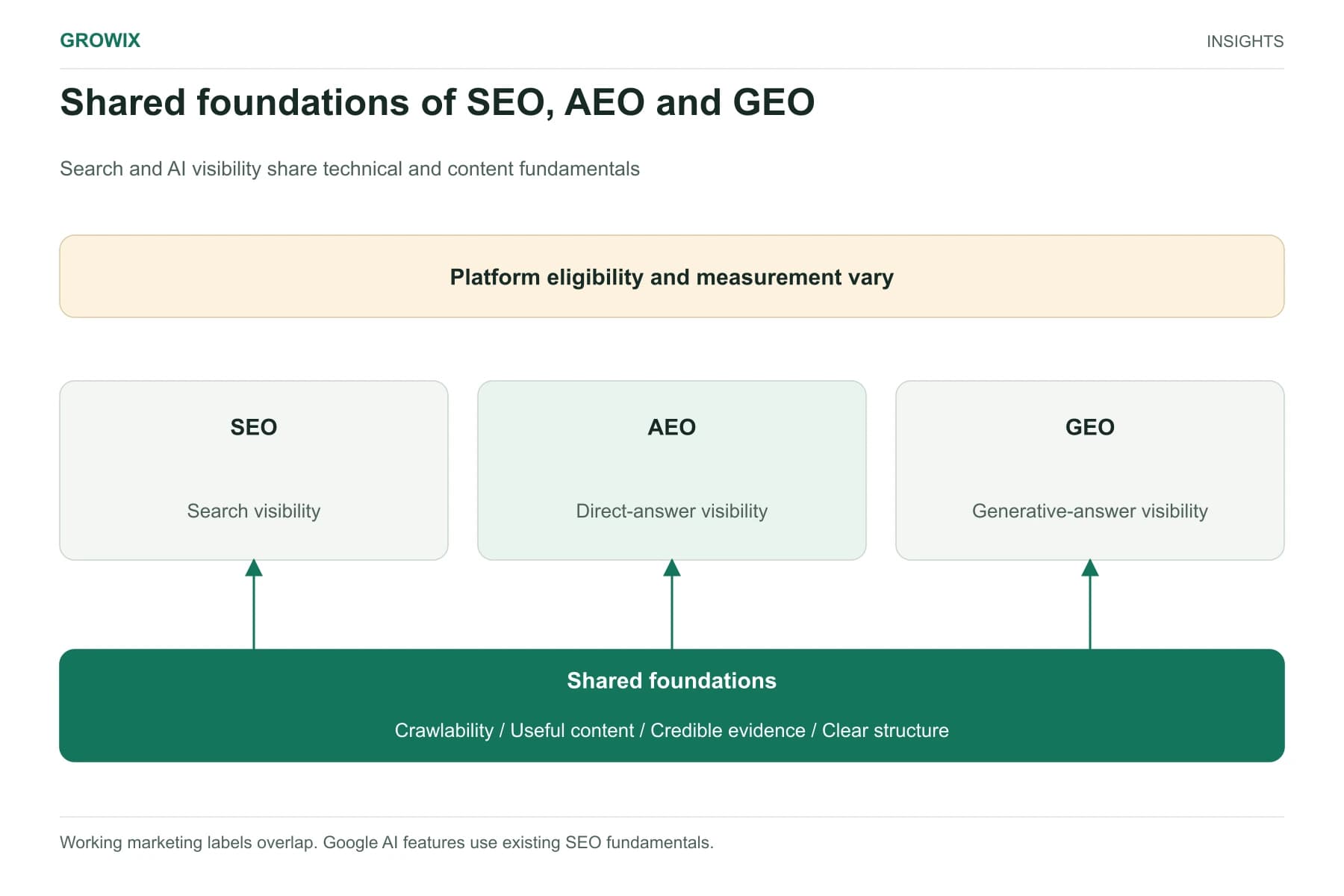
Search engines treat these pages like any other. Google's documentation on AI features and your website says there are no special requirements for its AI features beyond normal SEO fundamentals, such as crawlable, indexable pages with important content in text and structured data that matches visible content.
Earn presence beyond your own site
Buyers use several sources, and AI systems synthesize from many. Your strategy should include:
- Review sites: encourage genuine reviews from real customers, respond to criticism and keep product listings current. TrustRadius found 74% of buyers use reviews to inform their decisions.
- Partner and marketplace listings: make sure integration partners describe your product accurately.
- Communities and events: contribute expertise where your buyers discuss problems.
- Original research: publish data only you have, with a clear method, so others have a reason to cite it.
Connect articles to product and service pages
Content that never leads anywhere does not support pipeline. Build deliberate paths:
- Every article links to the use-case, integration or comparison page that represents the logical next question.
- Every use-case page links to relevant proof and to pricing.
- Navigation and internal links make commercial pages easy to reach without forcing them into every paragraph.
- Calls to action match intent: a template download suits early research, while a demo request suits pricing and comparison readers.
A hypothetical example
The following scenario is invented to illustrate the method.
A SaaS company selling scheduling software to clinics reviews 60 recent sales calls. The most frequent questions concern integration with two practice management systems, how pricing changes with additional locations, and data handling for patient information. The company has 140 blog posts but only a one-line integration listing and a "contact us" pricing page.
Its next quarter's plan is therefore not more articles. It publishes two detailed integration pages with setup steps and limitations, a pricing page that explains location-based pricing with three worked examples, a security page describing data storage and sub-processors, and a comparison page with its two most common alternatives, reviewed by product and legal teams. Existing blog posts on clinic scheduling are updated to link to the relevant integration and use-case pages.
Prioritize the content backlog
Once questions are mapped, the list will be longer than your team can produce in a quarter. Score each missing or weak page from 1 to 5 on three factors:
- Deal impact: how often the question appears in deals that matter, and whether a poor answer stalls them.
- Answer gap: how badly your current public answer serves the buyer, from missing to adequate.
- Effort: how much work, input from product or legal, and maintenance the page requires (score low effort as 5).
Pages that score high on all three come first. In many SaaS companies, the first wave turns out to be pricing explanations, two or three integration pages, a security overview and one honest comparison page, rather than new blog topics.
Keep content accurate as the product changes
Software changes faster than most content programs update. Outdated pages hurt twice: buyers lose trust when a feature description is wrong, and AI systems can repeat the outdated claim.
- Assign an owner and review date to every commercial page, with comparison and pricing pages reviewed at least quarterly.
- Link the changelog to the content calendar, so a significant release triggers updates to affected use-case, integration and comparison pages.
- Retire or redirect pages about discontinued features or plans rather than leaving them live.
- Date factual claims on comparison pages, so readers know when they were last checked.
Common mistakes
- Writing for keywords the sales team never hears. High-volume informational topics can attract readers who will never buy.
- Gating the facts buyers need, such as pricing logic or security basics, behind a form.
- Publishing comparison pages that only praise yourself. Buyers and AI systems cross-check them against reviews.
- Measuring success by traffic alone, which rewards the wrong content.
Measure assisted enquiries
Content that answers buying questions often influences deals without being the last click. Measure in layers:
- Self-reported attribution: add an open "How did you hear about us?" field to demo and contact forms, and track mentions of AI assistants, review sites and specific pages.
- Page-level paths: track how many demo requests include visits to pricing, integration, comparison or security pages during the buying journey.
- Search Console: monitor non-brand impressions and clicks for commercial pages, plus branded search trends.
- AI referrals: segment sessions referred by AI assistants where a referrer is passed, and compare conversion with other sources.
- Sales feedback: ask the sales team monthly which pages buyers mention or send around internally.
- Pipeline quality: compare win rates and sales-cycle length for opportunities that consumed this content with those that did not.
Avoid treating any single metric, especially third-party "AI visibility" scores, as proof of impact. Pipeline and revenue are the measures that matter.
Responsibilities
- Product marketing: question research, use-case and comparison pages, and messaging accuracy.
- Content and SEO: information architecture, internal linking, technical SEO and measurement.
- Product and engineering: documentation, changelog and integration accuracy.
- Security and legal: trust content and review of comparative claims.
- Sales and customer success: a steady supply of real buyer questions and feedback.
Frequently asked questions
What is SaaS content marketing?
SaaS content marketing is publishing content that helps software buyers find, evaluate and choose a product: articles that attract the right audience, plus use-case, integration, comparison, pricing and security pages that answer the questions buyers ask before they talk to sales.
What content do B2B software buyers need most?
Buyers verify facts before shortlisting, so clear pricing explanations, use-case pages for specific customer types, detailed integration pages, honest comparison pages, security and compliance information, and current documentation usually matter more than additional blog posts.
How do you measure content marketing for B2B SaaS?
Measure in layers: organic and referral traffic to commercial pages, an open self-reported attribution question on demo and contact forms, content touches associated with opportunities in the CRM, and pipeline and revenue from those opportunities. No single metric proves impact on its own.
Next steps
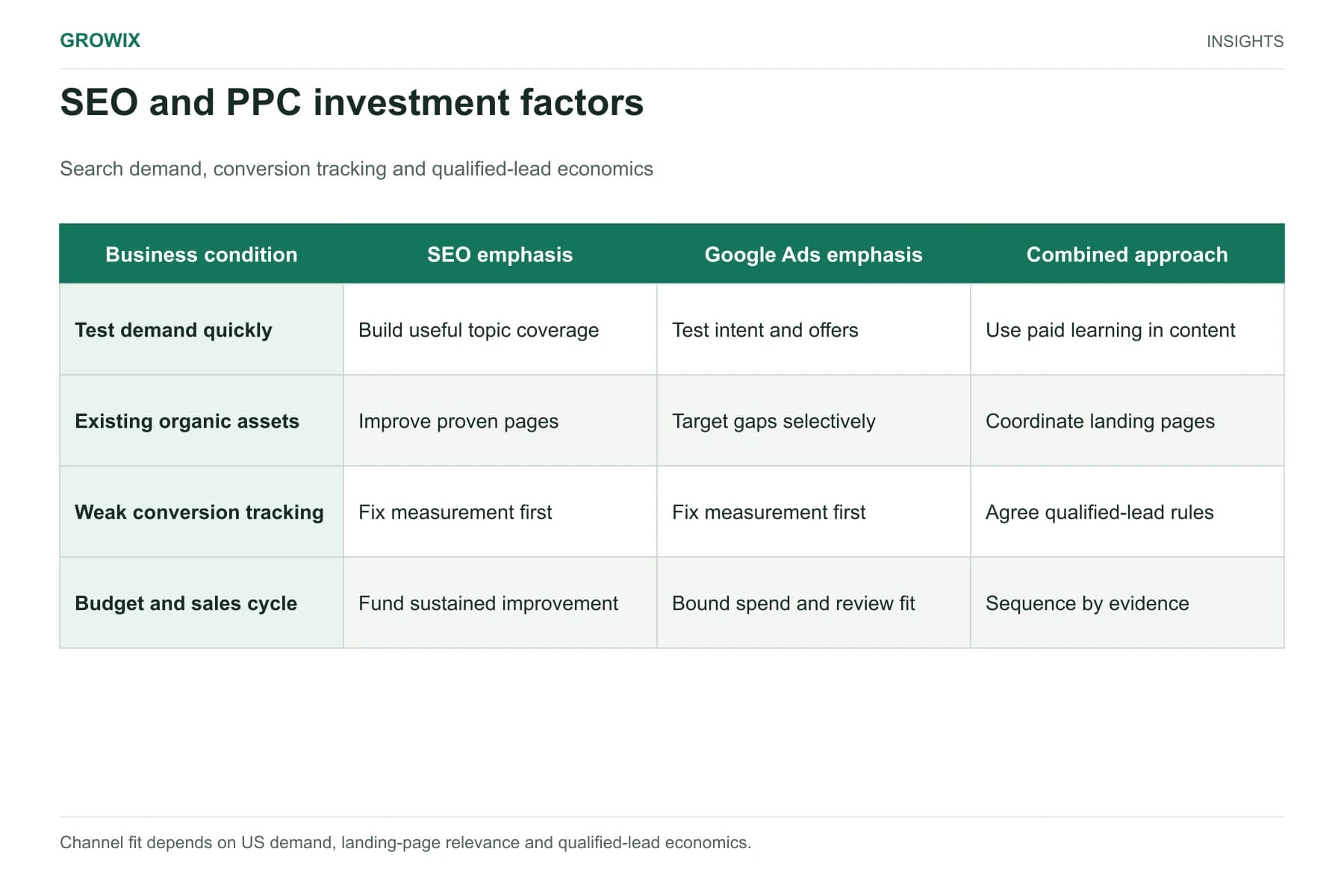
Collect fifty real buyer questions this month, map them to page types using the table above, and fix the five biggest gaps before writing another blog post. If you are deciding how to divide budget between organic content and paid search, our guide to SEO vs PPC for B2B lead generation covers that trade-off.
Growix's Content Marketing & Strategy team plans, produces and distributes content designed to move buyers forward, and our Search & AI Visibility service covers technical SEO and visibility in AI answer engines.
Discuss your marketing priorities