The short answer: buy off-the-shelf software for functions where your business works like everyone else's, such as accounting, payroll, email and most CRM needs. Build custom software when the process is a genuine source of advantage or no product fits without expensive workarounds. Use AI-built tools, meaning applications created quickly by staff with AI app builders or low-code platforms, for contained internal workflows where the data is low-risk and someone is accountable for maintaining the result. Many businesses end up with all three, connected to each other.
The decision gets harder when a process is somewhere in between. This guide defines the options, compares them on cost, security and ownership, and gives you a weighted scoring method to make the trade-offs explicit.
The three options defined
Off-the-shelf software is a packaged product, usually sold as a subscription (SaaS), that many companies use with configuration but little or no code. You get mature features, vendor support and regular updates, and you accept the vendor's roadmap, data model and pricing changes.
Custom software is designed and built for your organization by professional engineers, in-house or through a partner. You own the code and decide how it works. You also own its maintenance, security and hosting for as long as it runs.
AI-built tools are applications created by business users or small teams with AI coding assistants, AI app builders or low-code platforms, often in days rather than months. The barrier to building has fallen sharply. The barriers to running software safely, such as access control, data protection, testing and maintenance, have not.
There is also a common hybrid: buy the core platform, then build custom extensions, integrations or AI features around it.
How the options compare
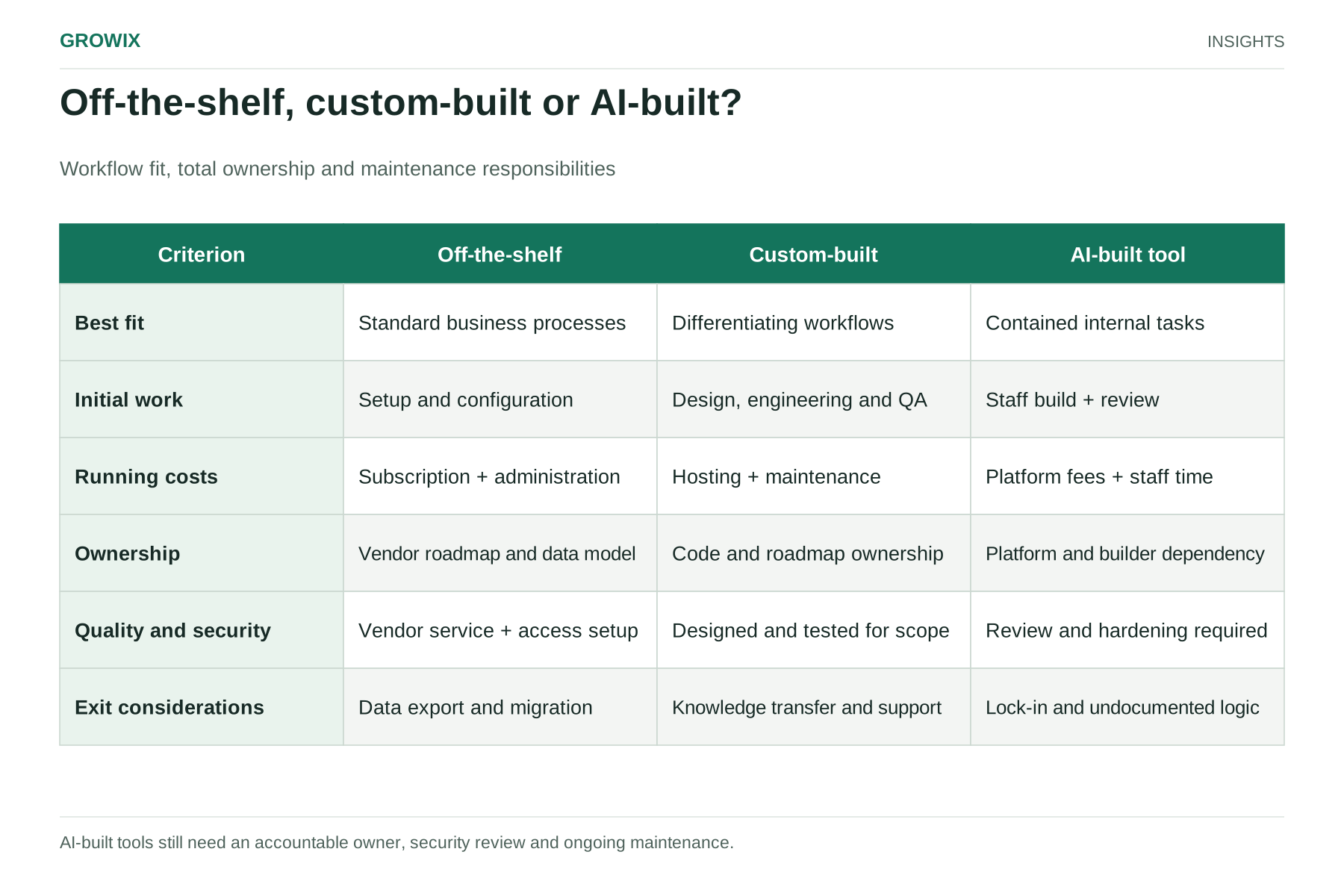
| Factor | Off-the-shelf | Custom-built | AI-built tool |
|---|
| Fit to your process | Good for standard processes; workarounds for unusual ones | Designed around your process | Good for narrow workflows; limited for complex ones |
| Time to first use | Days to weeks | Months for meaningful scope | Hours to weeks |
| Upfront cost | Low to moderate | High | Low |
| Ongoing cost | Subscription per user or usage; rises with headcount | Maintenance, hosting and changes | Platform fees plus staff time; maintenance often unplanned |
| Security and compliance | Vendor certifications; you configure access | You design and test it | Varies widely; frequently outside IT review |
| Ownership and control | Vendor controls roadmap and data model | You own code and roadmap | Often tied to one platform and one person |
| Scalability | Proven at scale for its use case | Designed for your expected scale | Uncertain beyond small teams |
| Exit risk | Data export and migration effort | Key-person or partner dependency | Platform lock-in; undocumented logic |
Retool's 2026 Build vs Buy report, based on a late-2025 survey of 817 of its customers and builders, found that 35% of respondents' teams had replaced at least one SaaS tool with a custom build, and that 60% had built software outside IT oversight in the past year. Retool sells an app-building platform and surveyed its own users, so those figures describe an enthusiastic sample rather than businesses in general. They still point to a real governance question: tools are being built faster than organizations are deciding who maintains and secures them.
Research on AI-assisted development also suggests caution about assuming speed equals productivity. Google's DORA team, in its 2025 State of AI-assisted Software Development report (as summarized by InfoQ), described AI as an amplifier that magnifies the strengths of high-performing organizations and the weaknesses of struggling ones, and found that software delivery instability continued to rise alongside throughput gains.
Model three-year ownership costs
Comparing a subscription price with a build quote is misleading. Compare total cost of ownership over the period you expect to use the software, typically three to five years.
Include for off-the-shelf: subscriptions at forecast headcount, implementation and configuration, integrations, data migration, internal administration, training and expected price increases.
Include for custom: discovery and design, build, testing, hosting, monitoring, maintenance and security updates, enhancements, and the internal product owner's time.
Include for AI-built tools: platform fees, staff time to build and change the tool, security review, hardening if it becomes business-critical, and the cost of rebuilding it properly if it outgrows the platform.
Hypothetical three-year comparison
The scenario below is invented, and every figure is an assumption for illustration, not a market price or Growix quote. A 60-person field service company needs a scheduling and job-tracking application.
| Item | Off-the-shelf | Custom-built | AI-built tool |
|---|
| Subscriptions or platform fees | $97,200 (60 users × $45 × 36 months) | — | $18,000 (10 builders × $50 × 36 months) |
| Implementation, build or configuration | $15,000 | $180,000 | $7,200 (120 staff hours × $60) |
| Integrations | $10,000 | Included in build | — |
| Security review and hardening | Included in vendor service | Included in build | $25,000 |
| Maintenance and administration | $24,000 ($8,000 a year) | $108,000 (20% of build a year) | $30,000 ($10,000 a year) |
| Hosting | Included | $18,000 ($500 × 36 months) | Included in platform |
| Three-year total | $146,200 | $306,000 | $80,200 |
On cost alone, the AI-built tool wins and custom software looks expensive. But cost is only one criterion, and the AI-built figure assumes the tool stays small and someone maintains it. If the scheduling logic is what wins the company contracts, and the off-the-shelf product forces a workaround on the core process, the picture changes.
Assess security, maintenance and ownership
Ask these questions of every option before you score it:
- Data: What customer or employee data will it hold, and where? Who can access it, and how is access removed when people leave?
- Authentication: Does it use your single sign-on and enforce multi-factor authentication?
- Change control: Who can change it, and is there testing before changes reach users?
- Maintenance: Who fixes it when it breaks, and who updates it when a connected system changes?
- Continuity: If the builder, vendor or partner disappears, can someone else take over? Is there documentation?
- Exit: Can you export all your data in a usable format?
AI-built tools most often fail on maintenance and continuity, because they start as one person's side project. Off-the-shelf products most often fail on fit and exit. Custom software most often fails on cost control and on underestimating ongoing maintenance.
Set simple rules for AI-built tools
Banning AI-built tools rarely works; people will build them anyway. A short policy is more effective:
- Register: every tool used by more than one person is listed with an owner, its purpose and the data it touches.
- Classify data: tools handling customer, financial or personal data need IT or security review before use.
- Use approved platforms: builders choose from platforms that support single sign-on, access logs and data export.
- Define graduation triggers: when a tool becomes business-critical, serves customers or exceeds an agreed number of users, it moves to a supported platform or is rebuilt by engineers.
- Plan for departures: ownership transfers when the builder changes role or leaves.
Questions to ask a vendor or development partner
For packaged software: How is pricing likely to change as you grow? What does the API allow? How do you export all data? What happens to configuration if you change plans?
For custom development: Who owns the code and repositories from day one? How is the work tested and documented? What does maintenance cost after launch, and can another team take it over?
Apply a weighted decision matrix
Score each option from 1 (poor) to 5 (strong) against criteria that matter to you, then weight the criteria so they total 100. The weights are a management decision, and making them explicit is the point of the exercise.
Continuing the hypothetical field service example:
| Criterion | Weight | Off-the-shelf | Custom-built | AI-built tool |
|---|
| Fit to core process | 25 | 3 | 5 | 4 |
| Competitive differentiation | 15 | 1 | 5 | 2 |
| Time to value | 15 | 5 | 2 | 5 |
| Three-year cost | 15 | 4 | 2 | 5 |
| Security and compliance | 15 | 4 | 4 | 2 |
| Maintainability and ownership | 15 | 4 | 3 | 2 |
| Weighted score (out of 5) | 100 | 3.45 | 3.65 | 3.40 |
Custom software scores narrowly highest because the company weights differentiation heavily. Now change the weights to reflect a company where scheduling is not a differentiator: differentiation drops to 5 and three-year cost rises to 25. Off-the-shelf then scores 3.75, the AI-built tool 3.70 and custom 3.35. Same options, same scores, different answer. Run the sensitivity check before committing.
When each option fits
Choose off-the-shelf when the process is standard, a mature product covers most needs, regulatory requirements favor certified vendors, and you would rather adapt your process than maintain software.
Choose custom software when the process differentiates your business, packaged products need costly workarounds, you need deep integration across several systems, or long-term per-user subscription costs exceed the cost of owning a solution.
Choose AI-built tools when the workflow is internal and contained, the data is low-risk, the user group is small, and a named owner commits to maintaining it. Set a rule for when such a tool must be reviewed or rebuilt, for example when it handles customer data or becomes business-critical.
Combine them when a packaged core covers most of the need but a specific workflow or integration does not. This is often the most cost-effective outcome.
In the field service example, a hybrid might look like this: a packaged field service product handles customer records, invoicing and the mobile app for technicians, while a custom scheduling service applies the company's own allocation rules and feeds assignments back through the product's API. An AI-built dashboard, registered and reviewed under the rules above, gives managers a view of the week ahead. Each part sits where it fits best, and only the differentiating logic carries the cost of custom ownership. The trade-off is integration: someone must own the connections between the parts and test them whenever either side changes.
When Growix is probably not the right fit: if a well-established product already fits your process and you only need it configured, the vendor or a specialist implementation partner is usually better value than a custom development team. Growix's software services focus on designing and building bespoke software, integrations and AI features.
Frequently asked questions
What are the benefits of off-the-shelf software?
Off-the-shelf software is usually faster to adopt, has lower upfront cost, is maintained and secured by the vendor and is proven by many other customers. The trade-offs are fitting your process to the product, recurring subscription costs and dependence on the vendor's roadmap and pricing.
What are the advantages of custom software?
Custom software fits your process exactly, can integrate deeply with your other systems and can become a competitive advantage, and you own the code. It costs more upfront and needs ongoing maintenance, security updates and a product owner for as long as you use it.
Are AI-built internal tools safe to use?
They can be, for contained internal workflows with low-risk data, a small user group and a named owner. Register each tool, classify the data it touches, require proper authentication and plan a review or rebuild once a tool becomes business-critical.
A practical decision process
- Write down the process, the users and the outcomes you need, without naming a solution.
- Shortlist two or three packaged products and test them against your real workflow.
- Estimate three-year costs for each option using the categories above.
- Run the security and ownership questions for each option.
- Agree weights with the people accountable for the outcome, then score.
- Run a sensitivity check on the weights.
- Decide, and record why, so the decision can be revisited when circumstances change.
If you choose to build, a narrow first release keeps risk manageable; our guide to MVP development cost explains how to scope and estimate it. If you are replacing an aging system, see legacy software modernization for manufacturers for a staged approach.
Growix's Custom Software Development team builds bespoke applications and internal platforms when packaged software does not fit, and our AI Development & Integration team adds AI capabilities to new or existing systems with evaluation and guardrails.
Discuss your software or AI project