MVP Development Cost in the AI Era: What to Budget and Where You Still Need Engineers
AI coding tools shorten some MVP tasks, but they do not remove design, architecture, security or QA. Build an MVP estimate from scope, team and weeks, and judge quotes properly.
The short answer: MVP development cost is driven far more by scope and team than by the tools engineers use. A narrowly scoped software MVP, with one core workflow, user accounts, an admin view and basic billing, is typically a few months of work for a small team, and the cost follows from the number of person-weeks multiplied by the rates of the people doing them. AI coding tools can reduce some engineering effort, especially on routine code, but the evidence so far does not support assuming they cut the whole budget dramatically. Design, architecture, security, testing and review still need experienced people.
This guide explains how to scope an MVP, build or check an estimate, decide where AI tools help, and compare quotes on more than the headline number.
Define MVP scope and acceptance before asking for a price
An MVP is the smallest product that lets real users complete the core job and gives you evidence about whether they value it. It is not a cheaper version of the full product.
Write down:
The core job: the one workflow users must be able to complete end to end.
Must-have supporting features: sign-up and login, roles if needed, basic settings, payment if you are testing willingness to pay.
Out of scope for now: integrations, advanced reporting, mobile apps, extra user roles and automation that can be done manually behind the scenes.
Acceptance criteria: how you will know each feature is done, written as testable statements.
Non-functional requirements: expected users, data sensitivity, uptime needs, accessibility and any compliance obligations.
Estimates differ by multiples when scope is vague, so this document is worth more than any rate negotiation.
What actually drives cost
Driver
Lower-cost end
Higher-cost end
Number of core workflows
One
Several, interdependent
User types and permissions
One role
Multiple roles, organizations, approvals
Integrations
None, or one with a good API
Several, or legacy systems
Data sensitivity
Low-risk business data
Health, financial or children's data with regulatory requirements
Platforms
Responsive web app
Web plus native iOS and Android
Design
Established component library
Custom brand and interaction design
AI features
None, or a single well-defined model call
Retrieval, agents and evaluation pipelines
Team location and seniority
Lower-cost regions, mixed seniority
High-cost regions, senior specialists
Itemize engineering, design and QA effort
The clearest way to estimate is bottom-up: list the work, assign roles and weeks, then apply rates.
Hypothetical estimate for a B2B SaaS MVP
The scope and figures below are invented for illustration. Rates are assumptions, not market quotes or Growix pricing.
Scope: one core workflow, user accounts with two roles, an admin area, subscription billing through an established payment provider and a simple reporting view. Responsive web only.
Role
Allocation
Duration
Person-weeks
Product and UX design
Full time
4 weeks
4
Software engineers
2 full time
10 weeks
20
QA engineer
Half time
8 weeks
4
Delivery or product management
Quarter time
12 weeks
3
Total
About 12 weeks elapsed
31
At an assumed blended rate of $150 an hour (40 hours a week, so $6,000 per person-week), the estimate is $186,000. At an assumed blended rate of $75 an hour, it is $93,000. The scope is identical; only the rate changed. Rates vary widely by location, seniority and engagement model, so ask every vendor to show their person-weeks as well as their price.
Hosting, monitoring and third-party services during development and after launch.
Security review or penetration testing if you handle sensitive data or sell to larger companies.
Legal work on terms of service and privacy policy.
Maintenance after launch. Budget for bug fixes, dependency updates and small improvements. Many teams plan a fixed monthly allocation or a percentage of the build cost each year; agree which before launch.
Where AI helps, and where it still needs review
AI coding assistants and agents are now standard tools. Google's DORA research found that nearly 90% of technology professionals use AI in their work, according to InfoQ's summary of the 2025 report, which also described AI as an amplifier of an organization's existing strengths and weaknesses and noted that delivery instability continued to rise.
Productivity evidence is mixed and changing quickly. In a randomized study of experienced open-source developers working in their own repositories in early 2025, METR found developers took about 19% longer when using AI tools. In a February 2026 update, METR said developers are likely more sped up by newer tools, but that its follow-up data was only very weak evidence of the size of the change, and it is redesigning the study.
In practice, AI tools tend to help most with:
Scaffolding projects, boilerplate code and standard create-read-update-delete screens.
Writing first drafts of unit tests and documentation.
Converting designs into initial front-end components.
Exploring unfamiliar libraries and producing quick prototypes to test ideas.
They still need experienced engineers for:
Architecture and data modeling: decisions that are expensive to change later, such as how tenants, roles and billing relate.
Security: authentication, authorization, input handling, secrets and dependency risk. Generated code can look correct and be unsafe.
Integration work: real APIs with rate limits, edge cases and inconsistent data.
Review and debugging: someone must understand every line that ships.
Testing strategy: deciding what to test and building automated checks that protect future changes.
What a realistic AI saving looks like
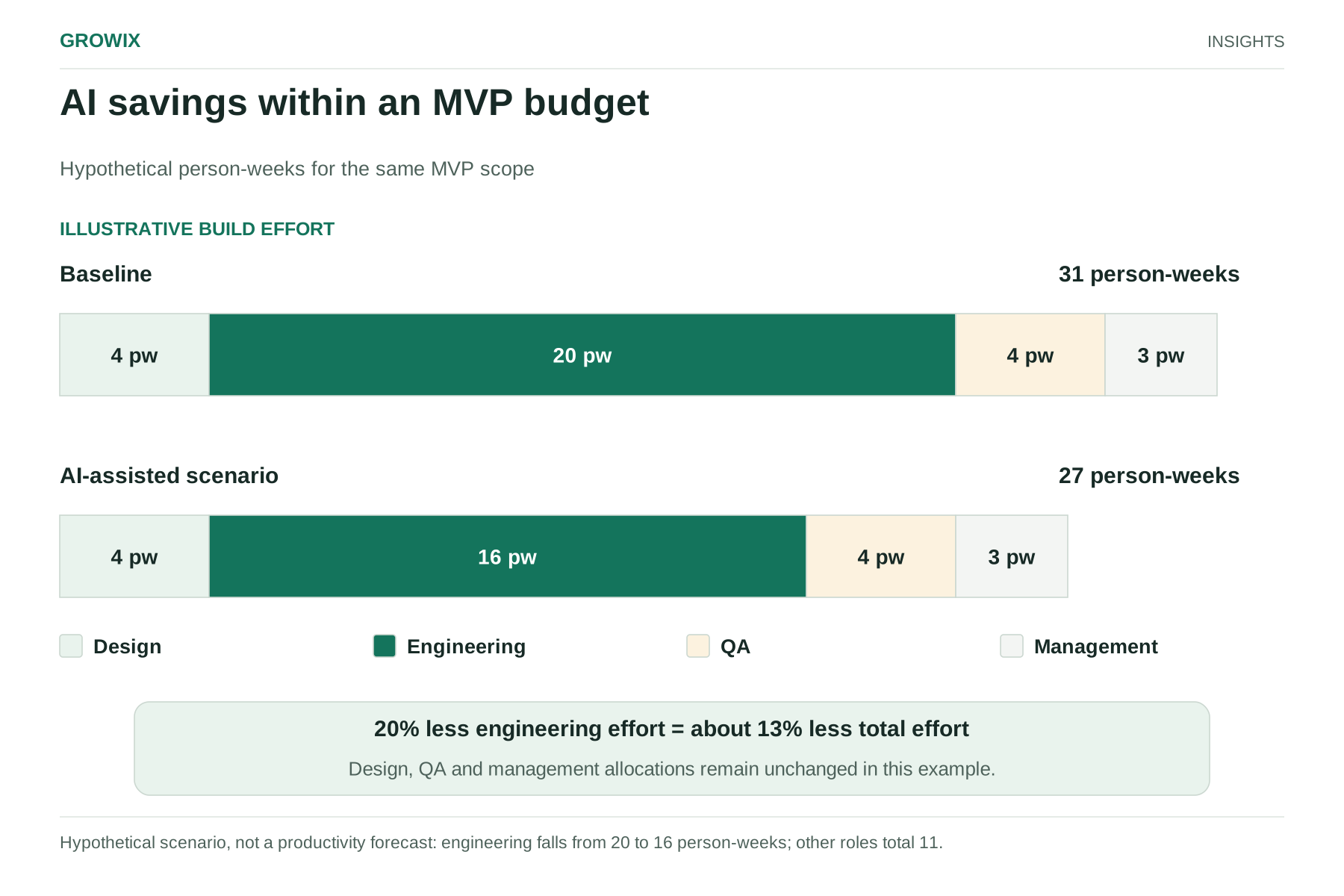
Continuing the hypothetical estimate, assume AI tools reduce software engineering effort by 20%, from 20 to 16 person-weeks, while design, QA and management stay the same. Total effort falls from 31 to 27 person-weeks. At $6,000 per person-week, the estimate falls from $186,000 to $162,000, a saving of $24,000, or about 13%.
The 20% figure is an assumption for illustration. The point is structural: even a meaningful engineering saving produces a smaller saving on the whole budget, because design, testing, coordination and review do not shrink at the same rate. Be cautious of quotes that claim AI cuts total cost by most of its value without explaining which work has been removed.
AI savings within an MVP budget. Hypothetical scenario, not a productivity forecast: engineering falls from 20 to 16 person-weeks; other roles total 11. View full size Read this comparison as a table
Role
Baseline person-weeks
AI-assisted scenario person-weeks
Product and UX design
4
4
Software engineering
20
16
Quality assurance
4
4
Delivery / product management
3
3
Total
31
27
Timeline expectations
Most of the elapsed time in an MVP is set by decisions and feedback, not typing. A realistic plan includes one to three weeks of discovery and design, several two-week build iterations with demos, a stabilization period for testing and fixes, and a soft launch to a small group of users before wider release. AI tools can shorten iterations; they cannot shorten the time users need to try the product and respond.
Compare estimates and maintenance plans
When you receive quotes, put them side by side on:
Question
Why it matters
What person-weeks and roles are included?
Reveals whether design, QA and management are priced in
What is explicitly excluded?
Exclusions become change requests later
How are changes to scope handled?
Fixed price with strict change control vs time and materials with a cap
Who owns the code, designs and accounts?
You should own your repository, cloud accounts and domain
How is quality assured?
Look for automated tests, code review and a staging environment
How is AI-generated code reviewed?
Ask how the team verifies security and correctness
What happens after launch?
Warranty period, maintenance terms and handover documentation
Fixed price or time and materials?
Most MVP quotes follow one of two commercial models, each with trade-offs:
Model
How it works
Suits
Risk to watch
Fixed price
Agreed scope for an agreed price
Well-defined scope with stable requirements
Vendors add contingency; every change becomes a change request
Time and materials
Pay for actual effort, usually per sprint or week
Products that will change as you learn
Budget drift without a cap and regular review
Capped time and materials
Pay for effort up to an agreed ceiling
Teams wanting flexibility with a budget limit
Scope must be reprioritized as the cap approaches
An MVP exists to learn, so some flexibility is usually worth paying for. Protect yourself with a clear backlog, fortnightly demos and a written agreement on what happens as the budget is used up.
Measure whether the MVP did its job
Agree success measures before launch, tied to the question the MVP is meant to answer:
Activation: the share of sign-ups who complete the core workflow.
Repeat use: whether users return to do it again within a set period.
Willingness to pay: conversions to paid plans, signed pilots or letters of intent.
Qualitative evidence: interviews about what users valued and what stopped them.
Stability: errors, support requests and time spent fixing defects rather than learning.
If those measures are not clear, the most expensive mistake is not overspending on the build. It is building an MVP that cannot tell you whether to continue.
When each route fits
A no-code prototype or concierge test fits when you have not yet confirmed that customers want the outcome. You may not need software yet. Growix's Startup & Venture Advisory covers business model validation before you commit to a build.
A small professional team fits when demand is validated enough to justify a real product, and the MVP must be secure, maintainable and able to grow.
A founder building with AI tools alone fits for prototypes and internal demos, provided it is treated as a prototype. Rebuilding properly before taking payments or sensitive data is often cheaper than fixing a fragile foundation later.
When Growix may not be the right fit: if your budget only covers a prototype to test an idea, a freelancer or no-code tool is usually more economical than a full product team.
Frequently asked questions
What is an MVP in software development?
A minimum viable product (MVP) is the smallest product that lets real users complete the core job and gives you evidence about whether they value it. It should be secure and usable for that job, not a cheaper version of the full product.
How much does it cost to build an MVP?
Cost follows scope and team: the number of person-weeks multiplied by the rates of the people doing them. In this guide's hypothetical B2B SaaS example, 31 person-weeks at an assumed $6,000 per person-week comes to $186,000. A tightly scoped MVP built at lower rates costs less; vague scope is the main reason estimates differ by multiples.
Do AI coding tools make an MVP cheaper?
They can shorten some engineering tasks, such as scaffolding, boilerplate and first-draft tests, but design, architecture, security, QA and project management still take similar time. A meaningful saving on engineering effort therefore produces a smaller saving on the total budget.
Next step
Write a one-page scope with acceptance criteria and exclusions, then ask for estimates broken down by role and person-week. That gives you a basis for comparing vendors fairly and seeing where AI-assisted development is genuinely reducing effort.