Pay Transparency Laws: A Job Posting Compliance Workflow for Multi-state Employers
With salary range rules in more states each year, the hard part is not the posting but the pay structure behind it. A workflow from compensation bands to job ads, records and candidate questions.
Pay transparency laws have spread quickly across the United States. A growing number of states and cities now require employers to include a pay range in job postings, and several more have enacted laws that take effect over the next year. For a company hiring in one state, compliance can be a matter of adding a line to the job ad. For a company hiring remotely or across several states, it becomes an operational question: who sets the ranges, how they are justified, where they appear and how the company proves it acted in good faith.
This guide explains the current requirements at a practical level, then sets out a workflow that multi-state employers can use to post compliant ranges consistently. It is general information, not legal advice; requirements differ by jurisdiction and change often, so confirm the details with employment counsel.
Where pay range posting requirements apply
Pay posting requirements differ by jurisdiction, employer coverage and role location. A reliable workflow begins with the official guidance for the places where a role may be performed, rather than a single national template or an undated list of states. Two examples show why the details matter:
Example jurisdiction
Coverage and posting requirement
Official reference
California
Employers with 15 or more employees must include a pay scale in job postings. The Labor Commissioner's guidance addresses employee counting and positions that may be filled in California, including remotely.
The law effective October 29, 2025 covers employers with 25 or more employees in the Commonwealth and requires disclosure of the position's pay range in its posting.
These examples are not an exhaustive jurisdiction list. For each hiring location, the legal or HR owner should record:
Which employer-size threshold applies and how employees are counted.
Whether remote positions, internal moves and third-party recruiter postings are covered.
Whether benefits or other compensation must be described alongside the salary or hourly range.
What a good-faith range means for the role and geographic pay policy.
Which notices, posting records and retention rules apply.
Who checks changes in official guidance and updates the hiring templates.
Put that jurisdiction review alongside the requisition record. A recruiter should be able to see the approved range, covered locations, source guidance and last review date before an advertisement is released. Where coverage is unclear, resolve it with employment counsel instead of excluding a location from the advert as a shortcut.
Step 1: Build the pay structure first
Posting a range is easy. Posting a defensible range consistently across dozens of roles requires a pay structure behind it.
Define job levels. Group roles into families, such as engineering, sales and operations, and levels within each family, with clear descriptions of scope and expectations.
Benchmark pay. Use reliable salary survey data for each role and level, matched to the labor markets where you hire. Note the source and date of each benchmark.
Set ranges. For each level, set a minimum, midpoint and maximum. Many employers use different ranges for different geographic pay zones.
Decide how location affects pay. For remote roles, decide whether pay depends on where the employee lives, and if so how many zones you use. That decision drives which range appears in each posting. Fewer zones are easier to explain and administer; more zones track local labor markets more closely but multiply the ranges you must maintain and justify. A practical rule is to start with the fewest zones that reflect real differences in the markets where you hire, and to review them annually alongside benchmark data.
Document the rationale. Record how ranges were set and when they were last reviewed. If a regulator or candidate questions a range, this record supports your good-faith position.
Step 2: Decide what goes in each posting
For every job requisition, the posting should state the range the company genuinely expects to pay for that role and location. Common decisions to make once, in policy:
Range width: a range so wide that it tells candidates nothing may be challenged as not made in good faith, and some laws specifically consider breadth.
Which range for remote roles: if the role can be filled from several states, decide whether to post the full national range, ranges by zone, or a range for each location listed.
Hourly or annual: match the way the role is actually paid.
Other compensation: whether to describe bonuses, commissions or equity, and how to describe benefits where required.
Internal postings: some laws cover internal job announcements and promotion opportunities, not only public advertisements.
Step 3: Build compliance into the hiring workflow
Manual compliance breaks down as hiring volume grows. Make the range a required part of the requisition process:
Requisition approval: the hiring manager selects the job level and location; the range comes from the pay structure, not from negotiation.
Applicant tracking system fields: store pay range and currency as required fields, and use posting templates that insert them automatically.
Job board syndication: check that ranges appear correctly when postings are syndicated to job boards and aggregators.
Third-party recruiters: require agencies posting on your behalf to include the approved range.
Exceptions: define who can approve an offer outside the posted range, and record why.
Recordkeeping: keep copies of postings and the ranges used, for the period your counsel advises.
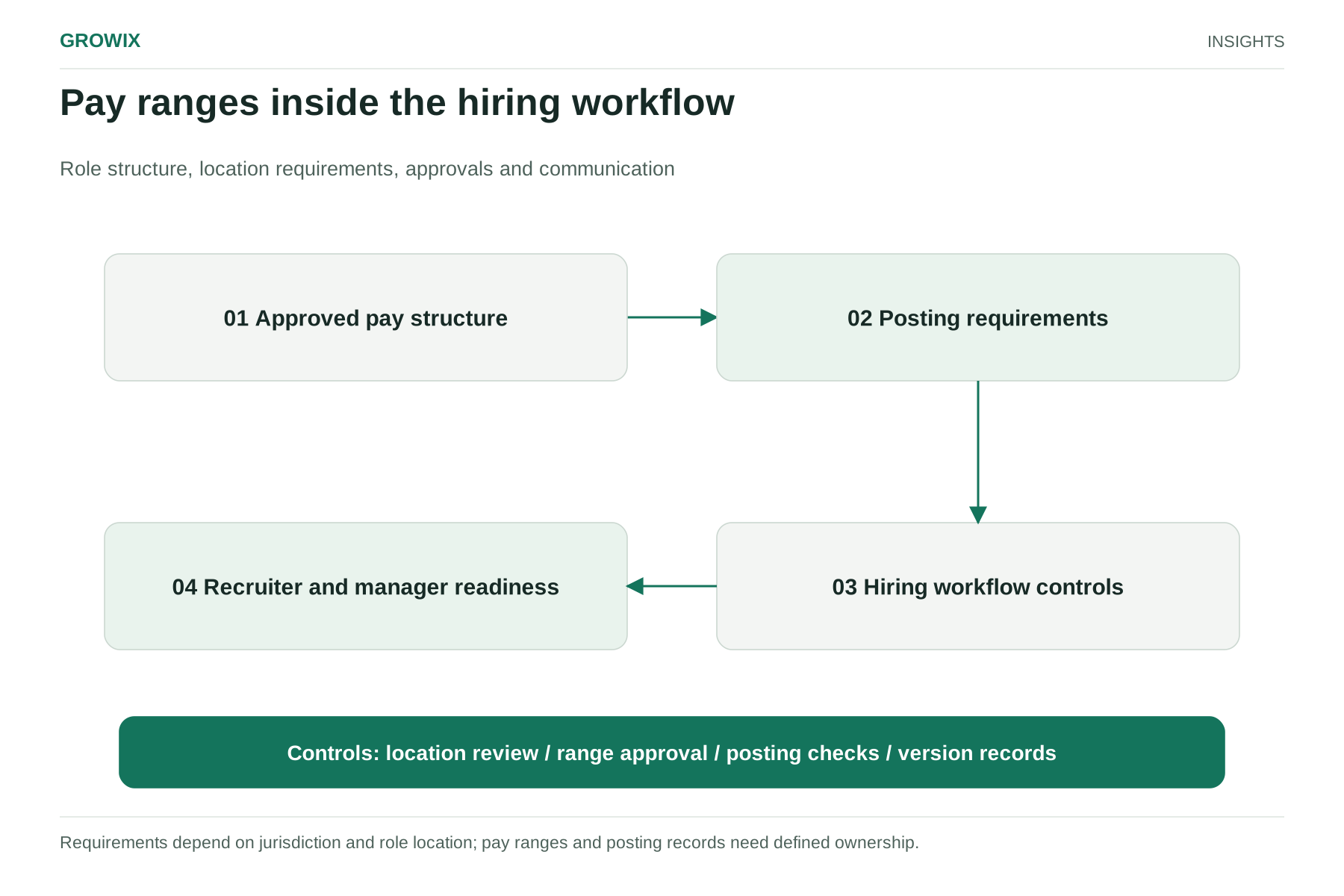
Pay ranges inside the hiring workflow. Requirements depend on jurisdiction and role location; pay ranges and posting records need defined ownership. View full size
Step 4: Prepare managers and recruiters for candidate questions
Once ranges are public, candidates and existing employees will ask questions. Prepare clear answers to:
How is the range set, and where in it are offers usually made?
How does location affect pay?
How can someone progress through the range?
Why does a new hire's range differ from a current employee's pay?
That last question is the most sensitive. Publishing ranges often reveals existing employees paid below the posted range for their role. Plan a pay equity review before or alongside the rollout, budget for adjustments, and agree how managers will discuss them.
Communicate with current employees before ranges go public
Employees will see your job postings, often before HR expects them to. If someone discovers that a new role at their own level advertises a higher minimum than they earn, trust suffers quickly. Before posting ranges widely:
Explain the pay structure to managers first, then to employees, including how levels and zones work.
Tell employees how they can find their own range and how progression through it works.
Address known gaps directly, with a timetable for adjustments where they are warranted.
Give managers a short guide for individual conversations, and a route to escalate difficult cases to HR.
Companies that communicate first tend to face fewer surprised and frustrated employees than those whose staff learn about ranges from public job boards.
Keep ranges current
Ranges set once and left alone drift away from the market. Review benchmark data at least annually, and more often for roles where the market moves quickly or where you consistently pay outside the range to hire. Track how often offers land near the top or outside the range, and how often candidates decline over pay. Those signals show which ranges need updating before your next annual review.
Common mistakes
Posting ranges only where you think a law applies, then missing a jurisdiction where a remote role could be filled.
Using ranges so wide they look like an attempt to avoid disclosure.
Letting recruiters or agencies set ranges ad hoc, which creates inconsistency and weakens a good-faith defense.
Forgetting internal postings and promotions, which some laws cover.
Ignoring existing pay gaps that public ranges will expose.
Hypothetical example: a 300-person remote-first software company
The following scenario is invented for illustration.
A software company employs people in 22 states and hires mostly remote roles. Recruiters have been posting ranges inconsistently, sometimes only in states they know have laws. The company:
Defines five levels in each job family and benchmarks pay with two salary surveys.
Adopts three geographic pay zones and, for remote postings, lists the range for each zone.
Makes level, zone and range required fields in its applicant tracking system, with templates that insert the ranges.
Runs a pay equity review and finds a group of long-tenured employees below the new minimums, adjusting them over two budget cycles.
Trains managers on explaining ranges and progression, and assigns its HR operations lead to monitor new laws quarterly with outside counsel.
Correct level and location on requisitions; candidate conversations
Finance
Budget for adjustments and range changes
Legal counsel
Jurisdictional requirements and policy review
HR technology owner
Applicant tracking configuration and reporting
Measures of success
Posting compliance: share of postings with an approved range, checked monthly.
Offer alignment: share of offers within the posted range.
Range currency: share of ranges reviewed in the last twelve months.
Pay equity gaps identified and closed.
Candidate experience: fewer late-stage withdrawals over pay mismatches.
Frequently asked questions
What is pay transparency?
Pay transparency means disclosing pay information, most commonly a good-faith salary or wage range in job postings, and in some places also benefits information or ranges for internal promotions. It is driven both by laws in a growing number of jurisdictions and by candidate expectations.
Which states have pay transparency laws?
A growing number of states and some cities require pay ranges in job postings, including California, Colorado, Illinois, New York and Washington, and new laws take effect each year. Employer-size thresholds and details differ, so check official guidance for every location where a role could be performed.
Do pay transparency laws apply to remote jobs?
Often, yes. Several jurisdictions apply their rules to positions that could be performed in that location, including remotely. Decide in policy which range you post for remote roles, record the jurisdiction review with the requisition and confirm the approach with employment counsel.
Next steps
Audit your last 50 job postings: which included a range, how each range was set, and which jurisdictions the roles could be filled in. The gaps will show whether you need a full pay structure project or a tighter posting workflow.