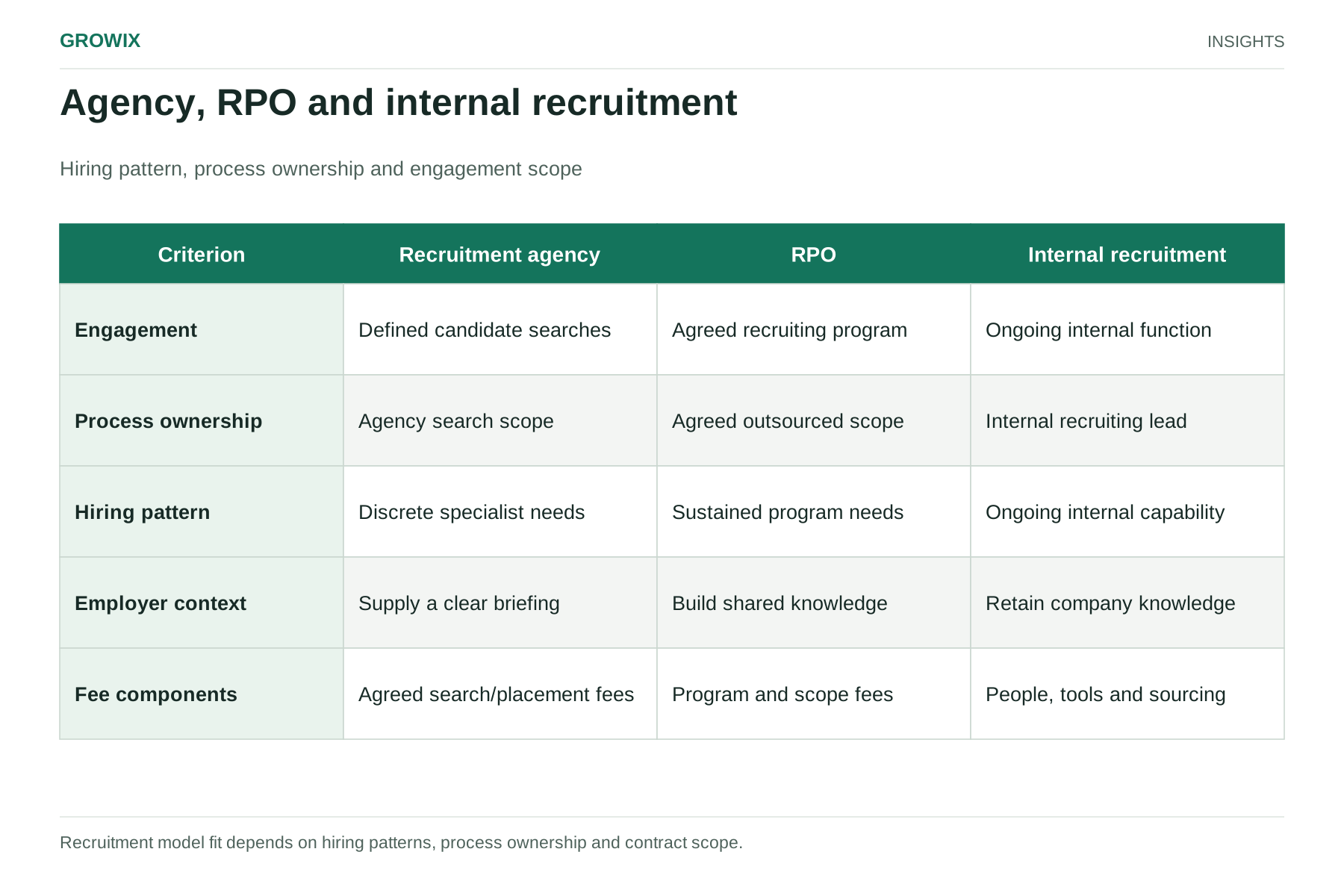
The short answer: use a recruitment agency for occasional, hard-to-fill or specialist roles where you pay only for success. Use recruitment process outsourcing (RPO) when you have a sustained or rising volume of hires and want a provider to run the hiring process under your brand, without building a full internal team first. Build in-house recruitment when hiring is steady, central to the business and large enough to justify permanent recruiters and systems. Many organizations combine them: an internal talent lead, RPO or internal recruiters for volume, and agencies for the hardest searches.
The decision depends on four things: how many hires you expect, how predictable that volume is, how much control you need over the process and employer brand, and how much you are prepared to pay per hire versus per month.
The three options defined
Recruitment agency. An external firm finds candidates for specific roles. Most agencies work on contingency, paid only when you hire their candidate, usually a percentage of first-year salary. Retained search firms, used for senior roles, are paid in stages regardless of outcome. Agencies own the candidate search; you own the rest of the process.
Recruitment process outsourcing (RPO). A provider runs part or all of your recruitment operation, such as sourcing, screening, scheduling, candidate communication and reporting, usually under your employer brand and inside your systems. RPO can cover all hiring, a specific function or a defined project, such as staffing a new location.
In-house recruitment. Your own recruiters and talent acquisition team manage hiring end to end, using your applicant tracking system, employer brand and processes.
Compare fees, volume and control
| Factor | Recruitment agency | RPO | In-house recruitment |
|---|
| Typical pricing | Percentage of first-year salary per hire | Management fee, per-hire fee or a combination | Salaries, tools, advertising and management |
| Cost behavior | Variable; rises with each hire | Partly fixed, partly variable | Mostly fixed |
| Best volume range | Low or irregular | Moderate to high, or a defined surge | Steady and predictable |
| Control over process | Low; agency controls search | Moderate to high, defined by contract | Full |
| Employer brand | Agency's brand often visible to candidates | Your brand | Your brand |
| Candidate data | May sit in agency systems | Usually in your systems | Your systems |
| Speed to scale up | Fast for individual roles | Fast once implemented | Slow; requires hiring recruiters |
| Knowledge retained | Low | Moderate; depends on handover terms | High |
What fees typically look like. Contingency agencies commonly charge around 15% to 25% of first-year salary, according to a 2026 overview by a recruiting platform that cites SHRM for a 20% to 25% range. The same overview describes RPO pricing models, attributed to the Recruitment Process Outsourcing Association, as cost-per-hire, monthly management fees and percentage-of-salary arrangements. Treat these as market indications; quotes vary by role, location and volume.
Model costs against your hiring forecast
The fairest comparison uses your own hiring plan.
Hypothetical example: 40 hires in a year
The following figures are assumptions for illustration, not market quotes or Growix pricing. A company plans 40 hires over twelve months with an average salary of $85,000.
| Item | Agency-led | RPO | In-house |
|---|
| Fees or people | 40 × 20% × $85,000 = $680,000 | $12,000 a month × 12 + $3,000 × 40 hires = $264,000 | 2 recruiters at $108,486 loaded = $216,971 |
| Tools and advertising | Included | $30,000 | $70,000 (applicant tracking, job ads) |
| Agency use for hardest roles | — | — | 4 × $17,000 = $68,000 |
| Annual total | $680,000 | $294,000 | $354,971 |
The in-house figure uses the Bureau of Labor Statistics median wage of $75,940 for human resources specialists, a category that includes recruiters (May 2025), divided by 0.70 to approximate benefits and payroll costs. It assumes two recruiters can handle 40 hires a year, which depends heavily on role complexity.
At this volume, both RPO and in-house recruitment cost far less than relying on agencies for every role. At five hires a year, the picture flips: agency fees of around $85,000 would be cheaper than a recruiter's salary or an RPO management fee. The breakeven point is the number that matters for your decision.
Also consider time. SHRM's 2026 recruiting benchmarking reports a median time to fill of 39 calendar days for non-executive roles. If recruiters are not in place when hiring needs arrive, the cost of open positions can outweigh fee differences.
Evaluate candidate experience and technology
Cost is not the only difference. Ask how each option will affect candidates and your data:
- Brand and communication: will candidates experience your company, or an intermediary? Agencies may represent several employers at once.
- Responsiveness: what service levels apply to candidate communication and interview scheduling?
- Assessment quality: who designs screening and interviews, and are they structured and consistent?
- Systems: will candidate data live in your applicant tracking system, so you keep it if the provider changes?
- Reporting: pipeline by stage, time to fill, source of hire, offer acceptance and quality of hire.
- Compliance: who handles equal employment opportunity records, data privacy and any rules on automated screening tools in the places you hire?
Hybrid models in practice
Few organizations rely on a single model. Common combinations include:
- Internal talent lead plus RPO: an employee owns hiring strategy, employer brand and hiring manager relationships, while an RPO provider handles sourcing, screening and coordination for volume roles.
- In-house team plus agencies for niche roles: internal recruiters fill most positions; agencies are used for senior or rare specialist roles with a clear fee agreement.
- Project RPO: a provider runs hiring for a defined surge, such as a new office or product launch, then hands back to the internal team with documented processes.
Whatever the mix, keep one applicant tracking system and one set of reports, so hiring managers and leadership see the whole picture.
What implementing RPO involves
An RPO arrangement takes planning before it delivers. A typical start includes agreeing role types and volumes, documenting your hiring process and approval steps, configuring access to your applicant tracking system, aligning employer brand messaging and job templates, training hiring managers on new scheduling and feedback routines, and setting service levels and reporting. Expect the first weeks to involve heavier management attention from your side. Contract terms worth reading closely include minimum volumes or fees, what happens when hiring slows, replacement guarantees, ownership of sourced candidate data and the handover process at exit.
When each option fits
Choose agencies when hiring is occasional, roles are specialized or senior, you need a network you do not have, or you want to pay only for results.
Choose RPO when you expect sustained or rising volume, need to scale quickly for a defined period, want consistent process and reporting, or are not yet ready to build an internal team.
Choose in-house recruitment when hiring is steady and core to the business, employer brand and candidate experience are strategic, and you can recruit and retain good recruiters.
When Growix may not be the right fit: if you expect only a handful of hires a year, an RPO arrangement, from Growix or anyone else, will rarely pay for itself. A targeted agency search or improving your own hiring process is likely to be better value.
Score vendors against your hiring forecast
Use a simple weighted scorecard for shortlisted providers:
| Criterion | Weight | Questions to ask |
|---|
| Relevant experience | 20 | Have they hired for similar roles, levels and locations? |
| Process quality | 20 | How do they screen and assess? Are interviews structured? |
| Cost at your forecast volume | 20 | What is the total cost at expected, low and high volumes? |
| Systems and data ownership | 15 | Will they work in your systems? Who owns candidate data? |
| Reporting and service levels | 15 | What do they measure and commit to? |
| Flexibility and exit | 10 | How do they scale down? What is handed over at the end? |
Score each from 1 to 5, multiply by the weight and compare totals. Then test the result with references from clients of a similar size.
Measure results after you decide
Whichever model you choose, track the same measures so you can compare over time and between providers:
- Time to fill and time to offer, by role type.
- Cost per hire, including fees, tools, advertising and internal time.
- Offer acceptance rate and reasons for declines.
- Quality of hire: performance and retention at six and twelve months.
- Hiring manager satisfaction with candidate quality and process.
- Candidate experience scores, including for rejected candidates.
- Source of hire, to see which channels produce people who stay and perform.
Review these quarterly. If an agency or RPO provider cannot report them, that is useful information in itself. Compare results against the baseline you recorded before the change, not against the provider's general claims, and involve hiring managers in the review: they see candidate quality first and are often the earliest to notice when a process is filling roles quickly with the wrong people.
Frequently asked questions
What is recruitment process outsourcing (RPO)?
Recruitment process outsourcing is an arrangement in which a provider runs part or all of your recruitment operation, such as sourcing, screening, interview scheduling and offer management, usually under your employer brand and in your systems. It suits sustained or rising hiring volume.
How much do recruitment agencies charge?
Contingency agencies are commonly paid a percentage of the hire's first-year salary, often cited as around 15% to 25%, and only when a placement is made. Retained search for senior roles is usually paid in stages. Always confirm fees, guarantees and replacement terms in writing.
When is RPO cheaper than using agencies?
Usually once hiring volume is sustained. Paying an agency fee on every role adds up quickly, while RPO pricing is typically a management fee plus per-hire or capacity charges. Model each option against your own hiring forecast, including a low and high scenario.
Next step
Write down your hiring forecast by role type and quarter, including a low and high scenario, and calculate the cost of each model at those volumes. If seasonal or project-based peaks drive your hiring, see our guide to e-commerce seasonal staffing for workforce forecasting.
Growix's Recruitment Process Outsourcing (RPO) service runs your recruitment operation end to end under your brand, against agreed volumes and timelines, and our Talent Acquisition & Recruitment team helps build or rebuild an in-house recruiting function.
Discuss your hiring and people operations needs