The short answer: hire directly for roles that are permanent, central to your product and worth the time it takes to recruit. Use staff augmentation to add specific skills or capacity to a team you already lead, for a defined period. Use a dedicated team when you need a complete, stable unit working on your product but lack the time or local market to build one yourself, and you can give it clear priorities. Many technology companies combine all three: a permanent core, augmented specialists for peaks and gaps, and sometimes a dedicated team for a distinct product stream.
The real differences are not mainly hourly rates. They are who manages the work, how quickly people become productive, what it costs to stop, and how much knowledge stays with you when people leave.
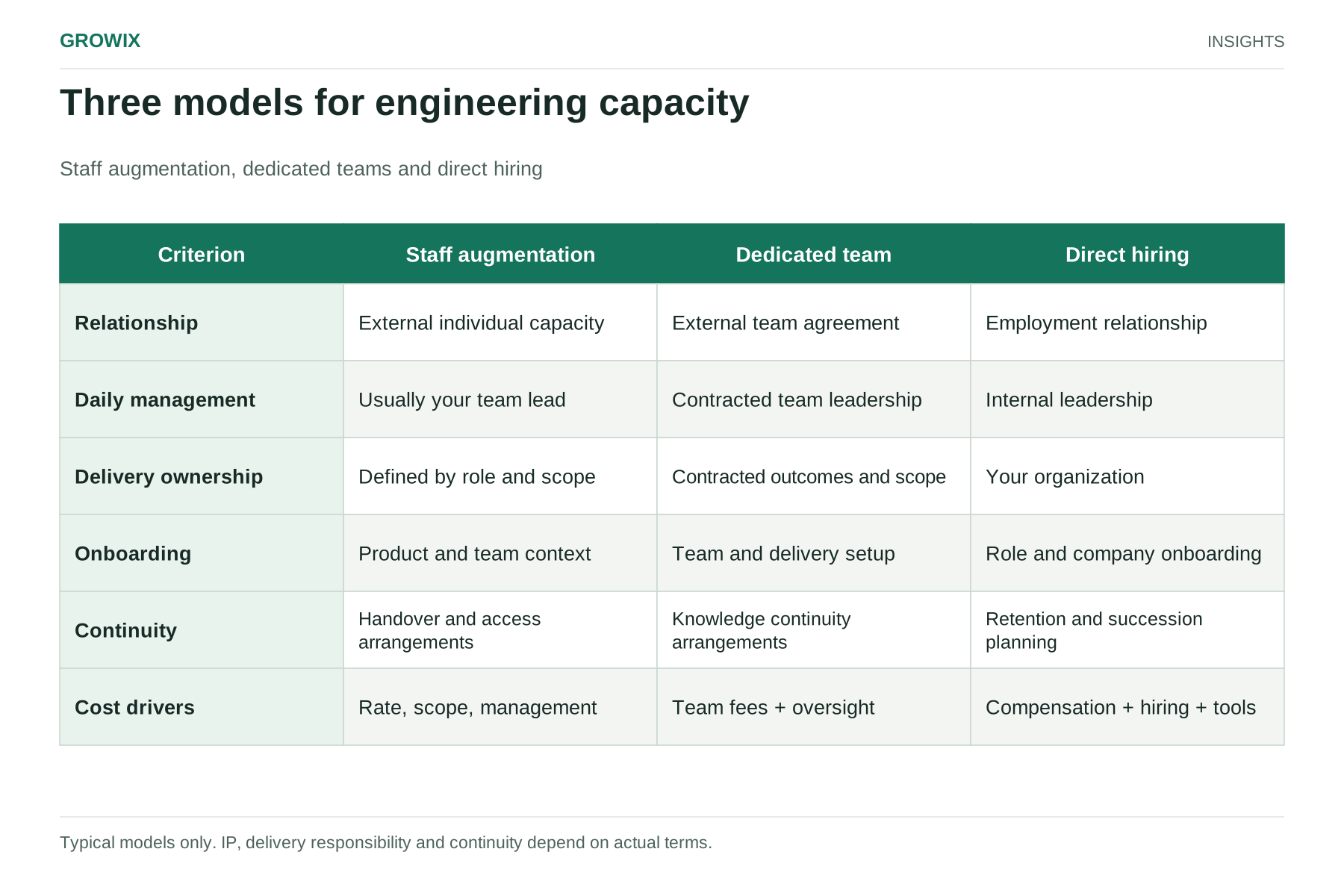
The three models defined
Direct hiring. You recruit employees, either through your own recruiters or an agency. You manage them fully, own their work and carry employment costs and obligations.
Staff augmentation. A provider supplies individual professionals, often contractors, who join your team and work under your direction, using your processes and tools. The provider handles employment, payroll and replacement; you manage day-to-day work and delivery.
Dedicated team. A provider assembles a team, typically engineers plus quality assurance and sometimes a team lead or delivery manager, that works exclusively on your product over a longer period. You set priorities and own the product; the provider usually handles team management, continuity and administration.
A fourth option, outsourcing a defined project with a fixed scope, shifts delivery responsibility to the provider. It suits a self-contained build better than ongoing capacity, and is covered in our guide to custom software vs off-the-shelf software.
Compare management and delivery ownership
| Factor | Direct hiring | Staff augmentation | Dedicated team |
|---|
| Who directs daily work | You | You | You set priorities; provider often manages team operations |
| Who owns delivery | You | You | Shared; agree it explicitly |
| Time to start | Longest: recruiting, notice periods, onboarding | Fast, often a few weeks | Moderate: team assembly and onboarding |
| Flexibility to scale down | Low; employment obligations | High, within contract notice | Moderate, within contract terms |
| Knowledge continuity | High if people stay | Lower; knowledge leaves with contractors | Medium to high if the provider keeps the team stable |
| Cultural integration | Highest | Moderate; depends on how you include them | Moderate; often a distinct unit |
| Management load on you | High: hiring, development, retention | High: direction and integration | Lower day to day; higher on governance and priorities |
| Typical fit | Permanent, core roles | Short to medium-term skills or capacity gaps | Long-running product streams |
The key question is whether you have the leadership capacity to direct additional people. Staff augmentation adds hands, not management. If your engineering leads are already stretched, adding three augmented engineers can slow the team down.
Model loaded costs and ramp time
Compare the full cost of productive capacity over the period you need it, not hourly or salary figures alone.
Direct hiring costs: salary, benefits and payroll taxes, recruitment (agency fees or internal recruiter time), equipment and tools, onboarding time and management. For reference, the US Bureau of Labor Statistics reports a median annual wage of $135,980 for software developers in May 2025, and benefits made up 30.0% of private-industry employer compensation costs in June 2026. Contingency recruitment agencies commonly charge around 15% to 25% of first-year salary, according to a 2026 market overview from a recruiting platform, which cites SHRM for a 20% to 25% range.
Ramp time matters as much as cost. SHRM's 2026 recruiting benchmarking, drawing on data from more than 4,600 organizations, reports a median time to fill of 39 calendar days for non-executive positions. Specialized engineering roles often take longer, and the clock does not include notice periods or the weeks before a new engineer is fully productive in your codebase.
Augmentation and dedicated team costs: provider rates or monthly fees, any onboarding or replacement terms, your management time and tool licenses. Rates vary enormously by location, seniority and provider.
Hypothetical 12-month comparison for three engineers
The following figures are assumptions for illustration, not market quotes or Growix pricing. They also assume the same location and seniority across models, which real comparisons rarely have, so adjust for your own situation.
| Item | Direct hiring | Staff augmentation | Dedicated team |
|---|
| People cost | 3 × $194,257 loaded ($135,980 ÷ 0.70) = $582,771 | 3 × $95 an hour × 1,800 hours = $513,000 | $42,000 a month × 12 = $504,000 (three engineers plus part-time lead and QA, assumed) |
| Recruitment | 3 × 20% of salary = $81,588 | Included in rate | Included in fee |
| Total | $664,359 | $513,000 | $504,000 |
| Productive from | Around months 2 to 4 | Around weeks 3 to 4 | Around weeks 4 to 8 |
| After 12 months | Three employees with growing product knowledge | Knowledge leaves unless contracts continue | Team continues if contract renews; knowledge sits partly with provider |
Over one year, direct hiring looks most expensive and slowest. Over three years, the picture often reverses: recruitment is a one-time cost, employees accumulate product knowledge, and provider margins continue. The right comparison depends on how long you need the capacity.
Evaluate IP, continuity and integration
Before choosing a provider-based model, check:
- Intellectual property: contracts should assign all work product and IP to you, including work by subcontractors.
- Access and security: contractors should use your accounts, with least-privilege access that you can revoke immediately.
- Continuity: how the provider handles replacement, notice periods and knowledge handover, and whether named people can be retained.
- Documentation: expectations for code documentation, architecture notes and runbooks, so knowledge does not leave with individuals.
- Time zones and overlap: enough shared working hours for collaboration and code review.
- Employment classification: how the provider employs or contracts its people, and any co-employment or classification risks where you operate. Take legal advice for your jurisdictions.
Make augmentation work in practice
Staff augmentation succeeds or fails on integration. Treat augmented engineers as team members, not as an external queue:
- Onboard them like employees: architecture walkthrough, coding standards, access on day one and a named buddy.
- Include them in team rituals: planning, stand-ups, retrospectives and code review, both giving and receiving.
- Give them ownership of real work with clear acceptance criteria, rather than leftover tickets.
- Require documentation as part of the definition of done, so knowledge stays when contracts end.
- Review fit early: agree a short initial period after which either side can change course with limited cost.
Set governance for a dedicated team
Dedicated teams need structure at a different level. Agree:
- A product owner on your side who sets priorities and accepts work.
- A regular cadence: sprint reviews, a monthly delivery review and a quarterly roadmap and contract review.
- Shared measures: delivery predictability, quality indicators such as escaped defects, and team stability.
- Escalation routes for delivery or quality concerns, on both sides.
- Access to the same tools and repositories your internal teams use, so the work is visible.
A dedicated team that receives clear priorities and fast feedback behaves like an extension of your organization. One that is briefed once a quarter drifts.
Moving from augmentation to permanent hiring
Some companies use augmentation to cover a gap while recruiting, or to evaluate whether a role is needed long term. If you might want to hire an augmented specialist permanently, check the contract for conversion terms before they start. Many providers charge a fee or require a minimum engagement period before conversion. Agreeing terms in advance avoids awkward negotiations when you and the individual both want to continue.
Questions to ask a provider
- How do you recruit and vet the people you supply, and can we interview them?
- How quickly can you replace someone who leaves or is not a fit, and at whose cost?
- Are your people employees or subcontractors, and where are they based?
- How do you protect our code, data and intellectual property?
- What notice period applies to scaling up or down?
- What overlap with our working hours can you guarantee?
- What happens to documentation and knowledge at the end of the engagement?
Compare answers in writing. Vague replies on replacement, IP and notice periods are a warning sign regardless of price.
Costs that do not appear on the invoice
Each model carries costs that are easy to miss. Direct hiring carries vacancy cost while roles are open, the time senior engineers spend interviewing, and the risk of a mis-hire. Staff augmentation carries the management time to direct and review extra people, and the cost of re-learning when contractors rotate. A dedicated team carries governance time, the risk of drifting priorities and, at the end, the cost of transferring knowledge back. Put a rough figure on these for your situation; they often decide close comparisons.
Choose by scope, duration and internal leadership
Use these questions to decide:
- Is the work permanent and core to your product? If yes, favor direct hiring, perhaps bridged by augmentation while you recruit.
- Is the need for a specific skill or a defined period, under a year? Favor staff augmentation.
- Do you need a whole stream of work delivered, with less day-to-day management from your side? Favor a dedicated team, with clear governance.
- Do you have an engineering leader with time to direct more people? If not, avoid augmentation-heavy plans until you do, or choose a dedicated team with its own lead.
- How fast must work start? If within a month, direct hiring alone will not meet the deadline.
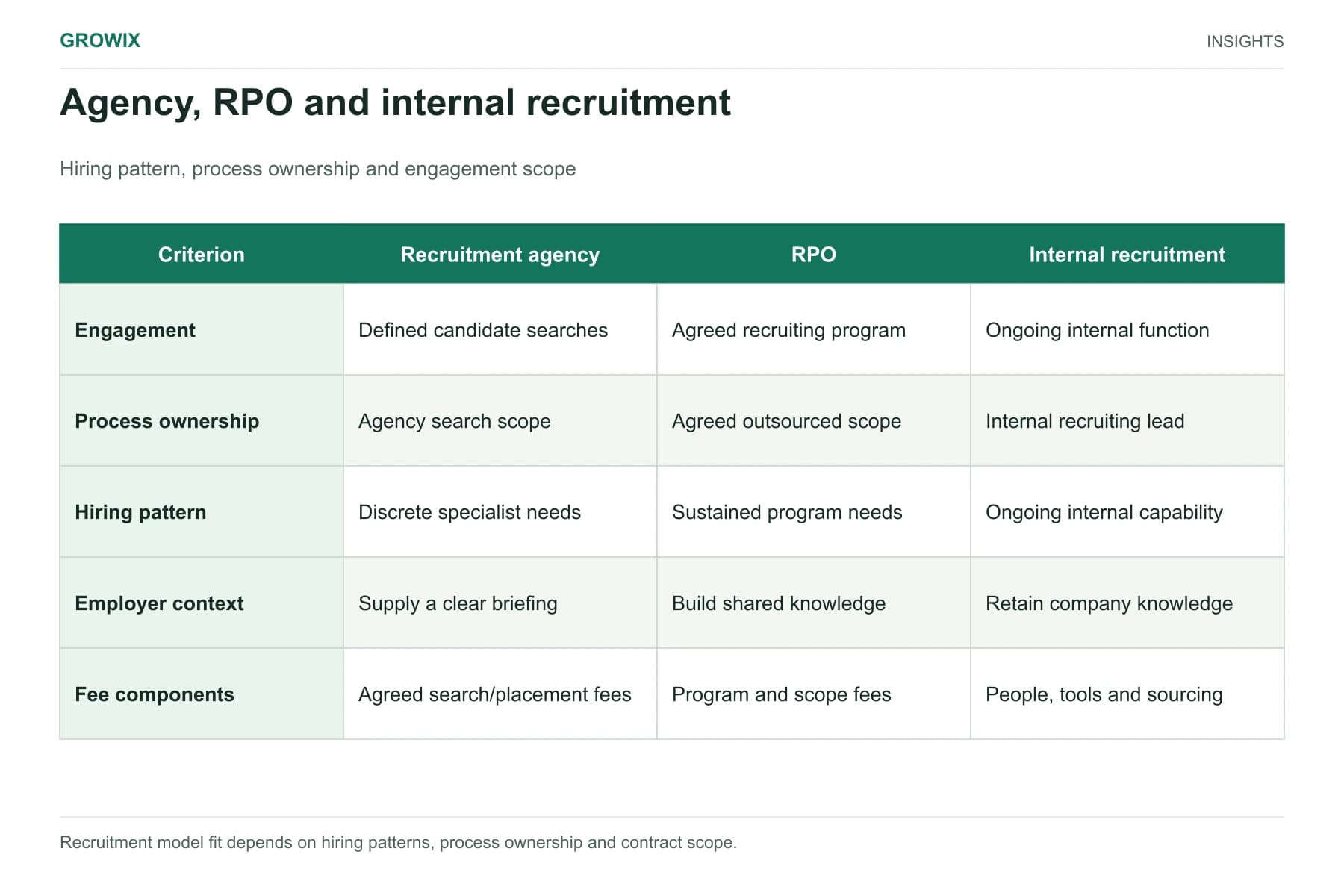
When Growix may not be the right fit: if you need a single permanent senior hire and have the time to recruit, a focused search, whether internal or through a specialist recruiter, is usually better value than an augmentation contract. Growix's Talent Acquisition & Recruitment team can support that route instead.
Frequently asked questions
What is staff augmentation?
Staff augmentation is a model in which a provider supplies individual professionals, often contractors, who join your existing team and work under your management for a defined period. It adds specific skills or capacity without permanent hiring, but you remain responsible for directing the work.
What is the difference between staff augmentation and a dedicated team?
With staff augmentation, you add individuals to a team you already lead. With a dedicated team, a provider assembles a complete, stable unit, usually including quality assurance and sometimes a team lead, that works on your product with your product owner setting priorities.
Who owns the code produced by an augmented or dedicated team?
You should. Contracts should assign all work product and intellectual property to your business, including work by subcontractors, and keep code, documentation and accounts in systems you control.
Next step
Write down the work you need done over the next twelve months, the skills required, how long each need lasts and who will lead the people involved. Then model costs over one and three years for the options that fit.
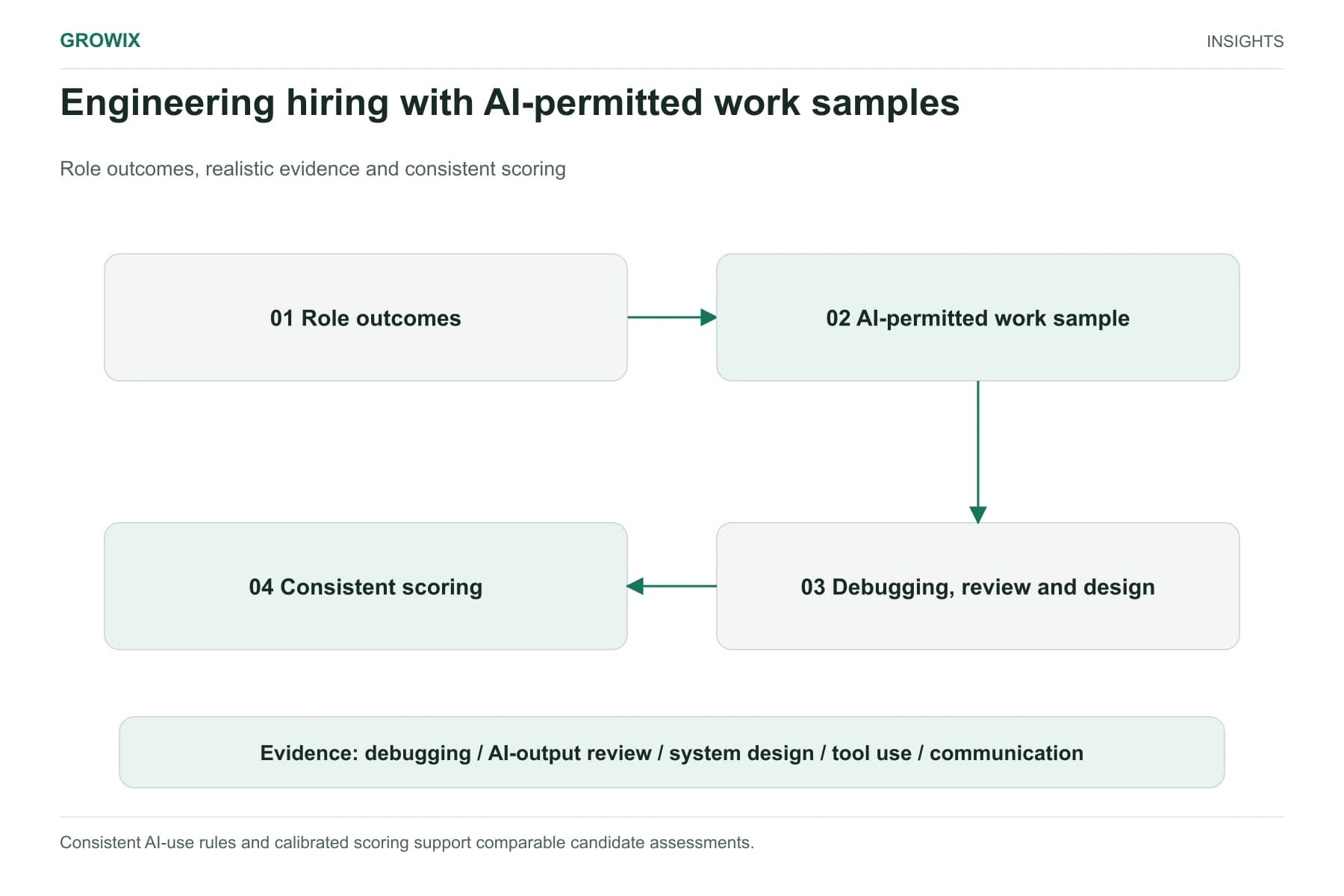
Growix's Staff Augmentation & Dedicated Teams service supplies contract specialists or dedicated remote teams for a project or ongoing capacity. If you are hiring permanently for engineering roles, our guide to skills-based hiring for developers who use AI tools covers how to assess candidates.
Discuss your hiring and people operations needs