Skills-based Hiring for SaaS Companies: Assessing Developers Who Use AI Coding Tools
When candidates can generate code instantly, writing code is a weaker signal. Assess what still separates strong engineers: debugging, reviewing AI output, design trade-offs and judgment.
Software engineers now write much of their code with AI assistants and coding agents. That has broken a familiar hiring pattern. A take-home exercise that once showed whether someone could build a small feature now mostly shows whether they can prompt a tool to build it. An algorithm quiz completed without AI shows a skill the job no longer uses in the same way.
Skills-based hiring for developers still works, but the skills worth measuring have shifted. The question is less "Can this person write the code?" and more "Can this person decide what should be built, spot what is wrong with generated code, fix it, and explain the trade-offs?"
This guide shows SaaS companies how to define role outcomes, design realistic work samples where AI use is allowed, assess the skills that now matter most, and score candidates consistently and fairly.
What has changed in technical hiring
CoderPad's State of Tech Hiring 2026, a global survey of about 650 developers, recruiters and hiring leaders run by a company that sells assessment software, illustrates how unsettled practice is:
Recruiters and hiring leaders were split on AI in assessments: 34% did not allow it, 29% allowed it with constraints, 17% allowed it broadly and 20% decided case by case.
Where AI was allowed, the most cited signal of real skill was catching and fixing AI mistakes (66%), followed by explaining trade-offs and correctness (56%).
Respondents rated debugging and system design as rising in importance over the next three years, and writing new code as declining.
The top cheating concern for 2026 was agent-generated solutions (52%), ahead of identity fraud (20%).
Identity and authenticity have also become hiring issues in their own right. When LinkedIn announced its Hiring Assistant 2 on September 29, 2026, it highlighted candidate verification signals and cited a survey finding that 39% of talent acquisition professionals say their top challenge is not knowing whether a candidate or their skills are real.
The practical conclusion: banning AI from assessments tests a way of working your engineers no longer use, while allowing it without changing the assessment tests very little. The answer is to redesign what you assess.
Step 1: Define role outcomes, not just a skills list
Skills-based hiring starts with what the person must achieve, not with years of experience or a list of frameworks. Write a short role scorecard with the hiring manager:
Element
Example for a mid-level backend engineer at a B2B SaaS company
Six-month outcomes
Owns the billing service's reliability; ships two customer-facing API improvements with tests and documentation
Core competencies
Debugging production issues; reviewing code, including AI-generated code; data modeling; API design; written communication
Context
Multi-tenant architecture; on-call rotation; small team with high autonomy
Tools
AI coding assistants permitted and expected; existing stack named
Not required
A specific degree; years with a single framework
Each competency on the scorecard should map to at least one stage of the assessment. If a competency is not assessed anywhere, it is not really part of the hiring criteria.
Step 2: Design a realistic, AI-permitted work sample
Choose exercises that reflect the job as it is now done. Several formats work well together:
Format
What it reveals
AI policy
Code review of an AI-generated pull request
Ability to spot bugs, security issues, missing tests and poor design
Collaboration, scoping, use of tools, testing habits
AI allowed; discuss choices aloud
System design discussion
Trade-offs, data modeling, failure modes, cost awareness
Usually conversational, without tools
Short written explanation
Communication with non-engineers and future maintainers
AI allowed, but candidates must defend it live
Keep the total candidate time proportionate. Long unpaid take-home projects disadvantage people with caring responsibilities or existing jobs, and they are easy to outsource to an agent. A live, time-boxed session of 60 to 90 minutes, combined with a design conversation, usually reveals more.
Hypothetical example: a code review exercise
The following exercise is invented for illustration.
Candidates receive a pull request that adds a discount-code feature to a sample subscription billing service. An AI assistant generated it. The code compiles and the happy-path test passes. It also contains four planted issues: discounts can be applied twice through a race condition, a tenant identifier is missing from one database query, error messages leak internal details, and there is no test for expired codes.
The candidate has 45 minutes, with AI tools available, to review the pull request as if for a colleague, then discuss it with an engineer. Strong candidates find most of the issues, rank them by severity, explain how they would verify each fix and comment respectfully. Weaker candidates either accept the code because it passes tests or rewrite it entirely without explaining why.
The exercise tests exactly the skills CoderPad's respondents valued most, and an AI assistant alone will not reliably find the multi-tenant issue without the candidate understanding why it matters.
Step 3: Assess debugging, review and architecture
Use a rubric with behavioral anchors, so interviewers score observed behavior rather than overall impressions:
Competency
1: Concern
3: Meets the bar
5: Strong
Debugging
Changes code at random; relies on AI suggestions without checking
Forms hypotheses, uses logs and tests to narrow the problem
Finds root cause quickly, explains it and prevents recurrence
Reviewing AI output
Accepts output that passes tests
Finds functional bugs and missing tests
Also finds security, tenancy and maintainability issues; prioritizes them
System design
Lists technologies without trade-offs
Proposes a workable design and explains main trade-offs
Anticipates scale, failure, cost and data-integrity issues
Tool use
Cannot work without AI, or refuses it entirely
Uses AI for speed and checks results
Uses AI deliberately, knows its limits, explains when not to use it
Communication
Unclear or defensive
Clear explanations and reasoning
Adapts explanation to audience; invites challenge
Watching how a candidate uses AI is informative. Some assessment platforms now let evaluators review prompt history, but a live conversation is often enough: ask why they accepted or rejected a suggestion.
Step 4: Use consistent scoring and train interviewers
Consistency is what makes skills-based hiring fair and defensible.
Structure every interview. Same exercises, same core questions and same rubric for every candidate in the role.
Score independently before discussing. Interviewers submit scores and evidence before the debrief to avoid anchoring on the most senior voice.
Calibrate regularly. Have interviewers score the same recorded or written example and discuss differences.
Train interviewers on the rubric, on avoiding questions unrelated to the job and on handling accommodation requests.
Monitor pass-through rates by stage and, where you collect demographic data lawfully, check for adverse impact on protected groups.
Verify identity proportionately, for example with a brief camera-on check at the start of live sessions, applied consistently to all candidates.
If you use automated candidate screening or scoring, determine whether it falls within applicable employment-tool rules. For tools covered by New York City Local Law 144, the city requires an independent bias audit within the preceding year, public audit information and specified notices. Covered NYC residents must receive the notice at least 10 business days before use. These requirements concern covered automated employment decision tools, not every AI tool a candidate uses while completing a work sample. Confirm coverage with employment counsel for the roles and locations involved.
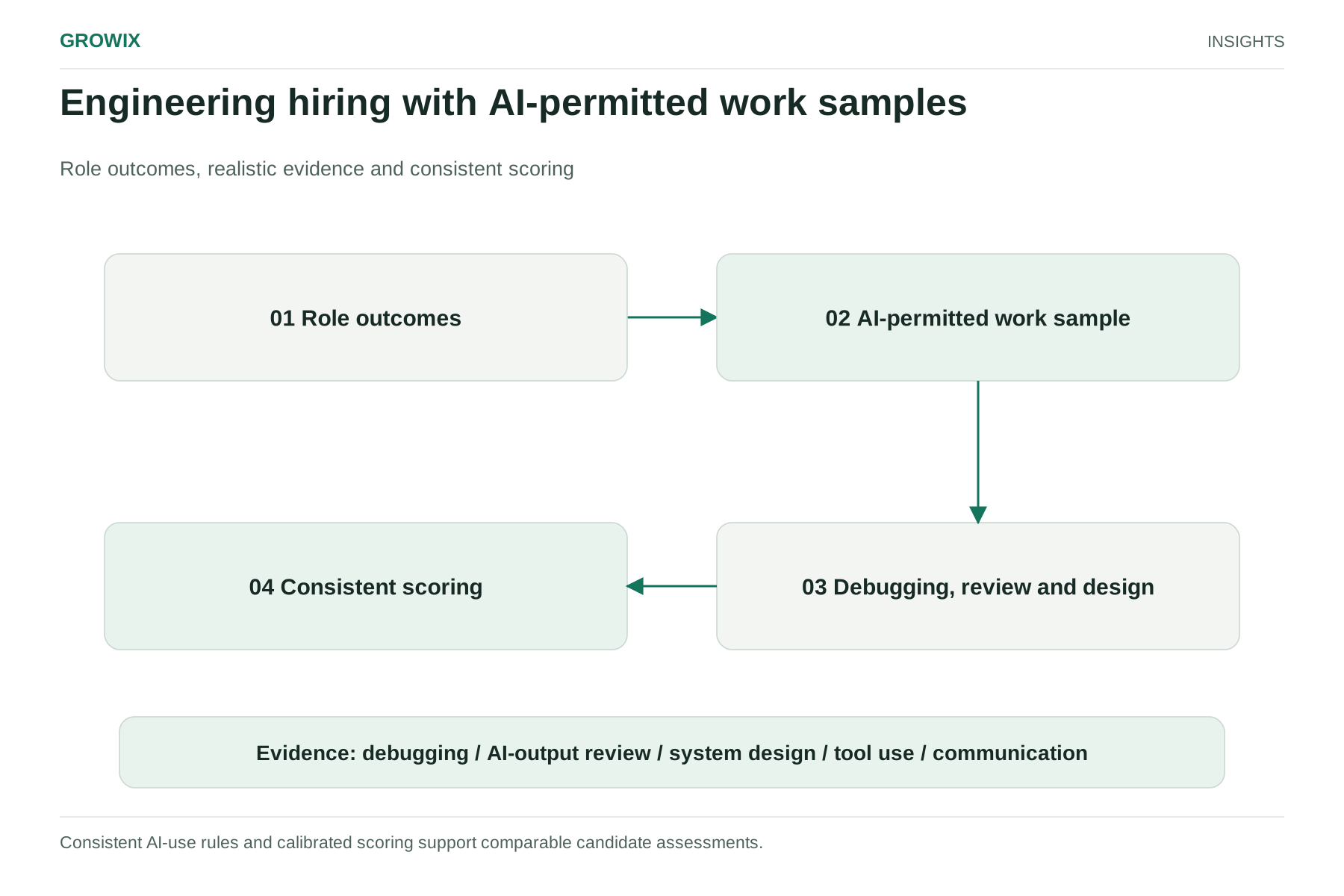
Engineering hiring with AI-permitted work samples. Consistent AI-use rules and calibrated scoring support comparable candidate assessments. View full size
Adapt the assessment to seniority
The same competencies apply at every level, but the evidence you look for changes:
Level
Emphasize
Example adjustment
Early career
Learning speed, debugging fundamentals, honest use of AI
Smaller codebase; ask them to explain every line they accept from an assistant
Mid-level
Ownership, code review, testing habits
Planted-issue review plus a short feature extension
Senior
System design, trade-offs, mentoring, risk judgment
Design discussion with changing constraints; review of a teammate's pull request with coaching comments
Staff or principal
Technical strategy, cross-team influence, cost and reliability
Written design proposal discussed with engineering leaders
Be careful with early-career candidates. Over-reliance on AI is a real risk, but so is screening out people who learned with these tools. Ask them to reason aloud about what generated code does and how they would test it; the ability to explain is a better signal than whether they typed every line.
Tell candidates the rules in advance
Ambiguity about AI use creates unfairness: some candidates hold back while others use every tool available. State the policy in the invitation for each stage:
Which tools are allowed, and whether candidates may use their own.
Whether the interviewer will ask to see prompts or tool output.
What you are assessing, such as judgment, testing and explanation, rather than speed of typing.
How to request accommodations, and that requesting one will not affect the outcome.
Clear rules also make cheating less attractive, because the exercise rewards the reasoning a hidden helper cannot easily supply in a live conversation.
Responsibilities and dependencies
Hiring manager: role outcomes, scorecard and final decision.
Engineering interviewers: exercises, rubric scoring and calibration.
Recruiting or talent acquisition: process design, candidate communication, scheduling and data.
HR or legal: accommodations, data retention, automated-tool compliance.
HR technology owner: applicant tracking configuration, scorecards and reporting.
Measuring whether the process works
Quality of hire: performance and retention of hires at six and twelve months, compared with the scorecard outcomes.
Predictiveness: whether assessment scores correlate with later performance, reviewed once you have enough hires.
Time to hire and offer acceptance rate.
Candidate experience: short surveys for all candidates, including those rejected.
Interviewer agreement: how often independent scores differ widely, as a calibration signal.
Pass-through rates by stage, to find stages that filter out good candidates or create disparities.
Frequently asked questions
What is skills-based hiring?
Skills-based hiring selects candidates on evidence of what they can do, gathered through realistic work samples and structured interviews scored against a rubric, rather than on degrees, years of experience or keyword matches. For developers, it means assessing the work they will actually do in the role.
Should candidates be allowed to use AI in coding interviews?
For most SaaS engineering roles, yes, with clear rules stated in advance. Banning AI tests a way of working your engineers no longer use. Allowing it shifts the assessment toward reviewing, debugging and explaining code, which are the skills that matter when AI writes the first draft.
How do you reduce cheating in remote technical interviews?
Verify identity at key stages, use exercises where candidates must explain and defend their reasoning live, follow a take-home task with a discussion of the choices made, and tell candidates the AI rules up front. Exercises that reward reasoning are hard for a hidden helper to fake.
Next steps
Pick one open engineering role. Rewrite its description around six-month outcomes, replace one existing exercise with an AI-permitted code review or debugging session, and introduce a shared rubric. Review the results after five or six candidates and adjust.