The short answer: choose a brand refresh when your positioning is still right but the way the brand looks and sounds has become dated, inconsistent or hard to use across channels. Choose a full rebrand when the business itself has changed so much that the existing brand misrepresents it: a new market, a merger, a different offer, a name that limits growth, or a reputation problem that cannot be repaired. Most businesses that think they need a rebrand actually need a refresh plus clearer messaging. A full rebrand is a larger, riskier project that touches every part of the business, and it should be driven by strategy, not boredom with the logo.
The terms defined
Brand refresh. An update to the brand's expression while keeping its core identity and name: modernized logo or wordmark, updated color palette and typography, a clearer visual system, refined tone of voice and messaging, and better guidelines. Customers should still recognize you immediately.
Rebrand. A change to the brand's foundations: positioning, promise, personality and often the name, logo and visual identity together. Customers are meant to see you differently.
Brand architecture change. A related decision about how a parent brand relates to products, divisions or acquired companies, for example whether acquired brands keep their names or move under one master brand.
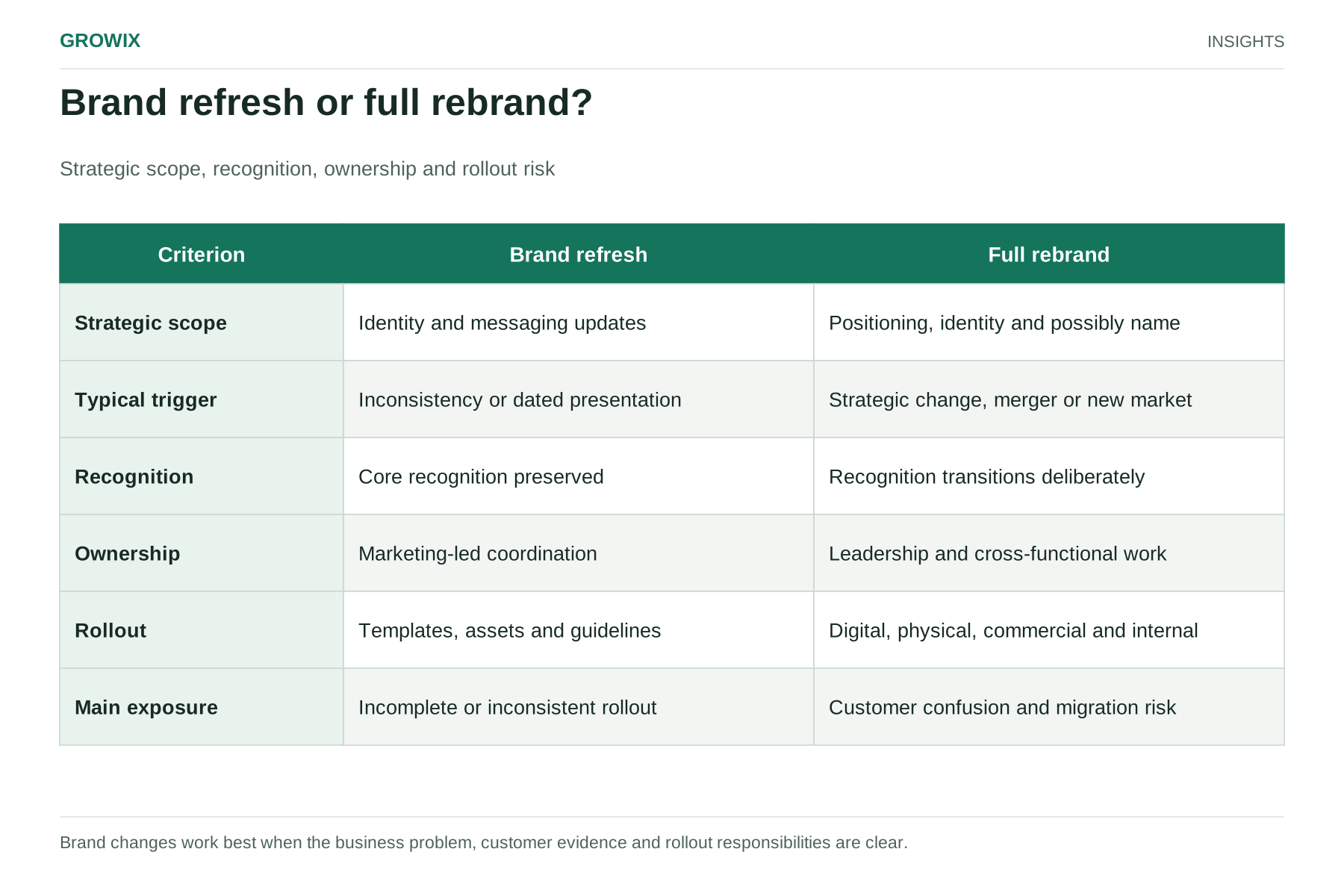
How they compare
| Factor | Brand refresh | Full rebrand |
|---|
| What changes | Visual identity, messaging and guidelines | Positioning, identity, often name and domain |
| Typical driver | Dated or inconsistent look; growth into new channels | Strategic change, merger, new market, reputation |
| Customer recognition | Preserved | Deliberately reset, with a transition period |
| Typical duration | Weeks to a few months | Several months to a year or more |
| Internal effort | Marketing-led, moderate | Leadership-led, cross-functional, high |
| Risk | Low to moderate | Moderate to high: confusion, lost search visibility, legal issues |
| Hidden costs | Updating assets and templates | Signage, vehicles, packaging, legal documents, domains, systems, accounts |
Triggers that justify a full rebrand
A rebrand is worth considering when one or more of these is true:
- The business has changed category or market. The name or identity ties you to something you no longer do.
- A merger or acquisition has combined brands that confuse customers when presented side by side.
- The name causes real problems: trademark conflicts, difficulty in new markets, confusion with competitors, or negative associations.
- Reputation damage that a change of practice alone cannot overcome, and only after the underlying problem is fixed.
- Positioning has shifted from, say, a low-cost provider to a premium specialist, and the existing brand actively undermines the new position.
Signs that a refresh is probably enough:
- Customers and staff like the name and what it stands for, but the visuals look outdated.
- The brand looks different across the website, sales materials and social channels.
- The logo does not work well at small sizes, on mobile screens or in social profile images.
- Messaging is vague, but the underlying positioning is sound.
Costs and risks
Hidden costs of a full rebrand
Agency or design fees are usually the smaller part of a rebrand budget. Inventory everything that carries the brand:
| Category | Examples |
|---|
| Digital | Website, domain, email addresses, social profiles, app store listings, online directories, ad accounts |
| Physical | Signage, vehicles, uniforms, packaging, printed materials, trade show assets |
| Commercial | Contracts, invoices, proposals and templates, partner and marketplace listings |
| Legal and admin | Trademark searches and filings, business registrations, bank and payment provider details |
| Internal | Training, internal tools, email signatures, document templates |
Search visibility risk
A name change usually means a domain change, which carries real search risk if handled carelessly. Google's guidance on site moves with URL changes recommends mapping every old URL to its new equivalent, using permanent server-side redirects, using Search Console's Change of Address tool for domain moves, and keeping redirects in place for as long as possible, generally at least a year. It also warns to expect temporary ranking fluctuation during a move. Plan the migration with your SEO team, and avoid launching a rebrand during your peak sales period.
Legal risk
Before committing to a new name or logo, have a trademark attorney run clearance searches in the markets where you operate or plan to operate. Discovering a conflict after launch is expensive and disruptive.
Customer and staff confusion
Existing customers may not recognize invoices, emails or packaging from a renamed company, which can affect payments and email deliverability. Communicate early, use "formerly known as" messaging for a period, and update every customer-facing system on the same day where possible.
A five-question decision framework
- Has our strategy changed? If the business, market or offer has changed fundamentally, consider a rebrand. If not, a refresh is likely enough.
- Is the name an asset or a liability? Test with customers and prospects rather than relying on internal opinion.
- What exactly is broken? List specific problems, such as inconsistent visuals, unclear messaging or a misleading name, and match each to the smallest change that fixes it.
- Can we afford the full transition? Include every asset in the inventory above, plus internal time.
- Is this the right time? Avoid peak seasons, major product launches or periods of internal disruption unless the rebrand is part of them.
If questions one and two point to a rebrand and you can fund the transition, proceed with a structured program. Otherwise, start with a refresh and a messaging project, which deliver most of the visible benefit with far less risk.
Hypothetical example
The following scenario is invented for illustration.
A regional IT services company named after its founding town now serves clients in several states and has added cybersecurity and cloud services. Sales teams report that prospects assume it is a small local provider. Customer interviews confirm the name limits perception in new markets, but existing clients value the company's reputation. The company chooses a rebrand with a new name, plus a twelve-month transition using "formerly" messaging, a planned domain migration with full URL redirects, and direct communication to every existing client. A competitor in a similar position, whose name was not limiting but whose website and sales materials looked inconsistent, chose a refresh instead and completed it in a fraction of the time.
What a refresh or rebrand cannot fix
Brand work changes perception; it does not change the experience behind it. If customers are unhappy with service, delivery or product quality, a new identity can make things worse by drawing attention to promises the business does not keep. Equally, a brand cannot compensate for unclear positioning: if leadership cannot say in one sentence who the business serves and why it is the better choice, settle that before commissioning design. The strongest brand projects start with an honest view of what customers already think, gathered through interviews, reviews and sales conversations, and focus the new expression on strengths the business can genuinely deliver.
A practical process for either path
- Research: interview customers, prospects and staff; review competitors.
- Strategy: confirm positioning, audience, promise and personality.
- Identity: develop visual identity, tone of voice and messaging.
- Guidelines: document rules and templates so the brand is applied consistently.
- Rollout plan: inventory assets, sequence changes, plan communication and the digital migration.
- Launch and measure: track brand search volume, direct traffic, inquiry quality, sales feedback and, if you measure them, awareness and perception.
Phasing a refresh
A refresh does not need a single launch day. Many companies phase it: update the website and digital templates first, where most customers see the brand, then sales materials, then physical items as they are naturally reordered. Phasing spreads cost and lets you correct problems before they are printed on vans and signs. The one requirement is a clear set of guidelines from the start, so assets created during the transition all follow the new rules.
Building internal support
Brand projects often stall on internal opinion rather than strategy. Senior people may be attached to the existing logo or name, while others want change for its own sake. Reduce subjective debate by agreeing the problems and success criteria before any design is shown, presenting customer research alongside creative options, and limiting final decisions to a small group with a clear owner. Involve sales and customer service early: they will explain the brand to customers every day, and they spot practical problems that leadership may miss.
When Growix may not be the right fit
If you need only a minor logo update or a set of social media templates, a freelance designer may be more economical than a full branding engagement. And if your challenge is mainly reputational, starting with the operational causes and a reputation management plan is more important than a new identity.
Frequently asked questions
What is a brand refresh?
A brand refresh updates how a brand looks and sounds while keeping its name and core identity: a modernized logo or wordmark, updated colors and typography, a clearer visual system, refined messaging and better guidelines. Customers should still recognize the brand immediately.
What is the difference between a rebrand and a brand refresh?
A refresh changes the brand's expression; a rebrand changes its foundations, such as positioning, promise and often the name and identity. A refresh is lower risk and typically takes weeks to a few months, while a rebrand is leadership-led and can take several months to a year or more.
Does a rebrand affect SEO?
It can, mainly when the domain or URLs change. Map every old URL to its new equivalent, use permanent redirects, use Search Console's Change of Address tool for domain moves and keep redirects in place for at least a year. Expect some temporary ranking fluctuation.
Next step
List the specific problems you want the brand work to solve and test them with ten customers or prospects. Their answers usually make the choice between a refresh and a rebrand clear.
Growix's Branding & Visual Identity team develops brand strategy, positioning, messaging and visual identity, along with the guidelines that keep it consistent. If a rebrand involves a domain change, our guide to SEO vs AEO vs GEO explains which search fundamentals to protect during the move.
Discuss your marketing priorities