Businesses that deliver services through several locations, such as auto service centers, veterinary clinics, fitness clubs, home services franchises, salons or dental groups, share a frustrating pattern. The core service is broadly the same everywhere, yet some locations earn strong reviews and repeat customers while others struggle. Leaders often look first at staff skills or local competition. Frequently, the difference lies in the customer journey around the service: how easy it is to book, how calls are answered, how long customers wait, how prices are explained and whether anyone follows up.
Customer journey mapping makes those differences visible. Done well for a multi-location business, it shows each step a customer takes, where customers drop out, how locations differ, and which steps should be standardized across the network. This guide sets out a practical method built on real data rather than workshop assumptions.
Why multi-location journeys are hard to manage
- Variation is invisible from head office. Each location develops its own habits for answering phones, handling walk-ins and following up.
- Data is fragmented across booking systems, phone systems, point of sale, review sites and email.
- Local managers own the experience but are measured mainly on revenue and costs.
- Reviews shape demand at the location level. Customers choose a specific site, often based on its ratings and recent comments.
- Small frictions compound: a missed call, a confusing booking form and an unexplained price change can each lose a modest share of customers, and together they lose many.
Step 1: Define the journey stages
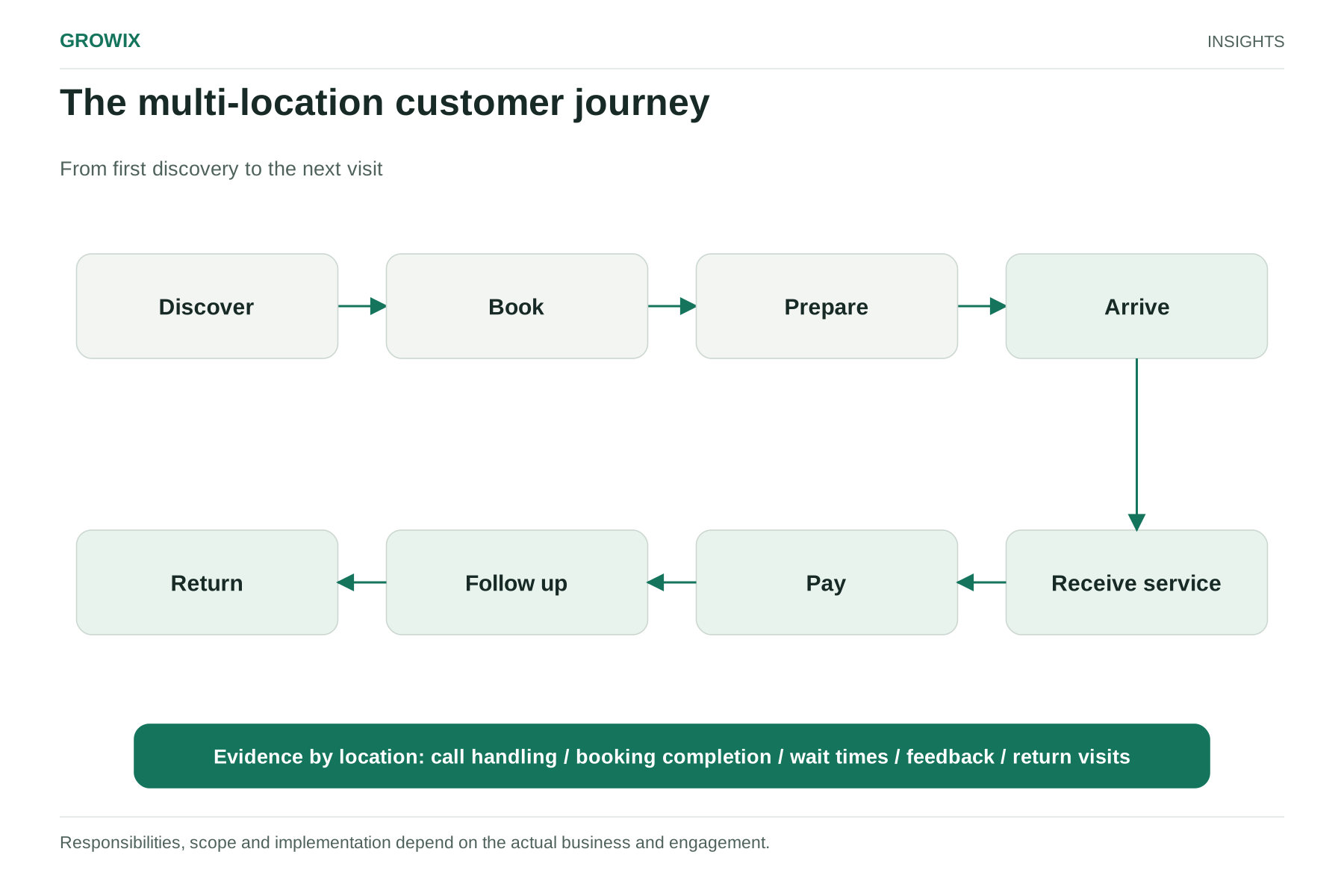
Start with a simple, shared outline of the journey. For most service businesses it looks like this:
| Stage | What the customer does | Typical touchpoints |
|---|
| Discover | Searches, compares locations, reads reviews | Search results, maps listings, website, review sites |
| Book | Calls, books online or walks in | Phone, online booking, chat, front desk |
| Prepare | Receives confirmation and reminders | Email, text messages |
| Arrive | Checks in and waits | Front desk, waiting area, signage |
| Receive service | Gets the service, hears recommendations | Staff, technicians, practitioners |
| Pay | Reviews the bill and pays | Estimate, invoice, payment terminal |
| Follow up | Receives a thank-you, survey or review request | Email, text, phone |
| Return | Rebooks, buys again or refers someone | Reminders, loyalty programs, word of mouth |
Adapt the stages to your business, but keep them consistent across locations so you can compare.
Step 2: Gather evidence for each stage
Workshops based on staff opinion produce maps of how the journey is supposed to work. Evidence shows how it actually works. Collect, for at least three months and for each location:
- Discovery: search and maps listing views, website visits by location page, review ratings and volume.
- Booking: calls received, answered and missed; online booking starts and completions; time to first available appointment.
- Attendance: no-show and late cancellation rates; reminder delivery.
- Visit: wait times where recorded; service duration; complaints.
- Payment: differences between estimates and final bills; disputes and refunds.
- Follow-up and return: survey responses, review requests sent, rebooking and repeat rates.
Add qualitative evidence: listen to a sample of recorded calls, read recent reviews for each location, and, where practical, make mystery bookings by phone and online. Ask frontline staff what customers complain about most; they often know exactly where the journey breaks.
Step 3: Map the journey and compare locations
Bring the evidence together into a map for the network, then a comparison by location. A simple comparison table often reveals more than a polished diagram:
| Measure | Location A | Location B | Location C | Network best |
|---|
| Calls answered | — | — | — | — |
| Online booking completion | — | — | — | — |
| No-show rate | — | — | — | — |
| Estimate-to-bill variance complaints | — | — | — | — |
| Average review rating (last 90 days) | — | — | — | — |
| Customers returning within 12 months | — | — | — | — |
Fill it with your own data. Look for stages where the gap between the best and worst locations is large, because those gaps show what is achievable inside your own business. Adjust for obvious differences, such as a location that is new, much busier or in a very different market, but resist explaining every gap away. If one site answers almost all its calls and a similar site misses many, the difference is usually in staffing patterns, phone setup or habits, all of which can be changed.
Create a service blueprint for the critical stages
For the stages with the biggest gaps, draw a service blueprint: the customer's actions, what staff do in front of the customer, what happens behind the scenes, and the systems involved. Blueprints show why a step fails. For example, a long wait at check-in may be caused not by front desk staff but by appointment templates that overbook the first hour of the day.
Step 4: Fix drop-off points and decide what to standardize
Not everything should be identical everywhere. Decide deliberately:
Standardize steps where consistency protects the customer and the brand: how calls are answered and when they are returned, booking and reminder processes, how estimates and price changes are communicated, safety and quality checks, and how complaints are handled.
Leave flexible what benefits from local judgment: community events, local partnerships, small courtesies and how teams build relationships with regular customers.
Then prioritize fixes by impact and effort. Common high-impact fixes include:
- Missed calls: call routing to another location or a central team during busy periods, with callback targets.
- Booking friction: fewer form fields, real-time availability and clear confirmation.
- No-shows: reminders at sensible intervals with easy rescheduling.
- Price surprises: written estimates and approval before additional work.
- Follow-up: a consistent thank-you and review request, plus a rebooking prompt where relevant.
Reviews: improve them honestly
Reviews are part of the journey and affect demand at each location, so it is tempting to manage them aggressively. Stay within the rules. The Federal Trade Commission's rule on consumer reviews and testimonials, announced in August 2024, prohibits fake reviews, offering incentives conditioned on a particular sentiment, undisclosed insider reviews and suppressing negative reviews through threats or intimidation, among other practices, and allows the FTC to seek civil penalties against knowing violators. Ask every customer for honest feedback, respond to criticism constructively and fix the causes.
Running the mapping sessions
Once evidence is gathered, bring together a small group: one or two location managers from strong and weak sites, frontline staff who handle calls and check-in, someone from marketing and someone who owns the booking and phone systems. Walk through each stage with the data on the wall. Ask three questions at every step: what the customer is trying to do, what gets in their way, and how the best location handles it. Keep the session focused on observed behavior and numbers rather than opinions about individual staff, so people engage rather than defend their sites.
Making improvements stick across locations
Fixes that depend on one enthusiastic manager fade when that manager moves on. To make changes last:
- Write simple standards: one page per critical stage, with the expected behavior and the measure that shows it is happening.
- Build standards into systems: booking templates, call routing rules, reminder schedules and estimate approval steps enforce consistency better than training alone.
- Add journey measures to location reviews, alongside revenue and cost, so managers are recognized for customer experience.
- Share practices between sites: short monthly calls where the best-performing location on a measure explains what it does.
- Revisit the map annually, or whenever you open new locations, change systems or acquire sites.
Common mistakes
- Mapping the ideal journey rather than the real one.
- Averaging across locations, which hides the variation that matters most.
- Fixing the most visible stage rather than the one losing the most customers.
- Standardizing everything, removing the local touches customers value.
Hypothetical example: a regional chain of auto service centers
The following scenario is invented for illustration.
A chain of 12 auto service centers finds that its three lowest-rated locations also have the lowest rate of customers returning within a year. Journey evidence shows two consistent problems at those sites: around a quarter of calls go unanswered during the morning rush, and reviews frequently mention final bills higher than the original quote.
The company introduces overflow call routing to a small central team during peak hours, a callback target for missed calls, and a standard rule that any additional work must be approved by the customer in writing or by recorded phone call before it starts. It also standardizes a post-visit message with a review link and a reminder for the next scheduled service. Each change is piloted at two locations, measured against the others, then rolled out across the network.
Responsibilities
| Role | Responsibility |
|---|
| Operations director | Standards, priorities and rollout across locations |
| Location managers | Local execution, staff coaching and feedback |
| Marketing | Listings, website, reviews program and communications |
| Customer service or contact center | Call handling, booking support and complaint routing |
| Finance and systems | Data from booking, phone and payment systems |
Measures of success
- Booking conversion: answered calls and completed online bookings as a share of attempts.
- No-show rate and rescheduling rate.
- Complaint rate by stage, especially pricing and wait times.
- Review rating and volume by location over rolling 90 days.
- Return rate: customers who come back within a set period.
- Variance between locations on each measure, which should narrow.
Frequently asked questions
What is customer journey mapping?
Customer journey mapping is documenting each step a customer takes with your business, from discovery and booking to the visit, payment, follow-up and return, together with the touchpoints, data and pain points at each step. Its purpose is to show where customers drop out and why.
What is the difference between a customer journey map and a service blueprint?
A journey map shows the experience from the customer's side. A service blueprint adds what happens behind it: what staff do in front of the customer, the work behind the scenes and the systems involved. Blueprints explain why a step fails.
How do you map the customer journey across multiple locations?
Use the same stages for every location, gather at least three months of evidence per stage and per site, such as calls answered, booking completion, no-shows, reviews and return rates, then compare locations side by side. Large gaps between similar sites show what is achievable.
Next steps
Pick three locations, one strong, one average and one weak, and collect three months of booking, call, review and return data for each. Comparing them usually points straight to the two or three journey stages worth fixing first.
Growix's Customer Experience Consulting team maps and improves customer journeys and service design, and our Operating Models & Business Process Optimisation team designs the standards and processes that make improvements stick across every location. If missed calls are part of the problem, see our guide to outsourced customer support pricing. For deciding how much customer and market research a change needs, see DIY, syndicated or custom market research.
Discuss your growth and operating priorities