The short answer: outsource HR administration and specialist expertise you need occasionally; keep decisions that shape culture, leadership and sensitive employee matters inside the business. For many companies below roughly 50 to 100 employees, an outsourced HR service plus a manager who owns people decisions is more practical than a first HR hire. As headcount, locations and complexity grow, an internal HR lead becomes necessary, often supported by outsourced administration and payroll. The question is rarely "all in or all out" but which responsibilities sit where.
This guide maps HR responsibilities, compares costs, covers data and escalation ownership, and gives recommendations by headcount, complexity and management capacity.
Terms to clarify first
HR outsourcing (HRO) means an external provider performs some or all HR operations for you, such as employee administration, policy management, onboarding paperwork, HR system administration and advice, while you remain the employer.
A professional employer organization (PEO) is a different model. In a co-employment arrangement, the PEO becomes the employer of record for certain purposes, often to provide payroll, benefits and compliance administration. Businesses that mainly want access to a PEO's benefits plans should compare PEOs specifically; the decision factors differ from those in this guide.
Payroll administration can be handled by a payroll provider, your finance team, an HR outsourcing partner or a combination. Clarify who calculates, who checks and who approves.
Map strategic and administrative responsibilities
Start by listing what HR work your business actually needs, then decide where each piece belongs.
| Responsibility | Nature | Usually best placed |
|---|
| People strategy, culture and values | Strategic | In-house leadership |
| Hiring decisions and leadership appointments | Strategic | In-house managers and leadership |
| Compensation philosophy and pay decisions | Strategic | In-house, with external benchmarking |
| Sensitive employee relations: discipline, grievances, terminations | Judgment-heavy | In-house decision-makers, with expert advice |
| Policy writing and handbook maintenance | Specialist, periodic | Outsourced or advisor, approved in-house |
| Onboarding and offboarding administration | Administrative, recurring | Outsourced or HR administrator |
| HR system administration and records | Administrative | Outsourced or HR administrator |
| Payroll data preparation and checks | Administrative, high accuracy | Outsourced or finance, with in-house approval |
| Compliance calendar and reporting | Specialist | Outsourced with in-house sign-off |
| Training and manager development | Mixed | Either, depending on scale |
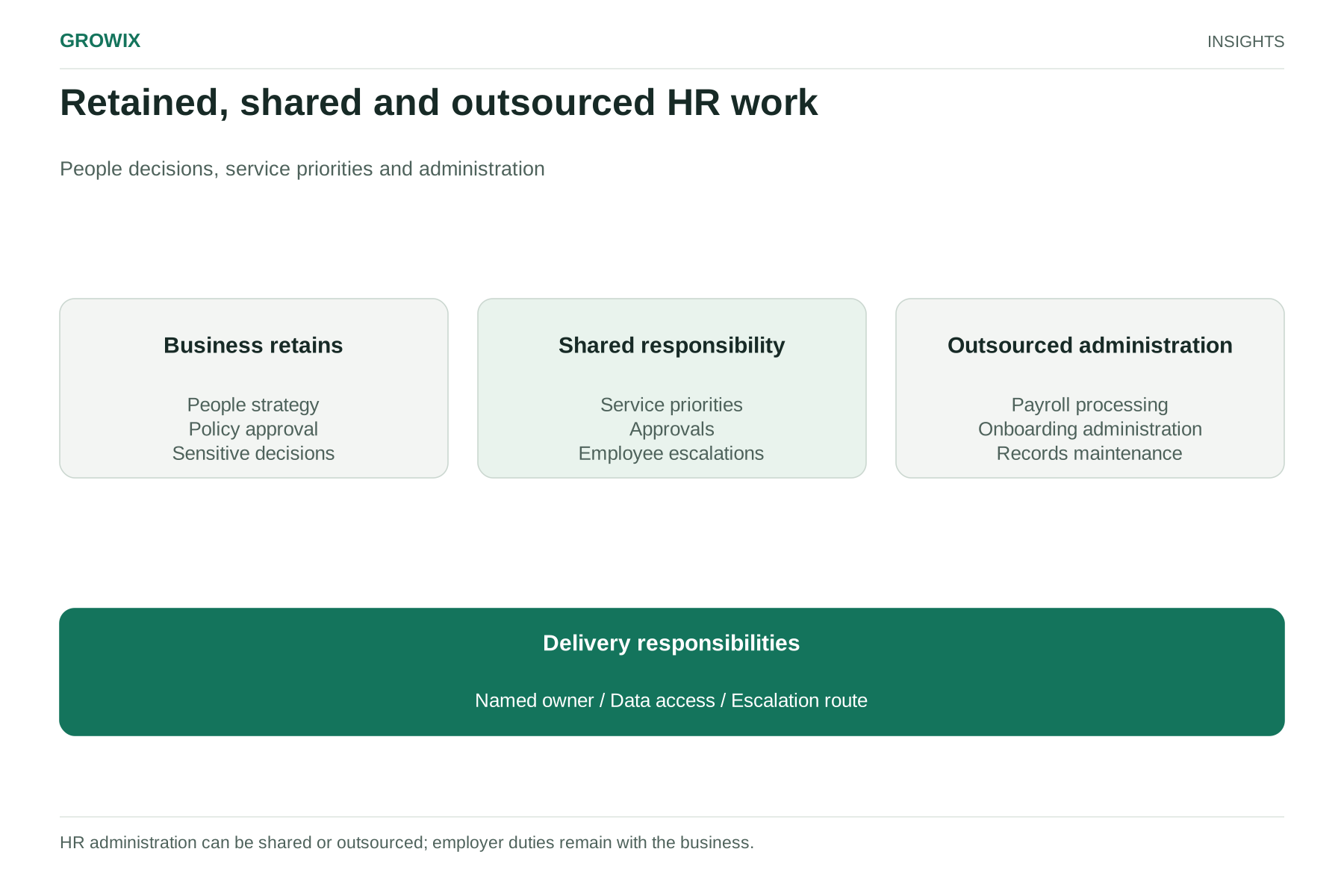
The pattern is consistent: administration and specialist knowledge outsource well; decisions about people stay with the people accountable for them.
Compare scope and loaded costs
Compare what each option delivers, not only its price.
In-house costs include: salary, benefits and payroll taxes, HR software, training, legal advice, recruitment and management time. For reference, the US Bureau of Labor Statistics reports median annual wages of $75,940 for human resources specialists and $149,280 for human resources managers in May 2025. BLS data also shows benefits making up 30.0% of private-industry compensation costs in June 2026, so dividing a wage by 0.70 gives a rough loaded cost.
Outsourced costs include: monthly or per-employee fees, setup or transition fees, charges for out-of-scope work such as investigations or restructuring, HR software if not included, and the internal time needed to manage the provider.
Hypothetical comparison for a 60-person company
The figures below are assumptions for illustration, not market quotes or Growix pricing.
| Item | First in-house HR hire | Outsourced HR |
|---|
| People cost | HR generalist at specialist median, loaded: $108,486 | — |
| Provider fees | — | $6,000 a month (assumed): $72,000 |
| HR software | $15,000 | $15,000 |
| Specialist advice (employment law, benefits) | $10,000 (assumed) | Partly included; $5,000 extra (assumed) |
| Annual total | $133,486 | $92,000 |
The outsourced option costs less in this example, but delivers something different. An internal generalist is present every day, builds relationships and absorbs ad hoc work. An outsourced service brings a broader team and documented processes, but works within its scope and response times. One generalist also cannot cover every specialism or every absence, which is where hybrid models help.
Check employee data and escalation ownership
Before outsourcing, agree in writing:
- Data ownership and access: employee records stay in systems you own or can export from, with access limited to named provider staff and removed promptly when they change roles.
- Data protection: how the provider stores, transfers and deletes personal data, including sensitive categories such as health and immigration documents.
- Escalation paths: which matters the provider handles, which it escalates to you, and response times for each, especially harassment complaints, safety issues and potential legal claims.
- Decision rights: the provider advises and administers; named managers decide on hiring, discipline, pay and terminations.
- Legal counsel: when an employment lawyer is involved, and who engages them.
- Exit terms: what happens to records, templates and open cases if the arrangement ends.
Recommend by headcount, complexity and management capacity
Headcount is a starting point, but complexity and management capacity often matter more.
| Situation | Suggested model |
|---|
| Under about 25 employees, one location, simple roles | Payroll provider plus outsourced HR support on demand; a founder or operations lead owns people decisions |
| About 25 to 100 employees, growing, few locations | Outsourced HR operations with an internal manager accountable for people matters |
| About 100 to 250 employees, or several states | Internal HR lead, supported by outsourced administration, payroll support and specialists |
| Over about 250 employees, or complex workforce | Internal HR team; outsource specific functions such as payroll processing or recruitment volume |
| Any size with high-risk employee relations, union environments or rapid restructuring | Internal senior HR capability plus specialist legal advice |
Multi-state operations add complexity quickly, because employment rules on leave, pay transparency and final pay differ by state. Factor that in earlier than headcount alone suggests.
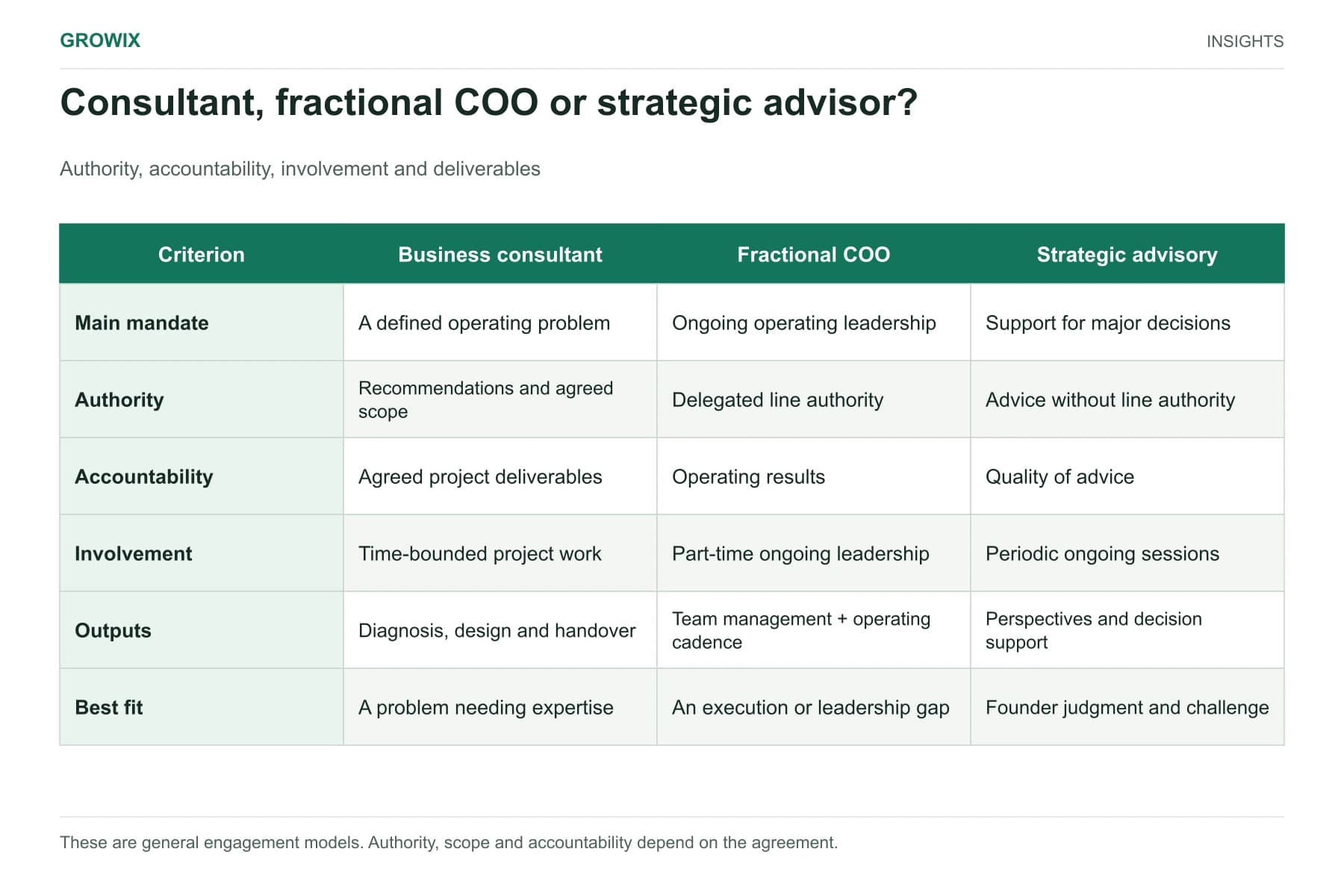
Distinguish administration from employment and leadership arrangements. If your main goal is access to benefits through co-employment, evaluate a PEO arrangement explicitly. If you need a senior HR leader embedded in your leadership team, specify that authority and involvement separately. Neither arrangement should be assumed from an HR administration proposal; confirm the employment relationship and responsibilities in the actual agreement.
Hybrid HR models in practice
Most growing businesses end up with a hybrid. Three common designs:
Accountable manager plus outsourced HR. An operations leader or chief of staff owns people decisions and priorities; the provider runs administration, policies, onboarding and advice. Suitable for smaller companies where people issues are not yet frequent enough for a full-time HR role.
HR lead plus outsourced operations. An internal HR lead focuses on culture, leadership development, organization design and employee relations, while administration, HR system management and payroll support are outsourced. This keeps senior attention on the work only an insider can do.
Internal team plus specialist partners. A larger internal team buys specific expertise, such as compensation benchmarking, investigations or learning programs, when needed.
In every design, write down who is responsible, accountable, consulted and informed for each HR process, and review it when the company grows.
Plan the transition carefully
Moving HR work to a provider, or bringing it back, affects employees directly. A sound transition includes an inventory of current processes and records, clean data migration with checks, clear communication to employees about whom to contact and for what, a short period of parallel support, and a review after the first payroll cycle and first month of onboarding. Employees judge HR by whether their questions are answered quickly and correctly, so measure that from the start.
Common mistakes
- Outsourcing judgment along with administration, leaving nobody inside the business accountable for people decisions.
- Choosing on price alone, then discovering that investigations, restructuring support or multi-state advice cost extra.
- Losing control of records because data sits only in a provider's system.
- Waiting too long to hire an internal HR lead after headcount and complexity have grown.
Questions to ask an HR outsourcing provider
- Exactly which tasks are included in the fee, and which are billed separately?
- Who will be our day-to-day contact, and what are the response times?
- Which states and employment situations do you have experience with?
- Where will employee data be stored, and can we export everything at any time?
- How do you handle sensitive matters such as complaints and investigations?
- How do you keep policies current as laws change, and who approves updates?
- What reporting will we receive, and how often?
Ask for references from clients of a similar size, industry and footprint, and ask those references how the provider handled their most difficult employee matter. The answer reveals more about fit than any service description.
Signs it is time to change your model
- Managers spend increasing time on HR administration instead of their teams.
- Policies are outdated or inconsistent across locations.
- Employee questions go unanswered or receive different answers.
- Payroll errors recur.
- You are planning significant growth, a new state or a restructuring.
Frequently asked questions
What is HR outsourcing?
HR outsourcing means an external provider performs some or all HR operations for you, such as employee administration, policies and handbooks, onboarding paperwork, HR advice and compliance support, while your business remains the employer and keeps ownership of people decisions.
Which HR functions can be outsourced?
Administration and specialist expertise outsource well: employee records, onboarding and offboarding paperwork, policy drafting, benefits administration support, payroll coordination, compliance updates and occasional employee relations advice. Culture, leadership and sensitive decisions about individuals should stay inside the business.
What is the difference between HR outsourcing and a PEO?
With HR outsourcing, the provider performs HR work and you remain the sole employer. A professional employer organization (PEO) uses co-employment: it becomes the employer of record for certain purposes, such as payroll taxes and benefits, which can change how benefits are offered.
Next step
List your HR responsibilities using the table above, mark who does each today and how well, and estimate the hours involved. The gaps and overloaded owners will show which model fits.
Growix's HR Outsourcing service runs day-to-day HR operations on an ongoing basis, our People Operations & HR Administration team designs the policies and processes a growing company runs on, and Payroll Administration supports accurate payroll processing alongside your finance team and payroll provider. If recruitment volume is the pressing issue, see RPO vs recruitment agency vs in-house recruitment.
Discuss your hiring and people operations needs