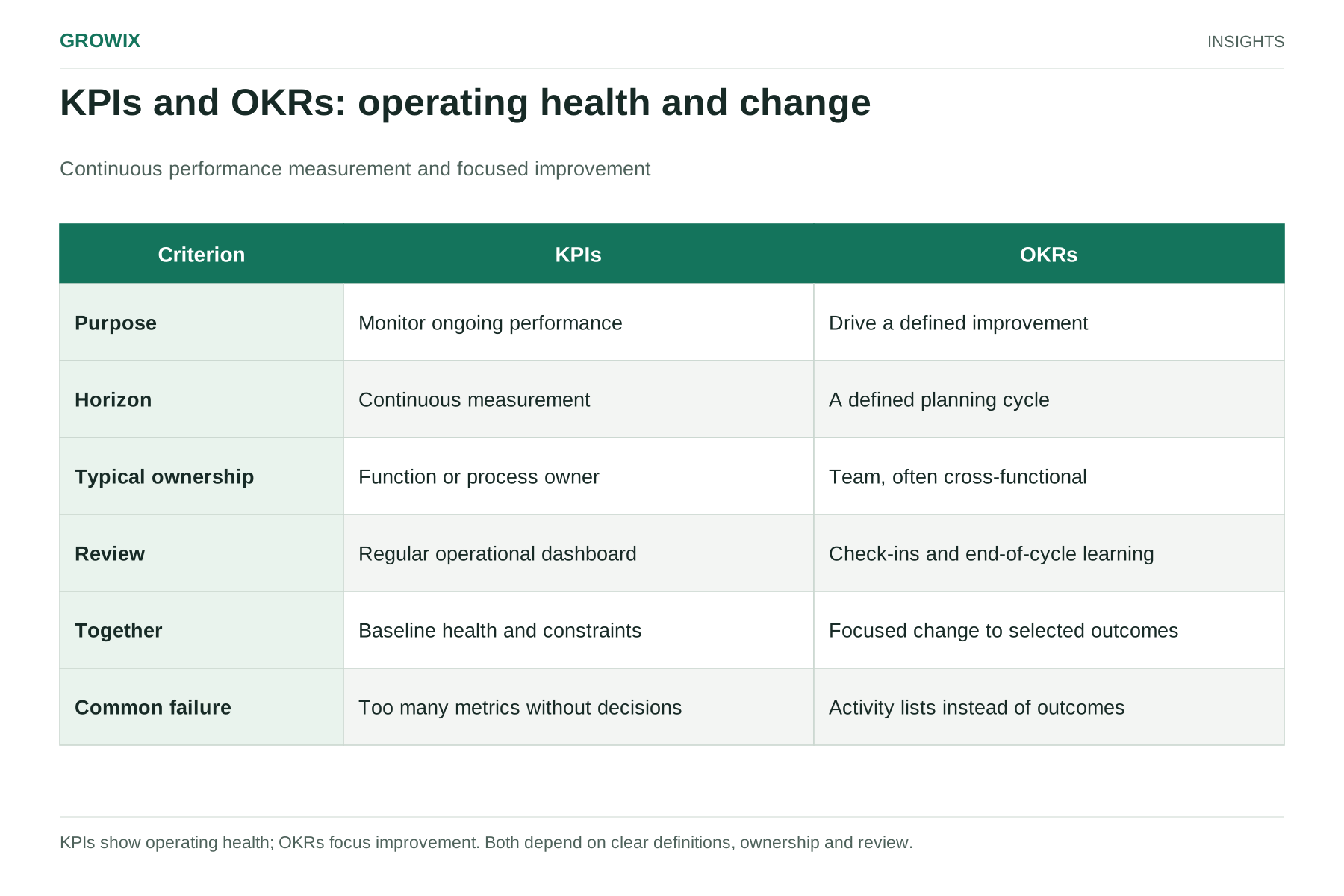
The short answer: use key performance indicators (KPIs) to monitor the ongoing health of the business, such as revenue, customer satisfaction, delivery times and error rates, against targets you expect to hit. Use objectives and key results (OKRs) to drive a limited number of deliberate changes over a quarter or a year, with ambitious goals you may not fully reach. Most growing businesses need both: KPIs as the dashboard that tells you whether things are running well, and OKRs as the short list of things you are trying to change. Problems start when the two are confused, or when ambitious OKRs are treated as pass-or-fail targets tied to pay.
The two frameworks defined
KPIs are measures that indicate how well an ongoing activity is performing. Each has a target or acceptable range, and they are reviewed regularly. Examples include monthly recurring revenue, on-time delivery, customer satisfaction, first-contact resolution and gross margin. KPIs usually persist for years.
OKRs pair a qualitative objective, describing what you want to achieve, with a small number of measurable key results that show whether you are getting there. Google's re:Work guide to OKRs describes objectives as ambitious and key results as measurable milestones, graded on a scale from 0.0 to 1.0. It notes that the "sweet spot" is around 0.6 to 0.7: consistently scoring 1.0 suggests the goals are not ambitious enough. The same guide states that OKRs are not synonymous with employee evaluations.
How they compare
| Factor | KPIs | OKRs |
|---|
| Purpose | Monitor ongoing performance | Drive specific change or improvement |
| Time horizon | Continuous | Typically a quarter or a year |
| Ambition | Realistic targets you expect to meet | Stretch goals; partial achievement is normal |
| Number | Several per team, often a dashboard | Few: typically a handful of objectives with a few key results each |
| Review | Weekly or monthly | Weekly check-ins, end-of-period grading |
| Typical owner | Function or process owner | Team, often cross-functional |
| Link to performance reviews | Commonly used as one input | Best kept separate from pay decisions |
| Risk if misused | Measuring everything, focusing on nothing | Sandbagged goals, or burnout from impossible targets |
How they work together
A useful way to connect them: KPIs tell you where attention is needed; OKRs describe what you will do about it.
Example for a customer support team:
- KPIs (ongoing): first response time, resolution time, customer satisfaction, cost per contact.
- Observation: satisfaction has fallen for three months, driven by billing questions.
- OKR for the quarter:
- Objective: Make billing questions effortless for customers.
- Key result 1: Reduce billing-related contacts per 1,000 customers by 30%.
- Key result 2: Raise satisfaction on billing contacts from 72% to 85%.
- Key result 3: Publish self-service answers for the ten most common billing questions.
Once the change is achieved, the improvement shows up in the KPIs, and the team chooses a new OKR. The KPIs remain.
More examples:
| Function | Example KPIs | Example OKR |
|---|
| Sales | Pipeline coverage, win rate, average deal size | Objective: Become the default choice for mid-sized manufacturers. Key results: win rate in that segment from 18% to 25%; five referenceable customers; sales cycle down by two weeks |
| Engineering | Deployment frequency, incident count, change failure rate | Objective: Make releases boring. Key results: change failure rate halved; automated test coverage on core services above an agreed level; zero failed releases on Fridays |
| Operations | On-time delivery, order accuracy, cost per order | Objective: Prepare the warehouse for peak season. Key results: picking accuracy above 99.5%; staffing plan approved by September; peak-day capacity tested at 150% of forecast |
All figures in these examples are illustrative.
Writing good KPIs and key results
The quality of the measures decides whether either framework helps.
Good KPIs are few, clearly defined and owned. Each needs a precise definition (what counts, from which system), a target or acceptable range, a review frequency and an owner who can act on it. A KPI nobody can influence is just a number on a screen.
Good key results describe outcomes, not activities. "Launch a new onboarding email sequence" is a task; "increase the share of new customers who complete setup within 14 days from 40% to 60%" is a key result. Useful tests:
- Can we measure it from data we trust?
- Would achieving it clearly move the objective forward?
- Is it ambitious enough that full achievement is uncertain?
- Does the team have meaningful influence over it?
If a key result fails these tests, rewrite it or move it to a project plan.
Keep the rhythm simple. Review KPIs on a weekly or monthly dashboard, depending on how fast they move. For OKRs, hold short weekly check-ins focused on confidence and obstacles, a mid-cycle review to adjust if circumstances have changed, and an end-of-cycle grading and reflection session. A spreadsheet or shared document is enough to start; dedicated goal-tracking software becomes useful when many teams need to see how their goals connect.
This is the most consequential design decision.
KPIs are often a reasonable input to performance reviews when the person genuinely controls the measure and the target is fair.
OKRs work best when kept separate from compensation. If people know that a 0.7 score will reduce their bonus, they set safer goals, and the framework loses its value. Google's guidance itself distinguishes OKRs from employee evaluations. A practical approach is to review how well someone set, pursued and learned from their OKRs as part of a broader conversation about contribution and behaviors, without converting OKR scores into pay formulas.
Whatever you decide, write it down and explain it before the first cycle. Ambiguity about whether goals affect pay is one of the fastest ways to undermine either framework.
When each fits
KPIs alone fit when:
- The team runs a stable, well-defined process and the main job is to keep it performing.
- The organization is small and the priorities are obvious.
- Leaders mainly need visibility, not a change program.
OKRs (alongside KPIs) fit when:
- The business is growing or changing and needs focus on a few priorities.
- Work crosses teams, and alignment is a problem.
- Leaders want teams to propose how to reach goals rather than receive task lists.
Neither framework will help when strategy is unclear, leaders change priorities every few weeks, or data needed to measure progress does not exist. Fix those first.
When Growix may not be the right fit: if you have a small team with clear priorities and a simple dashboard already works, introducing formal OKRs may add process without much benefit. Many off-the-shelf goal-tracking tools also include templates that are enough for a first attempt.
How to introduce OKRs without overwhelming people
- Start with leadership: set three to five company objectives for the year or quarter.
- Pilot with a few teams rather than the whole company.
- Limit the number: a few objectives per team, each with two to four key results.
- Make key results measurable and outcome-based, not task lists.
- Hold short weekly check-ins on progress and obstacles.
- Grade and reflect at the end of the cycle, focusing on learning.
- Keep KPIs visible on a dashboard so ongoing health is not neglected.
Hypothetical example
The following scenario is invented for illustration.
An 80-person services company introduces OKRs because teams pull in different directions. The leadership team sets three company objectives for the first half of the year. Two departments pilot OKRs while the rest continue with existing KPI dashboards. After one quarter, the pilot teams report clearer priorities but too many key results, so the company limits each team to three objectives with no more than three key results each and rolls out to all departments in the second half. OKR scores are discussed in quarterly conversations but kept out of the bonus formula, which continues to use a small set of KPIs and individual objectives.
Common mistakes
- Turning every task into a key result, which produces long lists and little focus.
- Using OKRs for business-as-usual targets that belong on a KPI dashboard.
- Setting goals top-down only, so teams feel no ownership.
- Abandoning check-ins after the first month.
- Linking OKR scores directly to bonuses, which encourages sandbagging.
A decision checklist
- Do we have clear priorities for the next quarter or year?
- Do we already track the KPIs that show whether the business is healthy?
- Are there two or three changes that matter more than everything else?
- Will leaders hold weekly check-ins for at least two quarters?
- Have we decided how goals relate to reviews and pay?
If the answers to three and four are yes, OKRs are likely to help. If not, start by improving KPIs and reviews.
Frequently asked questions
What are OKRs?
OKRs, or objectives and key results, pair a qualitative objective describing what you want to achieve with a few measurable key results that show progress. They are usually set for a quarter or a year and are meant to be ambitious, so partial achievement is normal.
What is the difference between OKRs and KPIs?
KPIs monitor the ongoing health of the business against targets you expect to hit, such as revenue, delivery times or customer satisfaction. OKRs drive a small number of deliberate changes. KPIs show where attention is needed; OKRs describe what you will do about it.
Should OKRs be tied to bonuses?
Generally not. If a 0.7 score reduces someone's bonus, people set safer goals and the framework loses its value; Google's own guidance distinguishes OKRs from employee evaluations. KPIs that a person genuinely controls are a more reasonable input to reviews and pay.
Next step
List the measures your leadership team already reviews, mark which are ongoing health measures and which describe changes you want to make, and choose no more than three changes for next quarter. That is the start of a workable combination of KPIs and OKRs.
Growix's Performance Management team builds KPI and OKR frameworks and fair, lightweight evaluation processes tied to company goals. For translating company goals into an annual plan, see 2027 growth planning for B2B SaaS.
Discuss your hiring and people operations needs