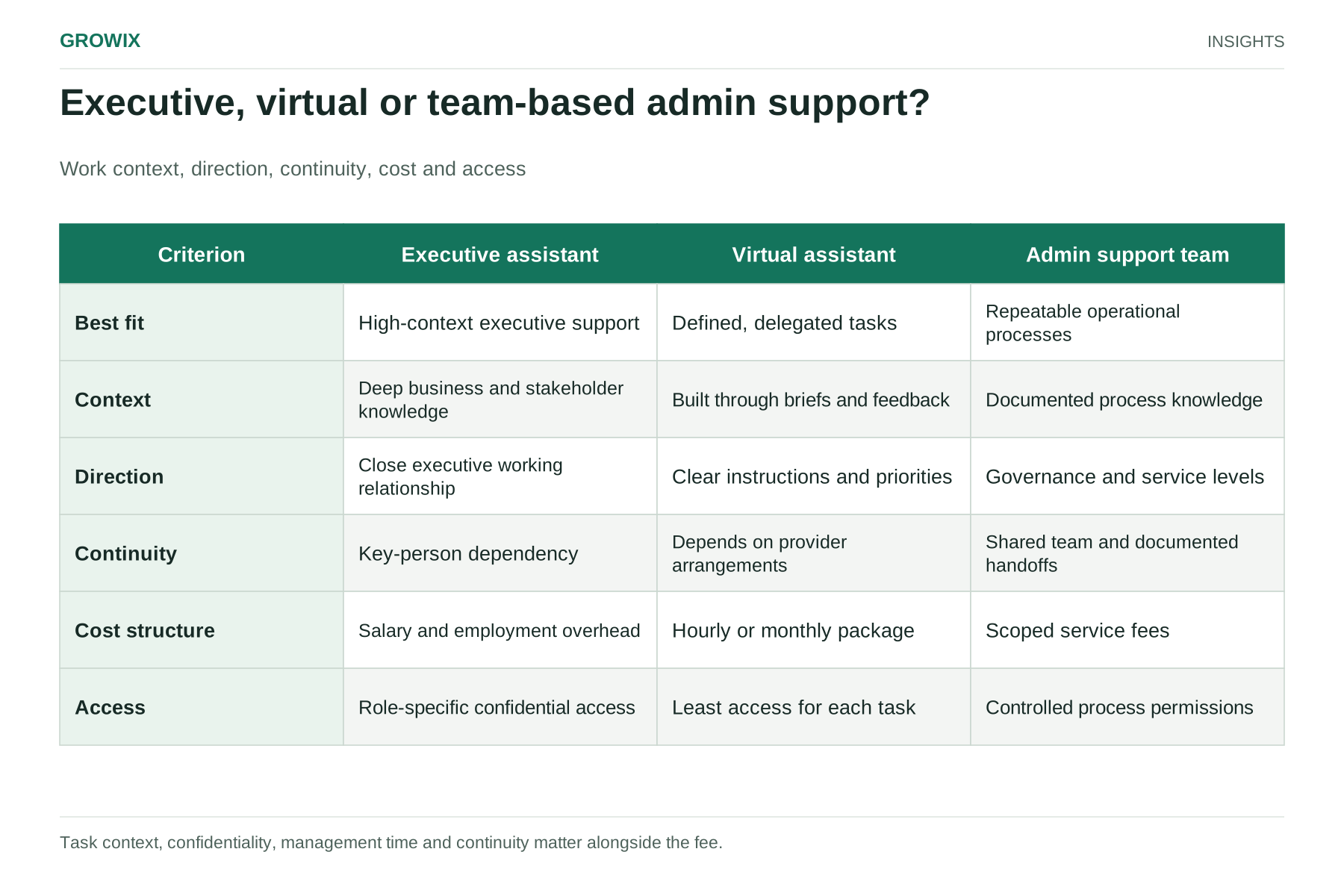
The short answer: hire an executive assistant when a senior leader needs someone who manages their time, priorities, communications and relationships with judgment and discretion, often as a trusted partner over years. Use a virtual assistant when the work is a set of defined tasks, such as scheduling, inbox triage, travel booking, research and data entry, that does not require full-time presence or deep business context. Use an outsourced administrative team when the work is a repeatable process serving many people, such as document handling, CRM updates, invoicing support or onboarding paperwork, and you need coverage, consistency and scale rather than one person. Many growing businesses combine them: an executive assistant for the chief executive, with routine tasks delegated to a virtual or outsourced team.
The three models defined
Executive assistant (in-house or dedicated remote). A senior administrative professional supporting one or a small number of executives. Typical work includes calendar strategy, preparing for meetings, managing correspondence, coordinating board and leadership activity, handling confidential matters and acting as a gatekeeper.
Virtual assistant. A remote assistant, freelance or provided by an agency, who handles defined administrative tasks, often part-time or on a set number of hours. Work is usually task-based and directed by the person being supported.
Outsourced administrative team. A provider runs administrative processes for your business with a team, documented procedures, quality checks and service levels. The focus is on processes rather than on supporting one individual.
How they compare
| Factor | Executive assistant | Virtual assistant | Outsourced admin team |
|---|
| Best for | Senior leader's time, priorities and relationships | Defined tasks for one or a few people | Repeatable processes across a team or business |
| Judgment required | High | Low to moderate | Moderate, guided by procedures |
| Business context needed | Deep | Limited | Process-specific |
| Hours | Usually full-time | Flexible, often part-time | Scales with volume |
| Continuity if someone leaves | Risk of losing knowledge | Depends on the provider | Covered by the team |
| Management effort | Moderate; a close working relationship | High at first; clear instructions needed | Lower day-to-day; governance and service levels |
| Cost structure | Salary plus benefits and overhead | Hourly or monthly package | Monthly fee or per transaction |
| Main risk | Single point of dependency; cost | Inconsistent quality; access and confidentiality | Rigid processes; less personal support |
What the work actually involves
Choosing well starts with a list of the work, not the job title. For two weeks, ask the leaders and teams who need support to note every administrative task they handle, how often it happens, how long it takes and what judgment it needs. Then sort the list:
| Type of work | Examples | Usually suited to |
|---|
| Strategic support | Deciding which meetings matter, preparing briefings, handling sensitive stakeholders | Executive assistant |
| Defined personal tasks | Scheduling, inbox triage, travel, expense reports, research | Virtual assistant or executive assistant |
| Repeatable processes | Data entry, document processing, CRM hygiene, vendor onboarding, invoice matching | Outsourced admin team |
| Confidential matters | Board materials, personnel issues, legal or merger work | Executive assistant, or tightly controlled roles |
If most of the list is strategic, a virtual assistant will frustrate you. If most is repeatable processing, an executive assistant will be underused and expensive.
Cost comparison
The U.S. Bureau of Labor Statistics reports median annual wages for secretaries and administrative assistants of $48,310 for the occupation overall and $76,590 for executive secretaries and executive administrative assistants, as of May 2025. Actual pay varies widely by location, industry and seniority, and employers also pay for benefits, payroll taxes, equipment and management time.
Hypothetical cost example
The following scenario is invented for illustration, and all figures are assumptions rather than quotes.
A 60-person company compares three options for supporting its chief executive and leadership team.
| Option | Assumption | Annual cost |
|---|
| In-house executive assistant | Salary $76,590 (BLS median) plus 30% for benefits, taxes and overhead | $99,567 |
| Virtual assistant | 80 hours a month at an assumed $30 an hour | $28,800 |
| Executive assistant at 60% of time, plus virtual assistant for routine tasks | 60% of $99,567, plus 40 hours a month at $30 | $74,140 |
The arithmetic: $76,590 × 1.3 = $99,567. Virtual assistant: 80 × $30 × 12 = $28,800. Combined option: $99,567 × 0.6 = $59,740 (rounded from $59,740.20), plus 40 × $30 × 12 = $14,400, giving $74,140.
The combined option assumes a part-time or shared executive assistant arrangement is available, which is not always the case. The cheapest option is not automatically the best: if the chief executive's time is poorly managed, the cost of lost focus can outweigh any savings. The point of the comparison is to price the options honestly and match them to the work list.
When each model fits
An executive assistant fits when:
- A senior leader's calendar, communications and priorities are complex and change daily.
- The role involves confidential information and sensitive relationships.
- You want someone who learns the business deeply and anticipates needs.
A virtual assistant fits when:
- The work is a set of defined, recurring tasks.
- Support is needed for a limited number of hours each week.
- The person being supported can give clear instructions and review output.
An outsourced administrative team fits when:
- Administrative work is process-based and serves many people or departments.
- Volume fluctuates, or you need coverage across time zones and absences.
- You want documented procedures, quality checks and reporting rather than reliance on one person.
When Growix may not be the right fit: if what you need is a long-term, on-site executive assistant who becomes part of your leadership team, a direct hire through a specialist recruiter is usually the better route. And if your requirement is only a few hours of occasional help, an individual freelance assistant may be simpler.
Security and access
Every model needs careful access control, and remote models need it most:
- Use delegated access rather than sharing passwords; most email, calendar and document platforms support it.
- Grant the minimum access needed for the tasks, and review it regularly.
- Use a password manager with shared vaults for accounts assistants must use.
- Require multi-factor authentication on every account.
- Set rules for payments: assistants should not be able to approve or change payment details without a second approval.
- Sign confidentiality agreements and confirm how the provider vets and trains staff.
- Plan offboarding: revoke access the same day someone stops supporting you.
Executives are frequent targets for impersonation and payment fraud. Agree a verification process for unusual requests, such as urgent payments or changes to bank details, that assistants follow without exception.
Making delegation work
Many failed assistant arrangements fail because of how work is delegated, not because of the assistant.
- Document recurring tasks: short written instructions or screen recordings for each.
- Define decision rights: what the assistant can decide alone, what needs approval and what they should never do.
- Agree communication rhythm: a daily check-in at first, then weekly planning once trust is established.
- Start small: delegate a few defined tasks, review quality, then expand.
- Give feedback quickly, especially in the first month.
Hypothetical example: combining models
The following scenario is invented for illustration.
A founder of a growing professional services firm spends about 15 hours a week on scheduling, email, travel and expense reports, and her operations team spends many hours updating client records and preparing engagement paperwork. She hires an executive assistant to manage her time, board preparation and key client relationships. The firm also outsources client record updates and engagement document preparation to an administrative team working from documented procedures, with weekly quality checks. Within a quarter, the founder recovers most of her administrative time, and the operations team focuses on client delivery.
Questions to ask a virtual assistant or administrative support provider
- Who exactly will do the work, and who covers when they are absent or leave?
- How are assistants screened, trained and supervised?
- What working hours and time zones do you cover, and how quickly do you respond to urgent requests?
- How do you document our recurring tasks, so knowledge is not held by one person?
- How do you handle access to our systems, confidential information and payment-related requests?
- How is quality checked, and what reporting will we receive?
- What is the notice period, and how is access removed and documentation handed back when an engagement ends?
Clear answers to these questions matter more than the hourly rate. A slightly more expensive arrangement with reliable cover, documentation and security controls usually costs less over a year than a cheaper one that has to be rebuilt every time an assistant changes.
Common mistakes
- Hiring for a title rather than for a documented list of work.
- Expecting a part-time virtual assistant to exercise executive-level judgment without context.
- Sharing passwords instead of setting up delegated, auditable access.
- Delegating without instructions, then concluding that delegation does not work.
- Leaving all administrative knowledge with one person, with no documentation or backup.
A decision checklist
- What work, specifically, needs support, and how many hours a week?
- How much of it requires judgment, discretion and deep business context?
- Is the work centered on one leader, or on processes across the business?
- What access to systems and confidential information will it require?
- Who will manage the arrangement, and how much time can they give it in the first months?
Frequently asked questions
What is the difference between a virtual assistant and an executive assistant?
An executive assistant manages a senior leader's time, priorities, communications and relationships with judgment and discretion, usually full time. A virtual assistant is a remote assistant who handles defined tasks, such as scheduling, inbox triage, travel booking and research, often part time and directed by the person they support.
How much does an executive assistant cost?
The US Bureau of Labor Statistics reports a median annual wage of $76,590 for executive secretaries and executive administrative assistants (May 2025). With benefits, payroll taxes and overhead, the loaded cost is roughly 30% higher, about $99,600 a year in this guide's example.
What tasks can a virtual assistant handle?
Typical tasks include calendar management and scheduling, inbox triage, travel booking, expense reports, research, data entry and document preparation. Give a virtual assistant delegated access rather than shared passwords, and keep payment approvals behind a second check.
Next step
Spend two weeks logging the administrative tasks you and your leadership team handle, with time spent and the judgment each requires. That list will show whether you need an executive assistant, a virtual assistant, an outsourced team or a combination.
Growix's Virtual Assistance & Administrative Support team provides remote assistants for scheduling and coordination, administrative workflows and documentation support for founders, executives and teams. If your workload is mostly repeatable processing, see our guide to back-office automation for professional services.
Discuss your outsourcing requirements