A marketing plan sets out what marketing will contribute to the business next year, which audiences and channels it will use, what it will cost and how progress will be measured. For a B2B company, the most useful plans start from the revenue target and work backward to the pipeline marketing must help create, the budget that pipeline requires and the channels most likely to deliver it. Plans that start from last year's spend and add a percentage tend to repeat last year's results.
This guide walks through that process for B2B services and software companies planning 2027: set the contribution target, translate it into pipeline and budget, choose a channel mix, and fit the result on one page that leadership, sales and finance can all use.
What a B2B marketing plan should answer
A good plan answers six questions in plain language:
- What must marketing deliver? Usually a share of qualified pipeline, plus any brand, launch or retention goals.
- Who are we trying to reach? The ideal customer profile, the roles in the buying group and the problems they care about.
- What will we say? The positioning and the few messages that differentiate you.
- Where and how? The channels, programs and content, and why each was chosen.
- What will it cost? Program spend, people, agencies and tools.
- How will we know it is working? Leading and lagging measures, with review dates.
Everything else in the plan supports those answers.
Step 1: Start from the revenue target
Agree with leadership and finance how much new revenue the business needs next year and how much of it marketing is expected to influence or source. Then work backward with your own conversion data.
Hypothetical example
The figures below are invented for illustration. Replace them with your own.
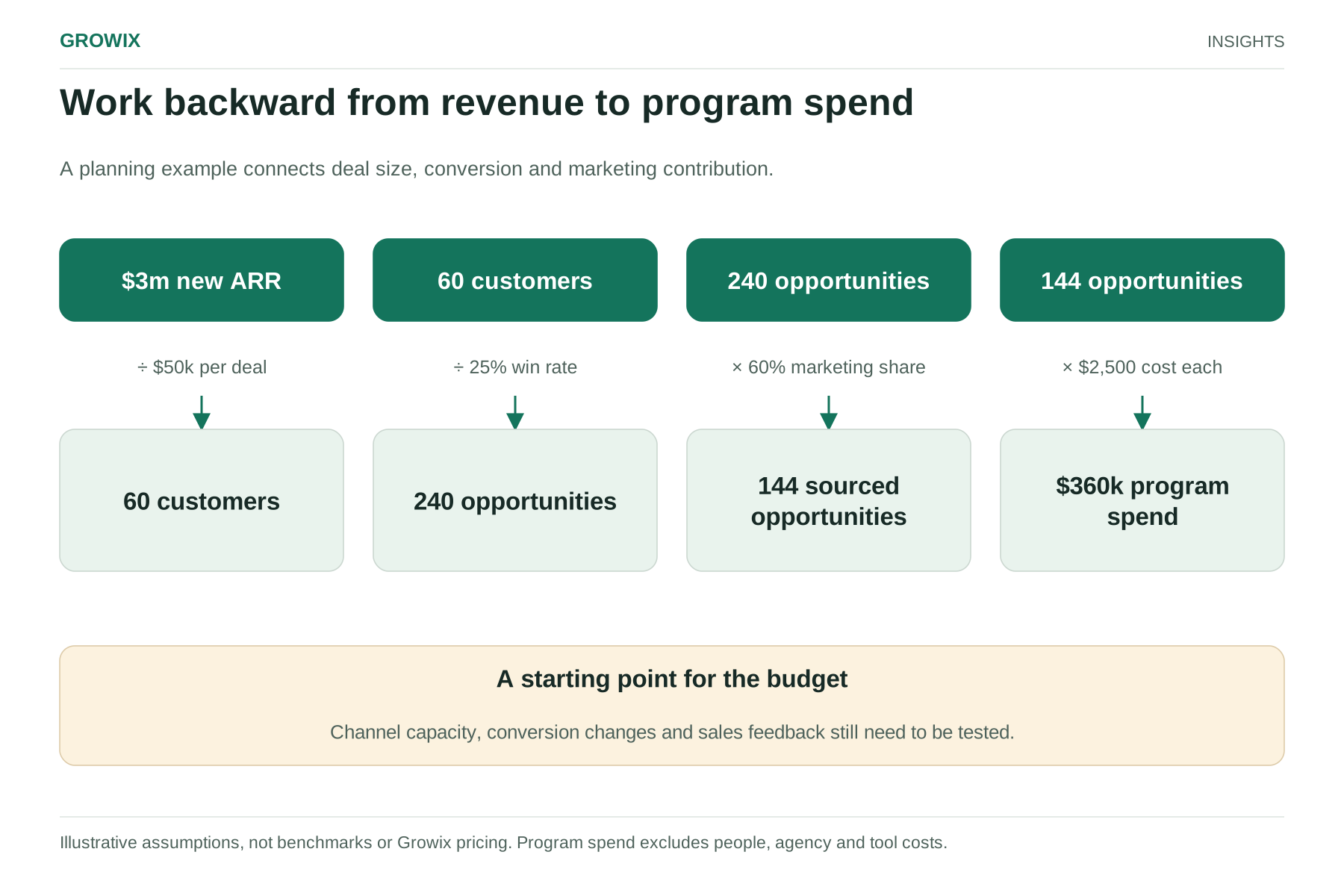
A B2B software company targets $3 million of new annual recurring revenue in 2027, with an average deal size of $50,000.
- New customers needed: $3,000,000 ÷ $50,000 = 60.
- At a 25% win rate from opportunity to customer, opportunities needed: 60 ÷ 0.25 = 240.
- If marketing is expected to source 60% of opportunities, with sales development and partners sourcing the rest: 240 × 0.60 = 144 marketing-sourced opportunities.
- At a blended cost of $2,500 per marketing-sourced opportunity, based on last year's actual results: 144 × $2,500 = $360,000 of program spend.
That number is a starting point, not a final budget. It assumes conversion rates and costs stay the same; the rest of the plan explains how you will improve them.
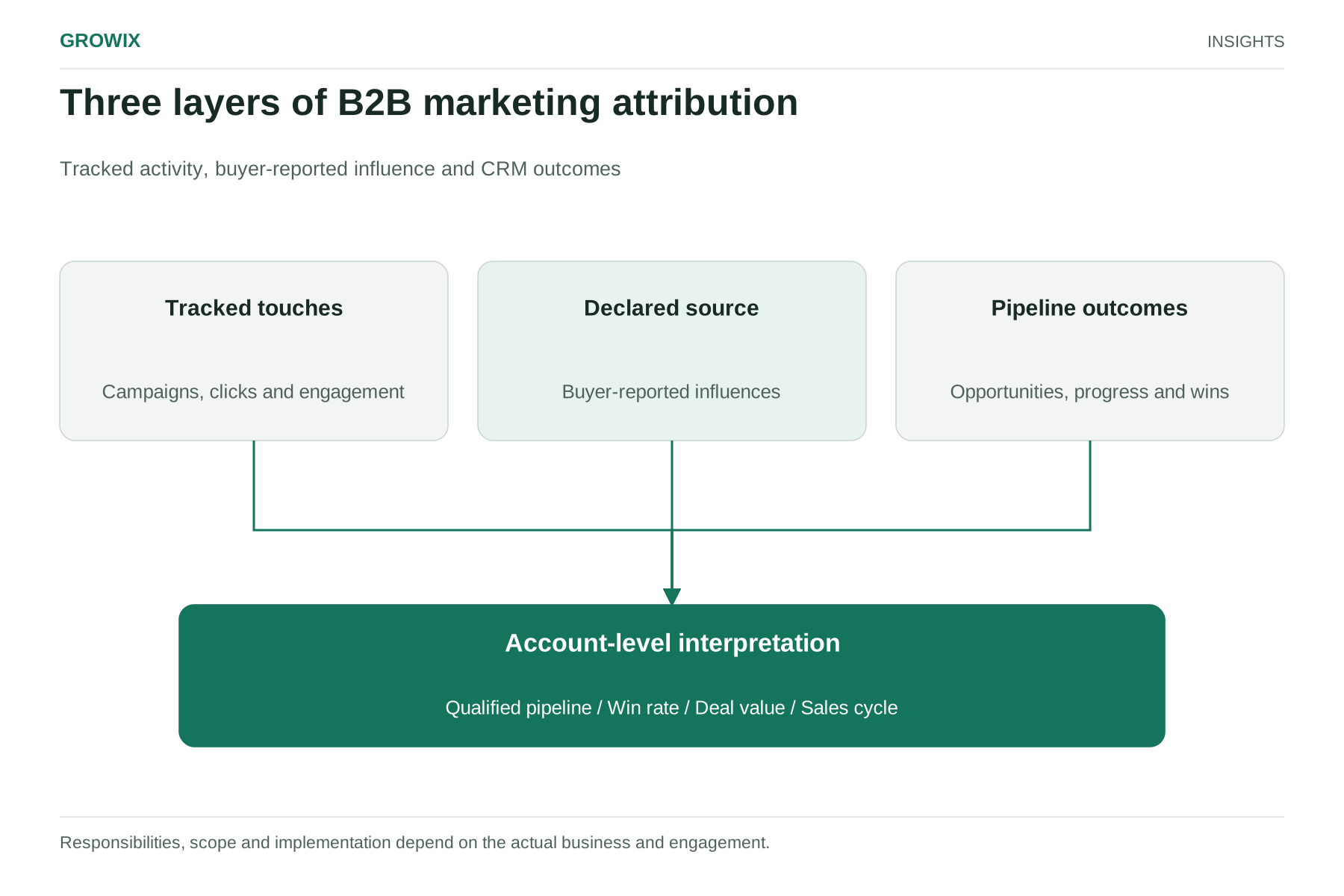
If you do not track cost per opportunity yet, use last year's spend and outcomes to estimate it, and make better measurement one of next year's goals. Our guide to B2B marketing attribution explains a practical setup.
Step 2: Sense-check the budget
Compare the bottom-up figure with a top-down view. In Gartner's 2026 CMO Spend Survey, marketing budgets averaged 7.8% of company revenue in 2026, up from 7.7% in 2025. The survey covered 401 marketing leaders in North America, the UK and Europe, mostly at larger organizations, and the figure includes people and technology as well as programs. Growing companies often spend a different share depending on stage, growth targets and sales model.
Use benchmarks to start a conversation, not to set the number. If your bottom-up budget is far above or below the benchmark, find out why. It may reveal unrealistic conversion assumptions, an under-funded sales team or a market where buyers are hard to reach.
A complete budget includes:
| Line | What it covers |
|---|
| Programs and media | Paid search and social, events, sponsorships, content production, review sites |
| People | Salaries and contractors for marketing roles |
| Agencies and specialists | Paid media, SEO, design, video, PR |
| Technology | Marketing automation, CRM add-ons, analytics, design tools |
| Testing reserve | A small share held back for new channels and ideas |
Step 3: Choose a channel mix you can defend
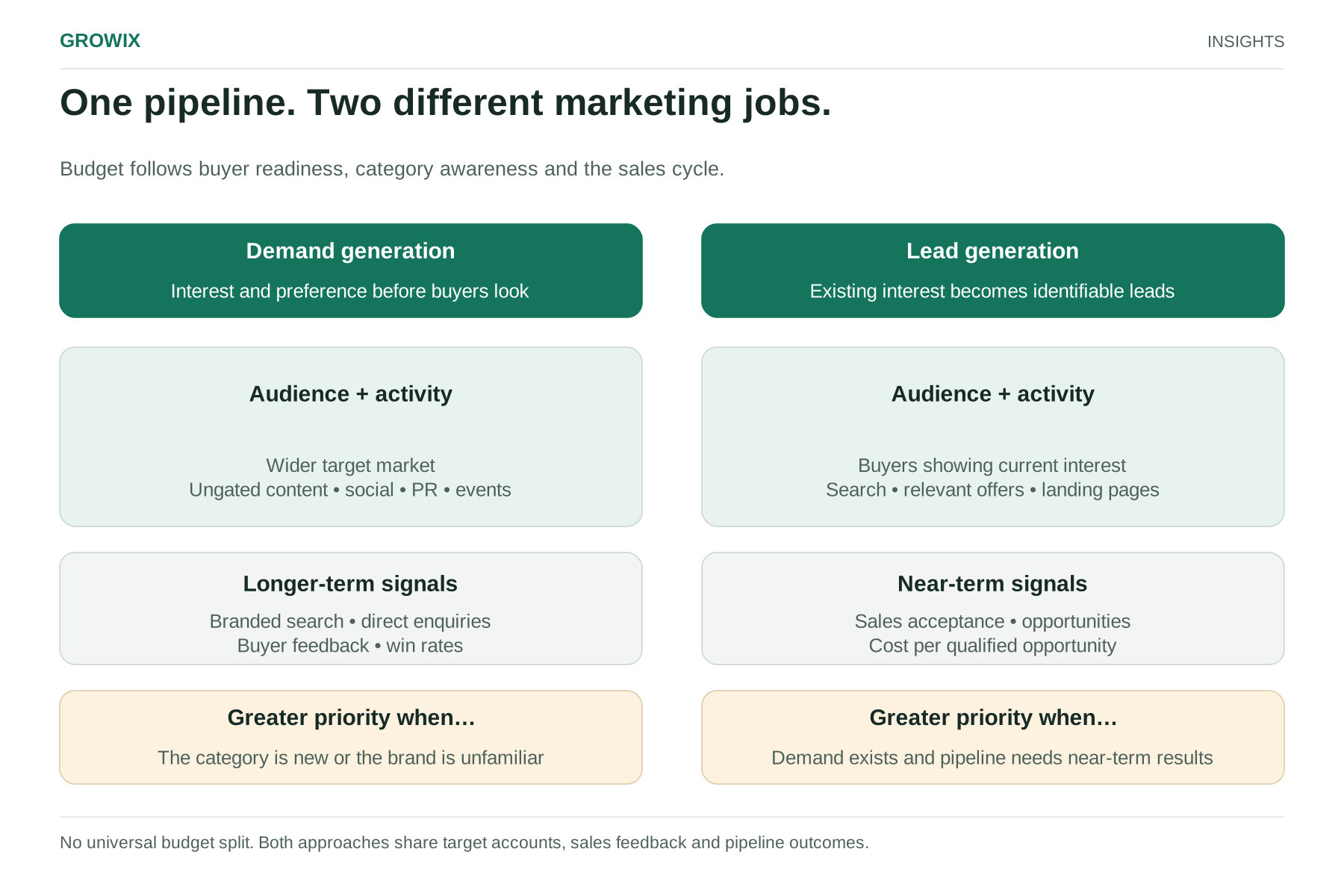
Split the plan between two jobs: capturing demand from buyers who are already looking, and creating demand among buyers who will look later. Our guide to lead generation vs demand generation explains why both matter.
Hypothetical allocation of the $360,000 program budget
| Area | Share | Amount | Examples |
|---|
| Demand capture | 40% | $144,000 | Search ads on high-intent terms, review sites, retargeting, conversion pages |
| Demand creation | 30% | $108,000 | Ungated content, expert video, LinkedIn distribution, webinars, events |
| Target-account programs | 15% | $54,000 | Account-based ads, direct mail, sales enablement content |
| Analytics and tools | 10% | $36,000 | Tracking, attribution, reporting |
| Testing reserve | 5% | $18,000 | New channels, formats or offers |
The shares add to 100% and the amounts to $360,000. Your split should reflect your market: if few buyers search for your category, shift more toward demand creation; if search demand is strong and your pipeline needs results this quarter, shift toward capture. For a closer comparison of search channels, see SEO vs PPC for B2B lead generation.
For each channel, write down why it is in the plan, the result you expect, the cost and the measure you will review. A channel that cannot be measured at all should be a deliberate, small bet, not a large default.
Step 4: Plan by quarter, not just by year
Annual plans go stale quickly. Break the year into quarters with:
- A theme or focus for each quarter, such as a product launch, an industry push or an event season.
- Budget phasing that matches your sales calendar and buyers' budget cycles.
- Fixed review points where you move money from channels that are underperforming to those that are working.
- Content and campaign calendars that sales can see in advance.
Build in the busy periods. Many B2B buyers set budgets in the fourth quarter and start new initiatives in January, while late December is quiet in most US markets.
Step 5: Agree measures with sales and finance
Measure each channel on its own terms and connect everything to pipeline:
- Leading indicators: qualified leads, sales acceptance rate, target-account engagement, branded search.
- Pipeline indicators: marketing-sourced and marketing-influenced opportunities, pipeline value and cost per opportunity.
- Revenue indicators: win rate, deal size and sales cycle for marketing-sourced deals.
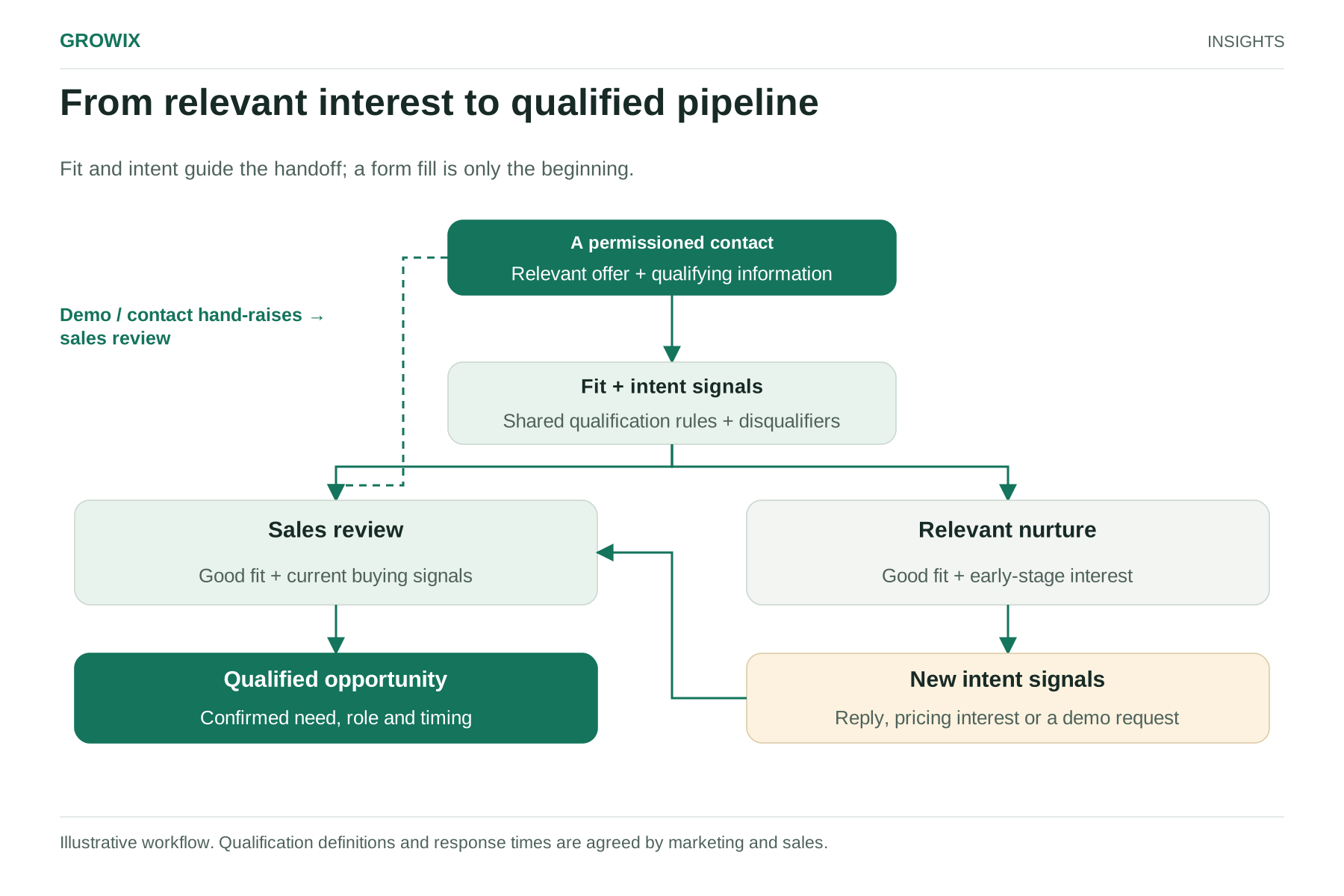
Agree the definitions in writing, especially what counts as a qualified lead and what counts as marketing-sourced. Our guide to B2B lead generation covers lead definitions and scoring.
Plan capacity, not just spend
A budget without the people to execute it produces half-finished campaigns. For each program, check who will plan it, produce it, run it and report on it, and how many hours that takes each month. Then decide what stays in-house and what goes to agencies or specialists. Our guide to in-house marketing vs an agency explains how to compare loaded costs and accountability.
Check sales capacity too. If the plan doubles qualified leads, sales needs enough people and time to follow up quickly; otherwise extra leads go cold and the plan looks like it failed.
The one-page marketing plan
Leadership teams rarely read a forty-slide plan. Summarize it on one page:
| Section | What to write |
|---|
| Goal | The revenue and pipeline marketing will contribute, with numbers |
| Audience | Ideal customer profile and the buying roles you target |
| Positioning | The problem you solve and why buyers should choose you, in two sentences |
| Priorities | Three to five programs that will deliver most of the result |
| Channel mix | Capture, creation and target-account shares, with budgets |
| Budget | Total, split into programs, people, agencies and tools |
| Measures | Leading, pipeline and revenue measures with targets |
| Risks | What could go wrong and the trigger for changing course |
| Review rhythm | Monthly performance, quarterly reallocation |
Common mistakes
- Copying last year's channel mix without checking which channels produced pipeline.
- Counting leads instead of opportunities, which rewards volume over quality.
- Spreading the budget thinly across too many channels to test any of them properly.
- Ignoring sales capacity. More leads do not help if nobody can follow up quickly.
- No reserve, which makes it impossible to act on a promising idea mid-year.
Frequently asked questions
What should a B2B marketing plan include?
It should state the pipeline and revenue marketing will contribute, the target audience, positioning, the main programs and channels, the budget, the measures and the review rhythm. A one-page summary helps leadership, sales and finance use it.
How much should a B2B company spend on marketing?
There is no single right figure. Build the budget from your revenue target, conversion rates and cost per opportunity, then compare it with benchmarks such as Gartner's 2026 average of 7.8% of company revenue, which mainly reflects larger organizations and includes people and technology.
How often should a marketing plan be reviewed?
Review performance monthly and reallocate budget quarterly. Revisit the plan's assumptions if win rates, deal sizes or market conditions change significantly.
Next steps
Pull last year's numbers for marketing-sourced opportunities, cost per opportunity and win rate, then run the backward calculation in Step 1 with your 2027 target. The gap between that figure and your current budget is the conversation to have with leadership.
Growix's Lead Generation & Demand Generation team builds the programs that create demand and convert it into qualified pipeline, and our Marketing Analytics & Attribution team sets up the tracking and reporting that show which spend is working. For aligning marketing with the wider revenue plan, see 2027 growth planning for B2B SaaS.
Discuss your marketing priorities