To write a business plan, decide who it is for, choose a format that suits that reader, then work through a standard set of sections: what the business does, the market and customers, how you will reach them, who will run it, what you need and the financial projections that tie it together. The most important part is not the writing. It is the set of assumptions behind the numbers, because those are what lenders, investors and your own team will test.
This guide explains how to write a business plan for 2027 whether you are raising money, applying for a loan or simply setting direction for a growing company. It covers formats, sections, financial projections and how to keep the plan in use once it is written.
Decide who the plan is for
The same company may need different versions of its plan:
| Reader | What they need | Typical format |
|---|
| Bank or lender | Ability to repay, cash flow, collateral, management experience | Traditional plan with detailed financials |
| Equity investors | Market size, growth potential, differentiation, team, use of funds | Pitch deck plus a concise plan and financial model |
| Leadership team | Priorities, targets, owners and budgets for the year | Short operating plan with quarterly milestones |
| New partners or key hires | Where the business is going and why | Summary plan or strategy narrative |
Write the core thinking once, then adapt the length and emphasis for each reader.
The US Small Business Administration's guide to writing a business plan describes two common formats.
A traditional business plan is a detailed document. The SBA notes that lenders and investors often request this format and lists sections including an executive summary, company description, market analysis, organization and management, service or product line, marketing and sales, funding request and financial projections.
A lean startup plan is a high-level summary, often on one page, covering key partnerships, key activities, key resources, value proposition, customer relationships, customer segments, channels, cost structure and revenue streams. It is quick to write and update, which suits early-stage businesses and internal planning, although some lenders and investors will still ask for more detail.
Many companies start lean, test their assumptions, then expand into a traditional plan when they approach a lender or investor.
Write each section with evidence
Executive summary
Write it last. In one page, state what the business does, who it serves, why it will win, the key numbers and what you are asking for. A reader should understand the opportunity without reading further.
Company description
Explain the problem you solve, for whom and how. Describe your stage, structure and any advantages that are hard to copy, such as expertise, relationships, technology or location.
Market analysis
Define the specific customers you serve, not the whole industry. Estimate how many potential customers exist and what they spend, using sources you can cite. Public data such as Census Bureau business counts, industry association reports and your own sales data are often more credible than broad market-size headlines. Our guide on how to do market research explains when desk research is enough and when to commission more.
Describe competitors honestly, including the option of customers doing nothing or solving the problem in-house.
Organization and management
Show who runs the business, their relevant experience, the roles you still need to fill and when. Investors and lenders back people as much as ideas.
Products or services
Describe what you sell, how it is priced, how it is delivered and what is planned next. Explain the economics of a typical sale.
Marketing and sales
Explain how customers will find you, how you will convert them and what it costs. Link this to the numbers: if the plan needs 200 new customers, show where they will come from.
Funding request
If you are raising money, state how much, in what form, what it will be used for and how long it will last. Tie each use of funds to a milestone.
Financial projections
Include projected income statements, cash flow and balance sheets, usually for three to five years with the first year by month or quarter. The section below covers how to make them credible.
Build financial projections from assumptions
Projections are only as good as the assumptions behind them. Build them from drivers you can explain, not from a growth percentage applied to last year.
Hypothetical example
The following scenario is invented for illustration.
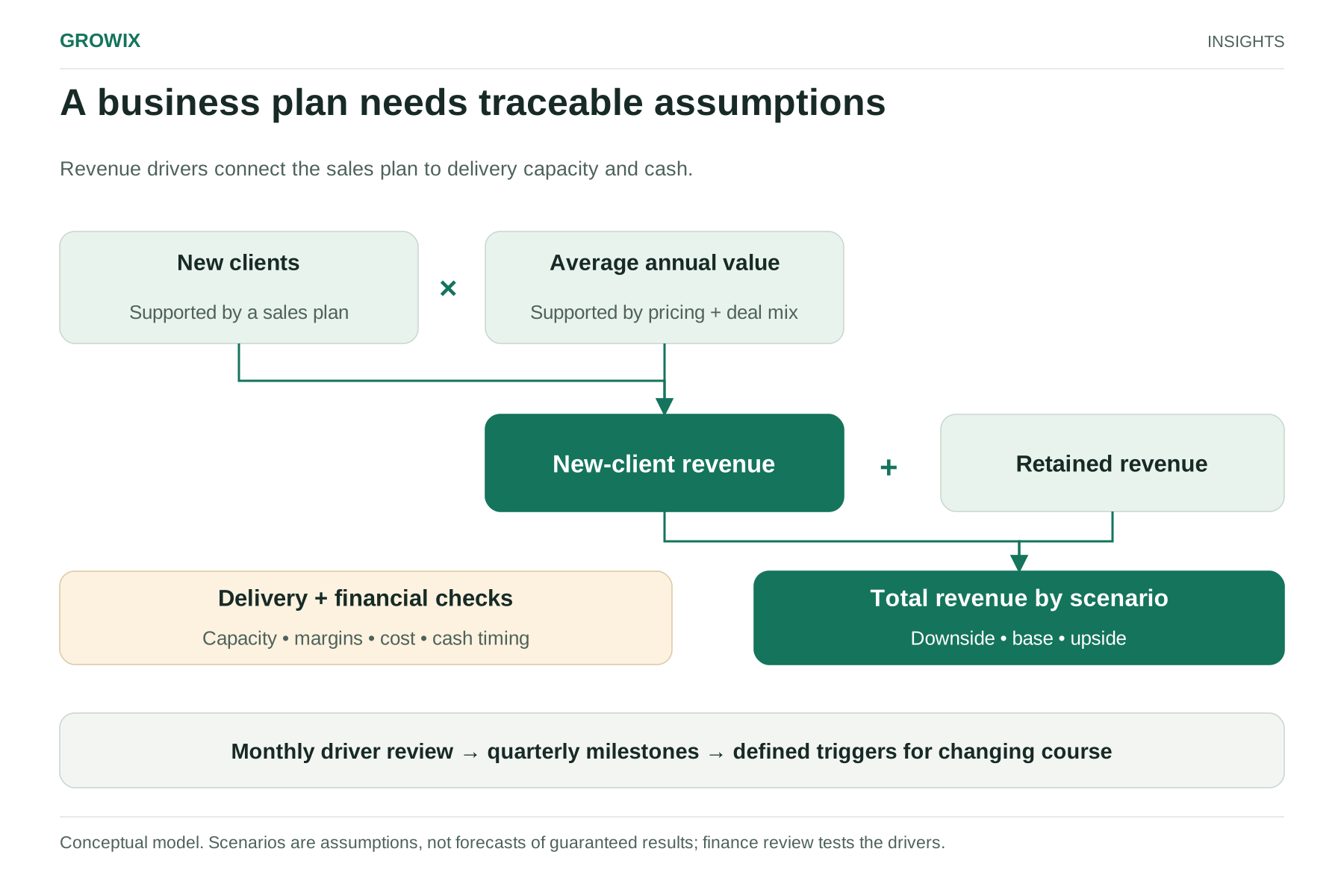
A services firm plans its 2027 revenue from three drivers: the number of new clients, the average annual value per client and client retention.
| Scenario | New clients | Average annual value | Retained revenue | Total 2027 revenue |
|---|
| Downside | 20 | $40,000 | $1,200,000 | $2,000,000 |
| Base | 30 | $45,000 | $1,400,000 | $2,750,000 |
| Upside | 40 | $50,000 | $1,500,000 | $3,500,000 |
The arithmetic: downside 20 × $40,000 = $800,000 + $1,200,000 = $2,000,000; base 30 × $45,000 = $1,350,000 + $1,400,000 = $2,750,000; upside 40 × $50,000 = $2,000,000 + $1,500,000 = $3,500,000.
Each driver should have a reason. If the base case assumes 30 new clients, the marketing and sales section should show how they will be won. Then model costs, hiring and cash flow for each scenario, and identify the point at which the business would need to cut costs or raise money.
Checks lenders and investors commonly apply:
- Do revenue assumptions match the sales and marketing plan?
- Do hiring plans match the work the revenue requires?
- Does cash flow, not just profit, stay positive, or is funding in place?
- Are margins realistic compared with similar businesses?
Have your accountant or finance lead review the projections before they go to a lender or investor.
Turn the plan into an operating rhythm
A plan that sits in a folder does little. For internal use, convert it into:
- Three to five priorities for the year, each with an owner.
- Quarterly milestones and a short monthly review against them.
- A one-page dashboard showing the drivers from your projections: new clients, average value, retention, cash.
- A clear rule for changing course, such as revisiting hiring if new clients fall below plan for two consecutive months.
For goal frameworks that connect the plan to teams, see our guide to OKRs vs KPIs.
Business plan, strategic plan or operating plan?
These terms are often used interchangeably, but they answer different questions:
| Document | Main question | Time horizon | Main readers |
|---|
| Business plan | Is this business viable, and what does it need? | Three to five years | Lenders, investors, founders |
| Strategic plan | Where will we compete and how will we win? | Three to five years | Leadership, board |
| Operating plan | What will we do this year, who owns it and what will it cost? | One year, by quarter | Leadership and teams |
A growing company usually needs all three over time, but they can share the same evidence and assumptions. Many businesses write one strategic narrative, then keep a detailed operating plan and update the business plan only when they seek funding.
What lenders and investors usually look for
Expectations differ, but most readers test the same things:
- A clear problem and customer: evidence that specific customers have the problem and will pay to solve it.
- Traction or proof: existing customers, pilots, letters of intent or test results, described honestly.
- Credible assumptions: projections that follow from sales capacity, conversion rates and pricing rather than from a desired outcome.
- Cash discipline: when cash runs low under each scenario and what management would do about it.
- The team: relevant experience, and a plan for the roles that are missing.
- Use of funds: what the money will achieve and which milestone it reaches.
Lenders focus more on repayment, cash flow and security; equity investors focus more on growth potential and the size of the outcome. Check each lender's or investor's own requirements before submitting.
Common mistakes
- Writing for an imaginary reader rather than the lender, investor or team who will use the plan.
- Top-down market sizing ("if we win 1% of a huge market") instead of bottom-up customer counts.
- Revenue projections with no sales plan behind them.
- Ignoring cash timing, such as payment terms and seasonal swings.
- Never updating the plan after it has been written.
Frequently asked questions
What are the main parts of a business plan?
A traditional plan usually includes an executive summary, company description, market analysis, organization and management, products or services, marketing and sales, a funding request if you are raising money, and financial projections. A lean plan summarizes partners, activities, resources, value proposition, customers, channels, costs and revenue on one page.
How long should a business plan be?
As long as its reader needs. A lean plan can fit on one page; a traditional plan for a lender may run to many pages with detailed financials. An internal operating plan is often best kept short enough to review every month.
Do I need a business plan if I am not raising money?
It is still useful. A short plan with clear priorities, financial drivers and milestones helps a growing company decide where to invest, when to hire and when to change course.
Next steps
Write down the five assumptions your 2027 plan depends on most, such as new customers, average deal value, retention, margin and hiring, and test each against last year's actual results. That exercise usually shows which parts of the plan need more evidence before anyone else sees it.
Growix's Startup & Venture Advisory team helps founders validate the business model, plan growth and prepare for fundraising, and our Financial Planning & Business Modelling team builds the forecasts and models behind the plan, working alongside your accountants. For software businesses, see 2027 growth planning for B2B SaaS.
Discuss your growth and operating priorities